Quaternion Inverse: Examples, Exercises, and Solutions
This entry is the self study companion to quaternion inverse.
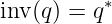
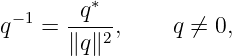
The quaternion inverse combines the conjugate and norm into the quantity that undoes quaternion
multiplication. For unit attitude quaternions the inverse reduces to the conjugate, but for a general
nonzero quaternion the norm squared in the denominator is essential.
All exercises are stated first. Complete worked solutions follow afterward.
1 Formula summary
For a nonzero quaternion
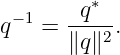
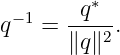
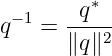
the inverse is
Because
we have
The inverse of a product reverses factor order:
For a unit quaternion,
and therefore
For the PhysicsLibrary passive attitude convention,
2 Exercises
- Direct inverse calculation.
For
compute
- Verify both inverse identities.
Using the quaternion from Exercise 1, compute
and
Verify that both equal the multiplicative identity.
- Unit quaternion simplification.
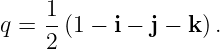
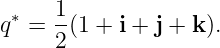
Let
First verify that q is unit.
Then compute q−1 and show that
- Real and pure quaternion inverses.
Find the inverse of the real quaternion
and the pure quaternion
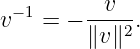
Show that the inverse of a nonzero pure quaternion may be written
- Why the zero quaternion has no inverse.
Explain why
cannot have a multiplicative inverse.
Relate the failure to the denominator in
- Inverse of a product.
Prove
for nonzero quaternions p and q.
Your proof should verify both the left and right inverse identities.
- Numerical product inverse.
Let
and
Compute
Verify numerically that the last two quantities are equal.
- Why
 is generally wrong.
Using the quaternions from Exercise 7, compute
Compare it with
Explain the discrepancy.
- Solve a left multiplication equation.
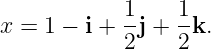
Let
where
and
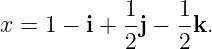
Solve for x by multiplying by the appropriate inverse on the correct side.
Verify your answer by direct substitution.
- Solve a right multiplication equation.
Let
with the same
and
Solve for x.
Compare the result with Exercise 9 and explain why the two answers differ.
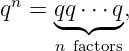
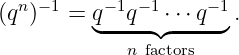
- Inverse of a power.
Prove for every positive integer n that
Does factor reversal create any complication when all factors are the same quaternion?
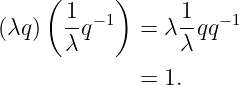
- Inverse of a real scalar multiple.
Let λ≠0 be real and q≠0.
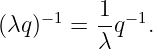
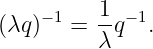
Prove
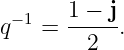
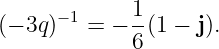
Then verify the identity with
- Passive frame map reversal.
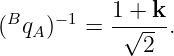
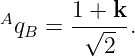
Frame B is obtained from frame A by a positive 90∘ frame rotation about +z.
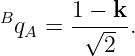
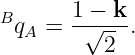
PhysicsLibrary uses
Compute
and identify it as a frame labeled quaternion.
- Undo a passive coordinate transformation.
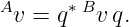
Suppose
with a unit attitude quaternion.
Use the inverse to solve for Av.
Write the reverse transformation using both inverse notation and conjugate notation.
- Inverse of
 versus inverse of
  .
.
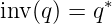
For nonzero q, prove
If q is a unit attitude quaternion, explain why q−1 and −q−1 still represent the same reverse
physical orientation.
- Software diagnostic: conjugate is not always the inverse.
A software routine defines
for every quaternion.
Test the routine on
Compute the routine’s result, the true inverse, and
Under what condition is the software routine correct?
3 Solutions
Solution 1: direct inverse calculation
For
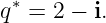
the conjugate is
The squared norm is
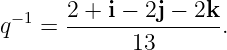
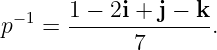
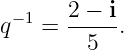
Therefore
Solution 2: verify both inverse identities
From Exercise 1,
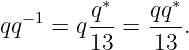
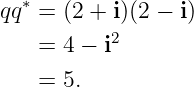
Therefore
Since
we obtain
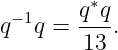
Likewise,
Because
we obtain
Thus the same quaternion is both the left and right multiplicative inverse.
Solution 3: unit quaternion simplification
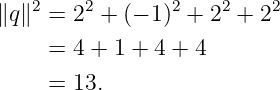
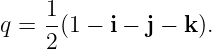
The quaternion is
Its squared norm is
Thus
The conjugate is
Since the norm squared is one,
Therefore
Solution 4: real and pure quaternion inverses
For
the conjugate is also −4, and
Therefore
Now consider
Because v is pure,
Its squared norm is
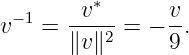
Therefore
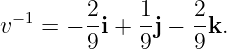
Explicitly,
Solution 5: why the zero quaternion has no inverse
An inverse q−1 would have to satisfy
If
then for every quaternion x,
Therefore no quaternion can satisfy
The formula
shows the same obstruction algebraically. For q = 0,
so the expression would require division by zero.
Thus
Solution 6: inverse of a product
Consider
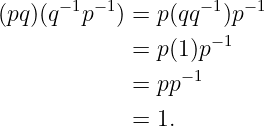
Multiply it on the right of pq:
Thus q−1p−1 is a right inverse of pq.
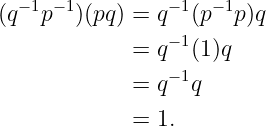
Now multiply it on the left:
Thus it is also a left inverse.
Therefore
The factor order reverses.
Solution 7: numerical product inverse
Let
and
Hamilton multiplication gives
Its squared norm is
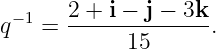
Therefore
Now
so
Also,
so
Multiplying in the reversed order,
The numerator product is
Hence
Solution 8: why  is generally wrong
Using the inverses from Solution 7,
The numerator product is
Therefore
But
They differ because quaternion multiplication is not generally commutative.
The inverse must undo the last factor first, so product inversion reverses factor order.
Solution 9: solve a left multiplication equation
We are given
Left multiply by p−1:
Thus
For
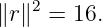
the squared norm is
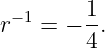
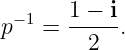
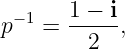
so
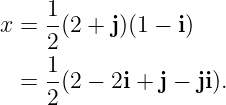
Therefore
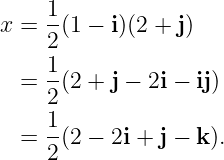
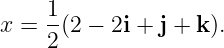
Hence
Direct substitution gives
Solution 10: solve a right multiplication equation
Now
Right multiply by p−1:
Thus
Using
we obtain
Because
we get
Therefore
This differs from Solution 9 in the sign of the k component.
The difference arises because left and right division are distinct operations in a noncommutative
algebra.
Solution 11: inverse of a power
For
repeated application of product inversion gives
Hence
Factor reversal creates no visible change because all factors are identical.
Solution 12: inverse of a real scalar multiple
Let
Since λ is real, it commutes with every quaternion.
Consider
Then
The product in the other order also equals one.
Therefore
For
With
we obtain
Solution 13: passive frame map reversal
The forward passive map is
It is unit, so inverse equals conjugate:
Therefore
The inverse reverses the frame map, so
Solution 14: undo a passive coordinate transformation
We begin with
Let
Because q is unit,
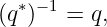
Left multiply by q−1 and right multiply by (q∗)−1:
Since
we obtain
Using the unit relation q−1 = q∗,
Equivalently, with frame labels,
Solution 15: inverse of  versus inverse of
Use
and
Then
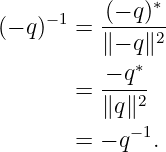
Therefore
For unit attitude quaternions, q−1 and −q−1 are antipodal unit quaternions representing the same
reverse physical orientation.
Solution 16: software diagnostic: conjugate is not always the inverse
The software routine returns
But
Therefore the true inverse is
The product with the conjugate is
Thus
not 1.
The routine
is correct only when
For general nonzero quaternions, division by the norm squared is required.
4 Compact review
The central inverse identities reinforced by this companion are
and, for unit quaternions,
For passive PhysicsLibrary attitude quaternions,
Thus algebraic inversion and reversal of a unit passive frame map are the same operation.
5 Sources and exercise provenance
The exercises and solutions in this companion are newly written or expanded for PhysicsLibrary
from the algebra developed in Quaternion Inverse.
Hamilton is the foundational source for quaternion division and reciprocals. Joly and Kelland–Tait
provide classical systematic treatments of quaternion inverse operations. Sommer and
coauthors provide a modern engineering discussion of unit quaternion conventions and frame
transformations.
References
[1] W. R. Hamilton, Elements of Quaternions, 2nd ed., edited by C. J. Joly, Longmans,
Green, and Co., 1899. Public domain historical source. Internet Archive scan
[2] C. J. Joly, A Manual of Quaternions, Macmillan and Co., London, 1905. Public
domain historical source. Internet Archive search
[3] P. Kelland and P. G. Tait, Introduction to Quaternions, with Numerous Examples,
2nd ed., Macmillan and Co., London, 1882. Public domain historical source. Internet
Archive search
[4] H. Sommer, I. Gilitschenski, M. Bloesch, S. Weiss, R. Siegwart, and J. Nieto, “Why
and How to Avoid the Flipped Quaternion Multiplication,” Aerospace, vol. 5, no. 3,
article 72, 2018. Published under CC BY 4.0. Publisher article
License
Unless otherwise noted, this PhysicsLibrary entry is intended for release under the Creative
Commons Attribution ShareAlike 4.0 International license.

![[parent]](https://images.physicslibrary.org/images/uparrow.png)