Archimedes’ Principle states that
When a floating body of mass M is in equilibrium with a fluid of constant density, then it displaces
a mass of fluid Md equal to its own mass; Md = M.
Archimedes’ principle can be justified via arguments using some elementary classical mechanics.
We use a Cartesian coordinate system oriented such that the z-axis is normal to the surface of the
fluid.
Let g be The Gravitational Field (taken to be a constant) and let Ω denote the submerged region
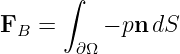
of the body. To obtain the net force of buoyancy FB acting on the object, we integrate the pressure
p over the boundary of this region
Where n is the outward pointing normal to the boundary of Ω. The negative sign is there because
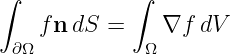
pressure points in the direction of the inward normal. It is a consequence of Stokes’ theorem that
for a differentiable scalar field f and for any Ω ⊂ ℝ3 a compact three-manifold with boundary, we
have
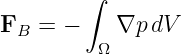
therefore we can write
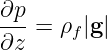
Now, it turns out that ∇p = ρfg where ρf is the volume density of the fluid. Here is why. Imagine
a cubical element of fluid whose height is Δz, whose top and bottom surface area is
ΔA (in the x − y plane), and whose mass is Δm. Let us consider the forces acting on
the bottom surface of this fluid element. Let the z-coordinate of its bottom surface
be z. Then, there is an upward force equal to p(z)ΔAez on its bottom surface and a
downward force of −p(z + Δz)ΔAez + Δmg. These forces must balance so that we
have
a simple manipulation of this equation along with dividing by Δz gives
taking the limit Δz → 0 gives
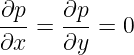
Similar arguments for the x and y directions yield
putting this all together we obtain ∇p = ρfg as desired. Substituting this into the integral
expression for the buoyant force obtained above using Stokes’ theorem, we have
where we can pull ρf and g outside of the integral since they are assumed to be constant. But
notice that ρfVol(Ω) is equal to Md, the mass of the displaced fluid so that
But by Newton’s second law, the buoyant force must balance the weight of the object which is
given by Mg. It follows from the above expression for the buoyant force that
which is precisely the statement of Archimedes’ Principle.