1 Time-Dependent Harmonic Oscillators
Nonlinear differential equations arise naturally in physics. Riccati equations and Ermakov systems
enter quantum theory in the study of exact Gaussian wave-packet solutions of the time-dependent
Schrödinger equation, including the time-dependent harmonic oscillator and free-particle
cases.
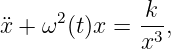
One of the simplest nonlinear equations of this type is the Milne–Pinney equation,
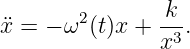
where k is a real constant. Equivalently,
1.1 Ermakov Systems
The equation was introduced by V. P. Ermakov in the nineteenth century in the study of first
integrals for the time-dependent harmonic oscillator. Lie had previously characterized classes of
non-autonomous first-order systems that admit a superposition rule,
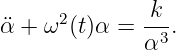
A classical Ermakov system consists of a time-dependent harmonic oscillator coupled to a
Milne–Pinney equation with the same frequency:
Such systems appear in studies of time-dependent oscillators, wave-packet dynamics, Bose–Einstein
condensates, and cosmological models.
For the system above, an Ermakov–Lewis invariant is
A direct differentiation, followed by use of the two equations of motion, gives
In quantum-mechanical applications, α(t) is often interpreted as an auxiliary amplitude related to
the width of a Gaussian wave packet, while η(t) may describe the corresponding classical oscillator
trajectory. Further insight into relations of this type can also be obtained through the Riccati
equation.
References
[1] Dieter Schuch. Riccati and Ermakov Equations in Time–Dependent and
Time–Independent Quantum Systems. Symmetry, Integrability and Geometry: Methods
and Applications (SIGMA), 4, 043, 16 pages (2008).
[2] R. Goodall and P. G. L. Leach. Generalised Symmetries and the Ermakov–Lewis
Invariant. Journal of Nonlinear Mathematical Physics, 12(1), 15–26 (2005).
[3] B. Grammaticos and B. Dorizzi. Two-dimensional time-dependent Hamiltonian
systems with an exact invariant. Journal of Mathematical Physics 25, 2194–2199 (1984).
[4] R. S. Kaushal. Quantum analogue of Ermakov systems and the phase of the quantum
wave function. International Journal of Theoretical Physics 40, 835–847 (2001).
[5] H. J. Korsch and H. Laurent. Milne’s differential equation and numerical solutions
of the Schrödinger equation. I. Bound-state energies for single- and double-minimum
potentials. J. Phys. B: At. Mol. Phys. 14, 4213–4230 (1981).
[6] H. J. Korsch, H. Laurent, and S. Möhlenkamp. Milne’s differential equation and
numerical solutions of the Schrödinger equation. II. Complex energy resonance states.
J. Phys. B: At. Mol. Phys. 15, 1–15 (1982).
[7] D. Schuch. Relations between wave and particle aspects for motion in a magnetic
field, in New Challenges in Computational Quantum Chemistry, eds. R. Broer, P. J. C.
Aerts, and P. S. Bagus, University of Groningen, 255–269 (1994).
[8] M. Maamache, A. Bounames, and N. Ferkous. Comment on “Wave function of a
time-dependent harmonic oscillator in a static magnetic field.” Phys. Rev. A 73, 016101
(2006).
[9] J. R. Ray. Time-dependent invariants with applications in physics. Lett. Nuovo Cim.
27, 424–428 (1980).
[10] W. Sarlet. Class of Hamiltonians with one degree of freedom allowing applications of
Kruskal’s asymptotic theory in closed form. II. Ann. Phys. (N.Y.) 92, 248–261 (1975).
[11] H. R. Lewis and P. G. L. Leach. Exact invariants for a class of time-dependent
nonlinear Hamiltonian systems. J. Math. Phys. 23, 165–175 (1982).
[12] P. G. L. Leach and A. Andriopoulos. The Ermakov Equation: A Commentary.
Applicable Analysis and Discrete Mathematics 2, 146–157 (2008).
[13] P. G. L. Leach, A. Karasu, M. C. Nucci, and A. Andriopoulos. Ermakov’s
Superintegrable Toy and Non-Local Symmetries. SIGMA 1, 018 (2005).
[14] M. Sebawe Abdalla and P. G. L. Leach. Linear and quadratic invariants for the
transformed Tavis–Cummings model. J. Phys. A: Math. Gen. 36, 12205–12221 (2003).
[15] M. Sebawe Abdalla and P. G. L. Leach. Wigner functions for time-dependent coupled
linear oscillators via linear and quadratic invariant processes. J. Phys. A: Math. Gen.
38, 881–893 (2005).
[16] R. S. Kaushal. Classical and Quantum Mechanics of Noncentral Potentials: A Survey
of 2D Systems. Springer, Heidelberg (1998).
[17] V. Ermakov. Second-order differential equations. Conditions of complete
integrability. Universita Izvestia Kiev, Series III, 9, 1–25 (1880); translation by A. O.
Harin.



![1 [ ( η )2]
IL = -- (α ˙η − η ˙α)2 + k -- .
2 α](https://images.physicslibrary.org/cache/objects/787/make4ht/TimeDependentHarmonicOscillators5x.png)
