As long as one deals only with commuting observables the rules of ordinary algebra may be used
without restrition. However, the observables of a given quantum system do not all commute. More
precisely, the observables of a quantum system in R dimensions are functions of the position
observables qi(i = 1, 2,…,R) and the momentum observables pi(i = 1, 2,…,R), all pairs of which do
not commute. The commutators of the q’s and the p’s play a fundamental role in the theory. One
has:
Relations (1) are obvious; in particular the second merely states that operations of differentiation
commute with each other. Relation (2) is a generalization of
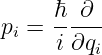
it is readily obtained by using the explicit form of the operators p:
From the fact that the q’s and the p’s do not commute in pairs, the precise definition of a
dynamical variable 𝒜≡ A(q1,…,qR; p1,…,pR) requires that one properly specifies the order of the
q′s and the p′s in the explicit expression of the function A(q1,…,qR; p1,…,pR). In practice, A is put
in the form of a polynomial in p - or possibly in the form of a power series in p - whose coefficients
are functions of q. Each term is a product of components pi and functions of the q arranged in a
certain order. The function A, considered as an operator, is well defined only when the order in
each of its terms is specified.
It is interesting to know he commutators of the q’s alone, or of the p’s alone, one obtains the
relations
The relations (3) and (4) are particular cases of the theorem:
If two observables commute, they possess a complete orthonormal set of common eigenfunctions,
and conversely.
To prove equation (5), t suffices to write down the operator pi explicitly and to verify that the
action of each side of the equation on an arbitrary wave function gives the same result (see
quantum operator concept). Equation (6) is proved by making an analogous verification in
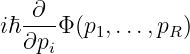
momentum space; let us recall that if Φ(p1,…,pR) is the wave function of momentum space
corresponding to Ψ(q1,…,qR), the function of momentum space coresponding to qiΨ(q1,…,qR)
is
One arrives at the same result using the rules of commutator algebra. Let us give here the four
principal rules. Thse rules are direct consequences of the definition of commutators. If A, B, and C
denote three arbitrary linear operators, one has
By repeated application of rule (9), one hs
In particular, for a one-dimensional system one has
Equation 6 is thus verified when F is an arbitrary power of the p; it is thus also verified (rule 8)
when F is a polynomial, or else a convergent power series in p.
For general functions of the q’s and p’s, one can also write
∂A∕∂qi, ∂A∕∂pi being defined by partial differentiation of A, it being understood that the order of
the p’s and q’s in their explicit expression has been suitably chosen.
0.1 References
[1] Messiah, Albert. ”Quantum mechanics: volume I.” Amsterdam, North-Holland Pub. Co.; New
York, Interscience Publishers, 1961-62.
This entry is a derivative of the Public domain work [1].

![[q ,q ] = 0, [p ,p ] = 0
i j i j](https://images.physicslibrary.org/cache/objects/834/make4ht/CommutatorAlgebra0x.png)
![[q,p ] = iℏδ
i j ij](https://images.physicslibrary.org/cache/objects/834/make4ht/CommutatorAlgebra1x.png)
![[ ]
ℏ ∂
[x, px] = i- x,∂x- = iℏ ⁄= 0](https://images.physicslibrary.org/cache/objects/834/make4ht/CommutatorAlgebra2x.png)
![[qi,F(q1,...,qR)] = 0](https://images.physicslibrary.org/cache/objects/834/make4ht/CommutatorAlgebra4x.png)
![[pi,G (p1,...,pR )] = 0](https://images.physicslibrary.org/cache/objects/834/make4ht/CommutatorAlgebra5x.png)
![ℏ-∂F--
[pi,F(q1,...,qR)] = i ∂qi](https://images.physicslibrary.org/cache/objects/834/make4ht/CommutatorAlgebra6x.png)
![∂G
[qi,G (p1,...,pR)] = iℏ----
∂pi](https://images.physicslibrary.org/cache/objects/834/make4ht/CommutatorAlgebra7x.png)
![[A, B ] = − [B,A ]](https://images.physicslibrary.org/cache/objects/834/make4ht/CommutatorAlgebra9x.png)
![[A,B + C ] = [A,B ] + [A, C ]](https://images.physicslibrary.org/cache/objects/834/make4ht/CommutatorAlgebra10x.png)
![[A, BC ] = [A,B ]C + B [A,C ]](https://images.physicslibrary.org/cache/objects/834/make4ht/CommutatorAlgebra11x.png)
![[A, [B, C ]] + [B, [C, A]] + [C,[A, B ]] = 0](https://images.physicslibrary.org/cache/objects/834/make4ht/CommutatorAlgebra12x.png)
![n∑−1
[A,Bn ] = Bs[A, B]Bn −s−1
s=0](https://images.physicslibrary.org/cache/objects/834/make4ht/CommutatorAlgebra13x.png)
![[q,pn] = niℏpn −1](https://images.physicslibrary.org/cache/objects/834/make4ht/CommutatorAlgebra14x.png)
![hbar ∂A
[pi,A ] = --------
i ∂qi](https://images.physicslibrary.org/cache/objects/834/make4ht/CommutatorAlgebra15x.png)
![∂A
[qi,A] = iℏ----
∂pi](https://images.physicslibrary.org/cache/objects/834/make4ht/CommutatorAlgebra16x.png)