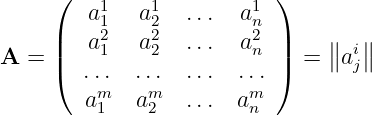
A matrix is defined as a rectangular array of elements (usually the elements are real or complex
numbers). An algebra of matrices is developed by defining addition of matrices, multiplication of
matrices, multiplication of a matrix by a scalar (real or complex number), differentiation of
matrices, etc. The definitions chosen for the above-mentioned operations will be such as
to make the calculus of matrices highly applicable. A matrix A may be denoted as
follows:
If m = n, we say that A is a square matrix of order n. If B is the matrix of elements
 ,i = 1, 2,…,m,j = 1, 2,…,n, then B is said to be equal to A, written B = A or A = B, if and
only if aji = b
ji for the complete range of values of i and j.
,i = 1, 2,…,m,j = 1, 2,…,n, then B is said to be equal to A, written B = A or A = B, if and
only if aji = b
ji for the complete range of values of i and j.
Two matrices can be compared for equality if and only if they are comparable in the sense that
they have the same number of rows and the same number of columns.
The sum of two comparable matrices A, B is defined as a new matric C whose elements cji are
obtained by adding the corresponding elements of A and B. Thus
We note that A + B = B + A.
We call A a zero matrix if and only if each element of A is equal to the real number
zero.
The product of a matrix A by a numbe k (real or complex) is defined as the matrix whose
elements are each k times those of A, that is
Every matrix A can be associated with a negative matrix B = −A such that A+(−A) = (−A)+A = 0
(zero matrix).
The rule for multiplying a matrix A by a scalar k should not be confused with the rule for
multiplying a determinant by k, for in this latter case the elements of only one row or only one
column are multiplied by k.
Before defining the product of two matrices let us consider the following sets of linear
transformations:
Since the z’s depend on the y’s, which in turn depend on the x’s, we can solve for the z’s in terms
of the x’s. We write this transformation as follows:
This suggests a method for defining multiplication of the matrics A, B.
If A =  ,i = 1, 2,…,m,j = 1, 2,…,n,B =
  ,i = 1, 2,…,n,j = 1, 2,…,p, then AB is defined
as the matrix C such that
,i = 1, 2,…,n,j = 1, 2,…,p, then AB is defined
as the matrix C such that
Let us note that the number of columns of the matrix A must be equal the number of rows of B.
The matrix C of (3) is an m × p matrix. In the case of square matrices the definition for
multiplication of matrices corresponds to that for multiplication of determinants. This implies that
 =
=  ⋅
⋅ , where
  denotes the determinant of the set of elements comprising the square
matrix C = AB.
denotes the determinant of the set of elements comprising the square
matrix C = AB.
A square matrix A is said to be a symmetric matrix if and only if A = AT . If A = −AT , we say
the A is a skew-symmetric matrix. We now exhibit a symmetric matrix A and a skew-symmetric
matrix B.
We let the reader verify that 
 is a symmetric matrix if A is a square matrix. Let the
reader first prove that
is a symmetric matrix if A is a square matrix. Let the
reader first prove that  T = A,
It is easily seen that 
 is a symmetric matrix. Any square matrix A can obviously be
written as
is a symmetric matrix. Any square matrix A can obviously be
written as
Hence every square matrix can be written as the sum of a symmetric and a skew-symmetric
matrix.
1 References
[1] Lass, Harry. ”Elements of pure and applied mathematics” New York: McGraw-Hill Companies,
1957.
This entry is a derivative of the Public domain work [1].