0.1 Introduction
Let us recall the following data related to Borel space and measure theory:
- sigma–algebra, or σ-algebra;
- the Borel algebra which is defined as the smallest σ-algebra on the field of real numbers
ℝ generated by the open intervals of ℝ;
- Borel space
- Consider a locally compact Hausdorff space X; a Borel measure is then defined as any
measure μ on the sigma-algebra of Borel sets, that is, the Borel sigma-algebra ℬ(X)
defined on a locally compact Hausdorff space X;
- When the Borel measure μ is both inner and outer regular on all Borel sets, it is called
a regular Borel measure;
- Recall that a topological space X is σ-compact if there exists a sequence
 n of
compact subsets Kn of X such that :
n of
compact subsets Kn of X such that :
Definition 0.1. Let (X; ℬ(X)) be a Borel space (with the σ-algebra ℬ(X) of Borel sets of
a topological space X), and let μ be a measure on the space X. Then, such a measure is
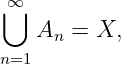
called a σ–finite (Borel) measure if there exists a sequence  n with An ∈ℬ(X) for all
n, such that
n with An ∈ℬ(X) for all
n, such that
and also μ(An) < ∞ for all n, (ref. [1]).
Definition 0.2. If μ is an inner regular and locally finite measure, then μ is said to be a
Radon measure.
Note Any Borel measure on X which is finite on such compact subsets is also (Borel) σ-finite in
the above defined sense (Definition 0.1).
References
[1] M.R. Buneci. 2006., Groupoid C*-Algebras., Surveys in Mathematics and its
Applications, Volume 1: 71–98.
[2] J.D. Pryce (1973). Basic methods of functional analysis., Hutchinson University
Library. Hutchinson, p. 212–217.
[3] Alan J. Weir (1974). General integration and measure. Cambridge University Press,
pp. 150-184.
[4] Boris Hasselblatt, A. B. Katok, Eds. (2002). Handbook of Dynamical Systems., vol.
1A, p.678. North-Holland. on line