Canonical quantization is a method of relating, or associating, a classical system of the form
(T∗X,ω,H), where X is a manifold, ω is the canonical symplectic form on T∗X, with a (more
complex) quantum system represented by H ∈ C∞(X), where H is the Hamiltonian
operator. Some of the early formulations of quantum mechanics used such quantization
methods under the umbrella of the correspondence principle or postulate. The latter states
that a correspondence exists between certain classical and quantum operators, (such
as the Hamiltonian operators) or algebras (such as Lie or Poisson (brackets)), with
the classical ones being in the real (ℝ) domain, and the quantum ones being in the
complex (ℂ) domain. Whereas all classical Observables and States are specified only by
real numbers, the ’wave’ amplitudes in quantum theories are represented by complex
functions.
Let (xi,p
i) be a set of Darboux coordinates on T∗X. Then we may obtain from each coordinate
function an operator on the Hilbert space ℋ = L2(X,μ), consisting of functions on X
that are square-integrable with respect to some measure μ, by the operator substitution
rule:
xi xi xi | = xi⋅, | (1)
|
pi pi pi | = −iℏ , , | (2) |
where xi⋅ is the “multiplication by xi” operator. Using this rule, we may obtain operators from a
larger class of functions. For example,
- xixj
 xixj = xixj⋅,
- pipj
 pipj = −ℏ2
 ,
,
- if i≠j then xip
j
 xip
j = −iℏxi
xip
j = −iℏxi .
.
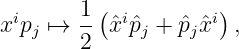
Remark. The substitution rule creates an ambiguity for the function xip
j when i = j, since
xip
j = pjxi, whereas xip
j≠pjxi. This is the operator ordering problem. One possible solution is to
choose
since this choice produces an operator that is self-adjoint and therefore corresponds to a physical
observable. More generally, there is a construction known as Weyl quantization that uses Fourier
transforms to extend the substitution rules (1)-(2) to a map
| C∞(T∗X) | → Op(ℋ) | |
|
| f |  f. f. | | |
Remark. This procedure is called “canonical” because it preserves the canonical Poisson brackets.
In particular, we have that
which agrees with the Poisson bracket {xi,p
j} = δji.
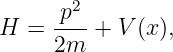
Example 1. Let X = ℝ. The hamiltonian function for a one-dimensional point particle with mass
m is
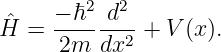
where V (x) is the potential energy. Then, by operator substitution, we obtain the Hamiltonian
operator

![− i[ˆxi, ˆpj] := −-i (ˆxiˆpj − pˆjˆxi) = δi,
ℏ ℏ j](https://images.physicslibrary.org/cache/objects/867/make4ht/CanonicalQuantization10x.png)