Centroids and Weighted Position Vectors
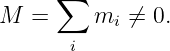
Let points Pi have scalar weights mi, with
Their weighted centroid P∗ is defined by
In position-vector form,
This is exactly the modern center of mass formula when the mi are masses.
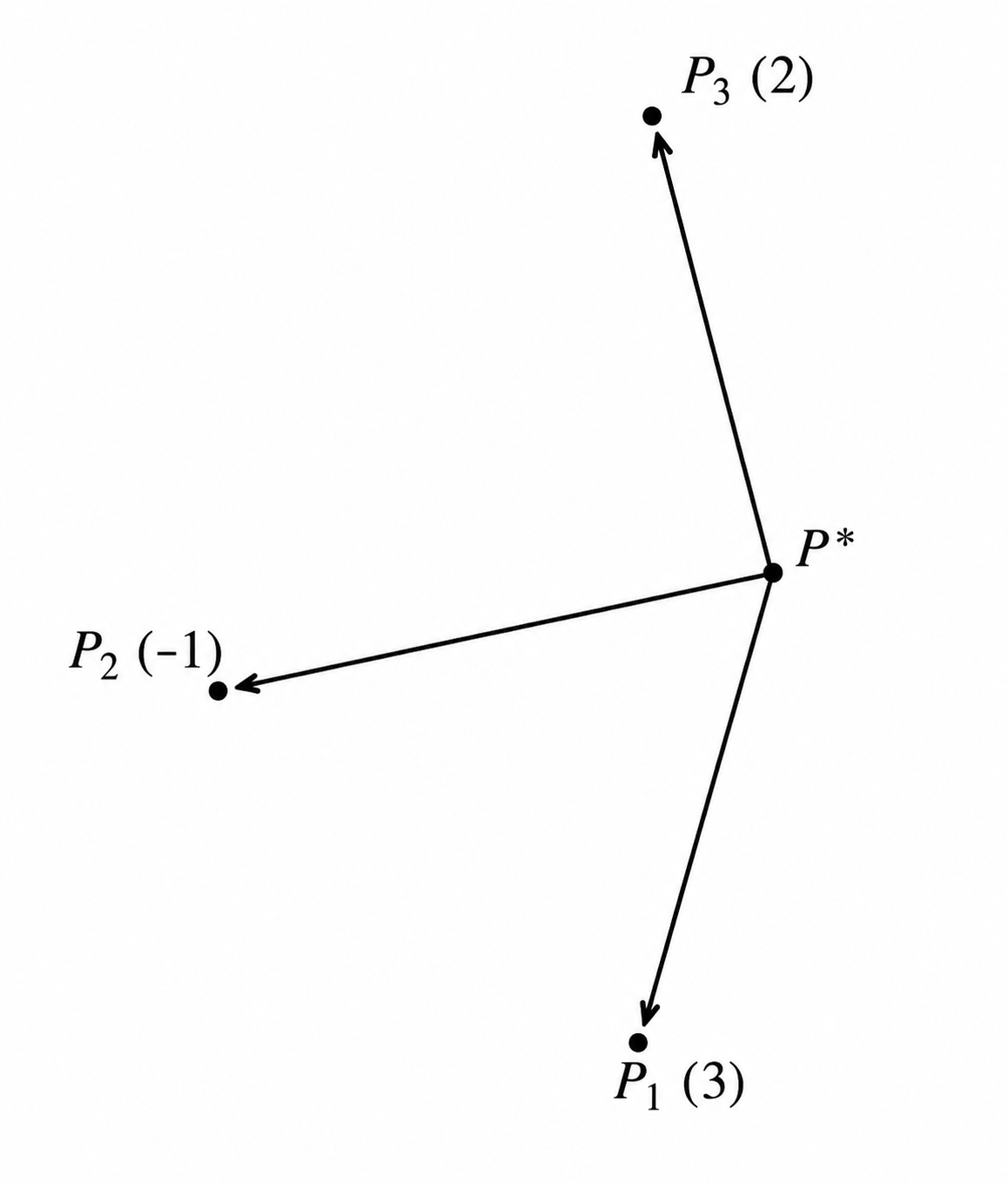
Figure 12, modernized: a weighted centroid with one negative weight.
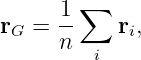
For equal weights,
which is the arithmetic mean of the position vectors.
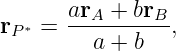
For two weighted points A,B with weights a,b,
so the point divides AB inversely to the weights.
Grouping theorem
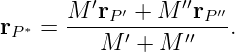
If a collection of weighted points is split into two groups with centroids P′,P′′ and total
weights M′,M′′, then the centroid of the entire set is the centroid of P′,P′′ weighted by
M′,M′′:
This property is useful for composite bodies and hierarchical center-of-mass calculations.
Source problems
- Find the centroid of (0, 1, 3), (−3, 0, 4), (3,−2, 0) with weights 2, 3, 1.
- In the tetrahedral midpoint construction of Figure 7f, prove the two midpoint-joining
segments meet at the centroid of A,B,C,D.
- If G is the centroid of A,B,C, prove that the centroid of A,B,C,D divides DG in the
ratio 3 : 1.
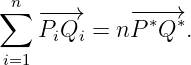
- If P∗,Q∗ are the centroids of two sets of n points P
1,…,Pn and Q1,…,Qn, prove
- Give a construction for the centroid of five equally weighted points using the grouping
theorem.
Modern notation references
The notation and terminology in this modernized article follow standard present-day mechanics
and vector-analysis usage, particularly:
- J. R. Taylor, Classical Mechanics, University Science Books, 2005.
- D. Kleppner and R. Kolenkow, An Introduction to Mechanics, 2nd ed., Cambridge
University Press, 2014.
- H. Goldstein, C. Poole, and J. Safko, Classical Mechanics, 3rd ed., Addison–Wesley,
2002.
Source
This article is a modernized restatement of the corresponding Public Domain article in Louis
Brand, Vectorial Mechanics, John Wiley & Sons, New York, 1930, Chapter I, “Vector Algebra.”
The original 1930 edition is the source basis.