In physics we enjoy measuring everything along with developing relationships that help give insight
into the physical world around us. When it comes to the stars above, apparent magnitude is a
relative scale used in comparing the brightness of astronomical objects. Like many things in
physics, it has a rich history and non-intuitive consequences. In this case, dating all the way back
to the Greek astronomer Hipparchus, who was the first to classify the brightness of
stars.
Although apparent magnitude has seen many revisions over the years, the agreed upon scale
today is that a difference of 5 magnitudes is equivalent to a factor of 100 in brightness.
Before studying the equations, it is important for us to be more precise and define the
brightness also known as the flux of an astronomical object, such as a star, galaxy or
planet, as the energy received per second per area from the object. Think about how
much water is flowing through a cross-section of a hose of a certain area in a certain
amount of time. We are just applying this concept to the photons received from the
stars.
For a more complete picture, we relate flux, the received energy, to the transmitter of the photons
through its intrinsic luminosity. More precisely, the energy emitted per second. Of course the
amount of flux received is not only dependent on an object’s luminosity, but also how far
it is away from the detector. This is encapsulated by the Inverse Square Law for
Light
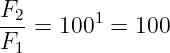
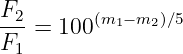
So if 2 objects differ by an apparent magnitude of 5, than we receive 100 times more flux from one
than the other. As an equation we write this ratio as
Generalizing apparent magnitude to any difference between two objects
we note that a difference of 1 magnitude yields the flux ratio of
Therefore, in general we have
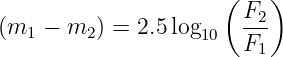
A more common form of this equation is obtained by taking the base 10 logarithm of both sides of
the equation.
Using the logarithm property
we get
dividing both sides by 0.4 yields
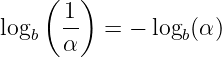
Finally, using the logarithm property
we are left with
Apparent magnitude can be a bit deceiving since it does not tell us whether an object is close to us
or whether it is just producing a copious amount of photons. We can shed some light on the
situation by defining absolute magnitude as the apparent magnitude of an object
if it was at a distance of 10 parsecs. Combining the inverse square law for light Eq.
(1) with the flux ratio Eq. (2) and having F2 be the flux that would be received at 10
pc
Canceling terms and noting that luminosity is the same L10 = L yields
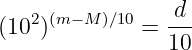
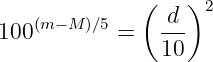
taking the square root of both sides
convert 100 to 10
combining exponents by multiplication
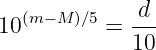
multiply both sides by 10
combining exponents through addition
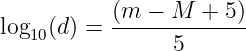
Similar to apparent magnitude take the logarithm of both sides
Rearrange the equation to get what is referred to as the distance modulus
Note that the distance units for all these equations is in parsecs.
If you have not yet caught on to the non-intuitive consequences of stellar magnitudes, we point out
that
- The larger the magnitude the fainter the object. So a 10th magnitude star is 100 times
fainter than a 5th magnitude star.
- An astronomical object can have a negative magnitude. As an example our sun has an
absolute magnitude of −26.7
References
[1] Buck, M.T. ”Exercises in Practical Astronomy Using Photographs” Taylor & Francis; 1st
edition, January 1, 1990.
[2] Carroll B., Ostilie, D. ”An Introduction to Modern Astrophysics”, Addison-Wesley Publishing
Company, Inc. Reading, Massachusetts, 1996.
[3] Inglis, Mike. ”Astrophysics is Easy!: An Introduction for the Amateur Astronomer” Springer;
1st edition, August 23, 2007.
[4] Roy, A.E.; Clarke, D. ”Astronomy: Principles and Practice” Fourth Edition. Taylor & Francis;
June 2003.
[5] Schulman, Eric; Cox, Caroline V. ”Misconceptions about astronomical magnitudes” American
Journal of Physics, volume 65, Issue 10, pp. 1003-1007 (1997).




![( F2 ) [ ]
log10 --- = log10 100 (m1− m2)∕5
F1](https://images.physicslibrary.org/cache/objects/850/make4ht/StellarMagnitude5x.png)



![---L10---
100 (m −M )∕5 = F10-= 4π102[pc]2
F 4Lπd2](https://images.physicslibrary.org/cache/objects/850/make4ht/StellarMagnitude11x.png)
![d
100 [(m−M )∕5]⋅1∕2 = 100(m−M )∕10 = ---
10](https://images.physicslibrary.org/cache/objects/850/make4ht/StellarMagnitude13x.png)