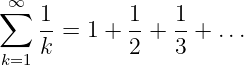
The harmonic series
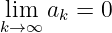
satisfies the necessary condition of convergence
for a series
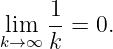
of real or complex terms. In particular,
Nevertheless, the harmonic series diverges. This can be seen by grouping the terms
as
Here, each parenthesized sum contains twice as many terms as the preceding one. The sum in the
first parentheses is greater than
and the sum in the second parentheses is greater than
Continuing in this way, one sees that every parenthesized block is greater than  . Consequently,
the partial sum of the first n terms eventually exceeds any given real number, and therefore the
harmonic series diverges.
. Consequently,
the partial sum of the first n terms eventually exceeds any given real number, and therefore the
harmonic series diverges.
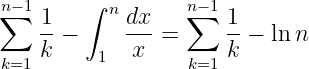
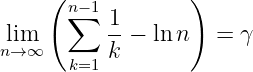
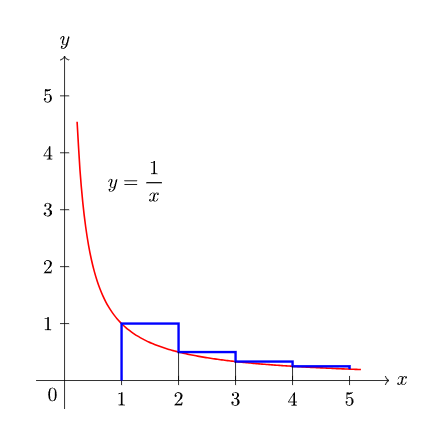
The divergence of the harmonic series is very slow, though. Its speed may be illustrated by
considering the difference
(see the diagram). We know that ln n increases very slowly as n →∞ (for example,
ln(1 000 000 000) ≈ 20.7). The increase of the partial sum ∑
k=1n−1 is about the same, since the
limit
is about the same, since the
limit
is a small positive number,
called the Euler constant or Euler–Mascheroni constant.