1 Stefan–Boltzmann Law
The Stefan–Boltzmann law, also known as Stefan’s law, states that the total radiant power emitted
per unit surface area of a body is proportional to the fourth power of its absolute temperature. For
a gray body,
where P is the radiant exitance in watts per square meter, 𝜖 is the emissivity, and T is the absolute
temperature in kelvins. For an ideal blackbody, 𝜖 = 1.
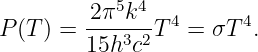
The constant of proportionality σ, called the Stefan–Boltzmann constant, can be written in terms
of other physical constants as
Thus, for an ideal blackbody at 100 K,
while at 1000 K,
The law was discovered experimentally by Jožef Stefan (1835–1893) in 1879 and derived
theoretically, using Thermodynamics, by Ludwig Boltzmann (1844–1906) in 1884. Stefan published
the result in the article Über die Beziehung zwischen der Wärmestrahlung und der Temperatur
(“On the relationship between thermal radiation and temperature”).
2 Derivation
The Stefan–Boltzmann law can be derived by integrating Planck’s blackbody spectrum over all
wavelengths. The spectral radiant exitance is
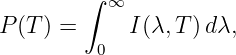
The total radiant exitance is therefore
or
Use the substitution
Then
As λ →∞, u → 0, and as λ → 0, u →∞. Substitution gives
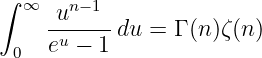
The standard integral
gives, for n = 4,
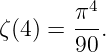
and
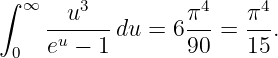
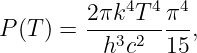
Hence
Therefore,
so
3 References
[1] National Institute of Standards and Technology
[2] K. Krane, Modern Physics, 2nd ed., John Wiley & Sons, New York (1996).
[3] S. Thornton and A. Rex, Modern Physics for Scientists and Engineers, 2nd ed., Saunders
College Publishing, Fort Worth (2000).
[4] alozano, “Values of the Riemann zeta function in terms of Bernoulli numbers,” PlanetMath
[5] archibal, “Bernoulli Number,” PlanetMath
This entry is a derivative of the Stefan–Boltzmann law article from Wikipedia, the Free
Encyclopedia. Authors of the original article include Yurivict, Patrick, XJamRastafire, Metacomet,
and Icairns. The history page of the original is here.