
|
|
|
|||||||
of the Gaussian bell-shaped function
where C and a are positive constants. We first obtain  Completing the square gives  With the substitution 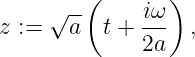 we may write
where l is a line in the complex plane parallel to the real axis and passing through the point  Now define  We can show that Iy does not depend on y. Indeed,
Hence  Substituting this result into (3) gives
Thus the Fourier transform of the Gaussian in (2) is another Gaussian. Interpretation. One can take the breadth of the bell to be the portion of the abscissa axis outside which the ordinate drops below the maximum value divided by e. For the Gaussian in (2),  so  By the evenness of the function, the breadth is 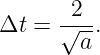 Similarly, from (5), the breadth of the transformed bell is 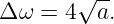 Therefore,
Thus, for this choice of breadth convention, the product has a constant value. More generally, other choices of pulse shape and width measure lead to analogous inverse relations between temporal width and frequency width. The two breadths are therefore inversely proportional in this sense. If t is time and f is the action of a force on a system of oscillators with their natural frequencies, then the inverse Fourier transform is  In this representation, F(ω) describes the frequency-domain amplitude associated with angular frequency ω. Equation (6) illustrates that a more localized action in time, corresponding to a smaller Δt, requires a broader frequency spectrum, corresponding to a larger Δω. Conversely, obtaining greater frequency selectivity requires the action to be spread over a longer interval of time. This time-frequency tradeoff is closely related to the mathematical structure underlying the quantum-mechanical uncertainty principle, also historically called a principle of indetermination. References
"uncertainty by waves" is owned by pahio. [ full author list (3) ]
This object's parent. Cross-references: spectrum, angular frequency, amplitude, representation, natural frequencies, oscillators, system, frequency, relations, complex plane, square, function, Fourier transform There is 1 reference to this object. This is version 10 of uncertainty by waves, born on 2009-01-09, modified 2026-09-07. Object id is 359, canonical name is Something20related20to20Heisenberg20uncertainty20principle. Accessed 3447 times total. Classification:
|
|
|
|
Pending Errata and AddendaNone.
|
DiscussionNo messages.
|
Interact |
![[parent]](https://images.physicslibrary.org/images/uparrow.png)


![[ ]
e−(x+iy)2](https://images.physicslibrary.org/cache/objects/359/make4ht/Something20related20to20Heisenberg20uncertainty20principle13x.png)

