|
|
|
|||||||
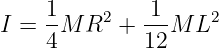
for other axes, such as rotation about x or y, the moment of inertia is given as
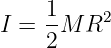
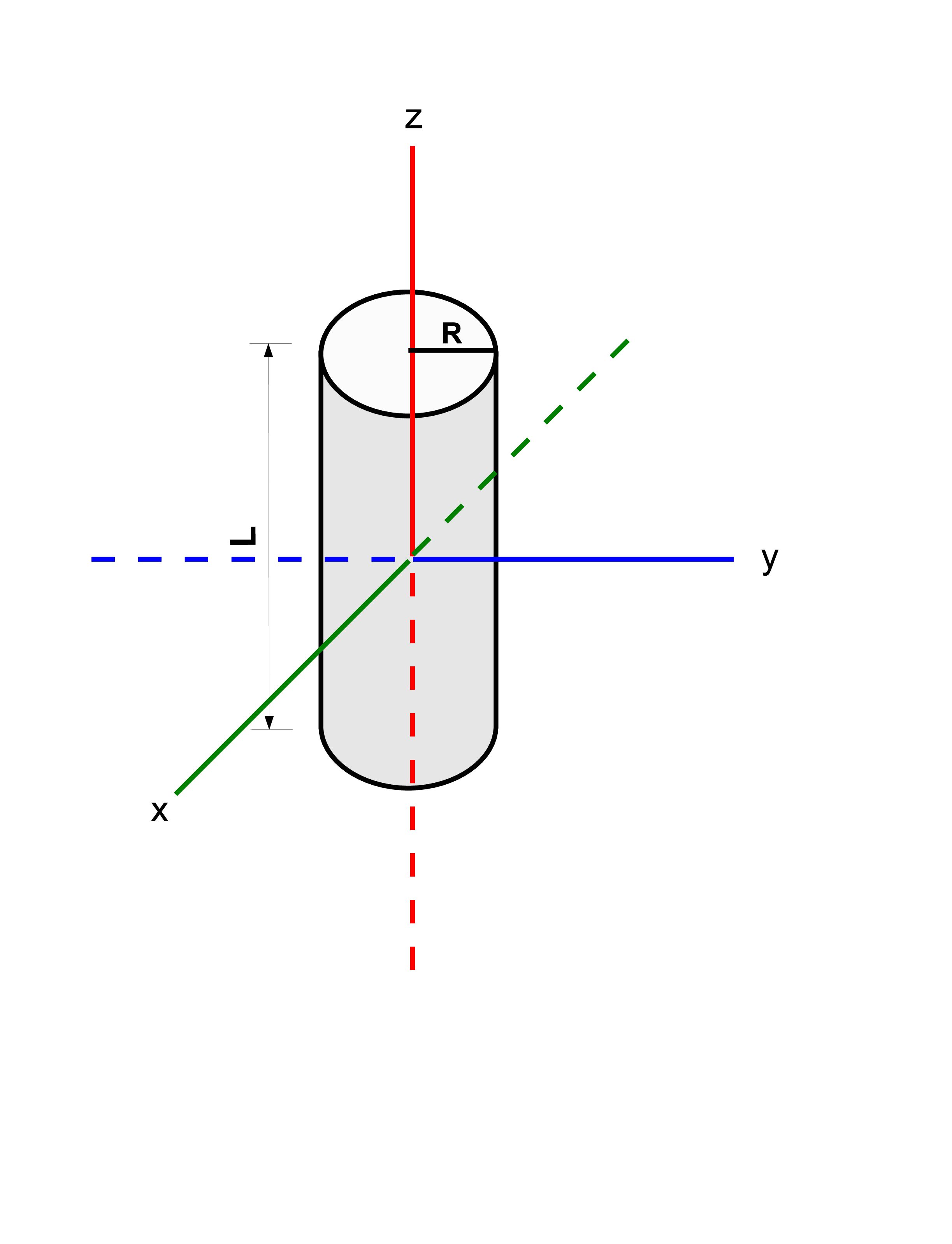
For the moment of inertia about the z axis, the integration in cylindrical coordinates is straight forward, since r in cylindrical coordinates is the same as in the inertia calculation so we have
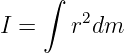 Assuming constant density throughout the cylinder leads to
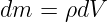 and in cylindrical coordinates the infinitesmal volume dV is given by
 giving the equation to integrate as
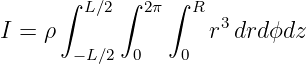 Integrating the r term yields
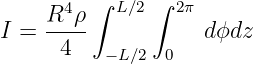 and ingtegrating the ϕ term gives
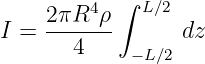 Next, integrating the z term and putting in the limits simplifies to
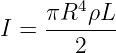 Finally, plugging in the equation for density and volume of a cylinder

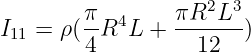
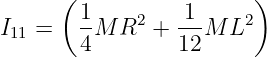
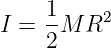
 leaves us with equation (1)
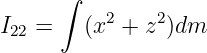
 In order to derive the rotational inertia about the x and y axes, one needs to reference the inertia tensor to make things easy on us. Essentially, we are trying to calculate I11 and I22 which correspond to the moments of inertia about the x and y axes in this case. Turning the sums into integrals for our continuous example to work with these equations
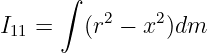
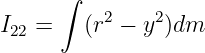 before we can dive into the integration, we need to convert to cylindrical coordinates. First we note that
 which gives us
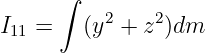
 Next, we see that in cylindrical coordinates that
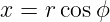
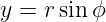
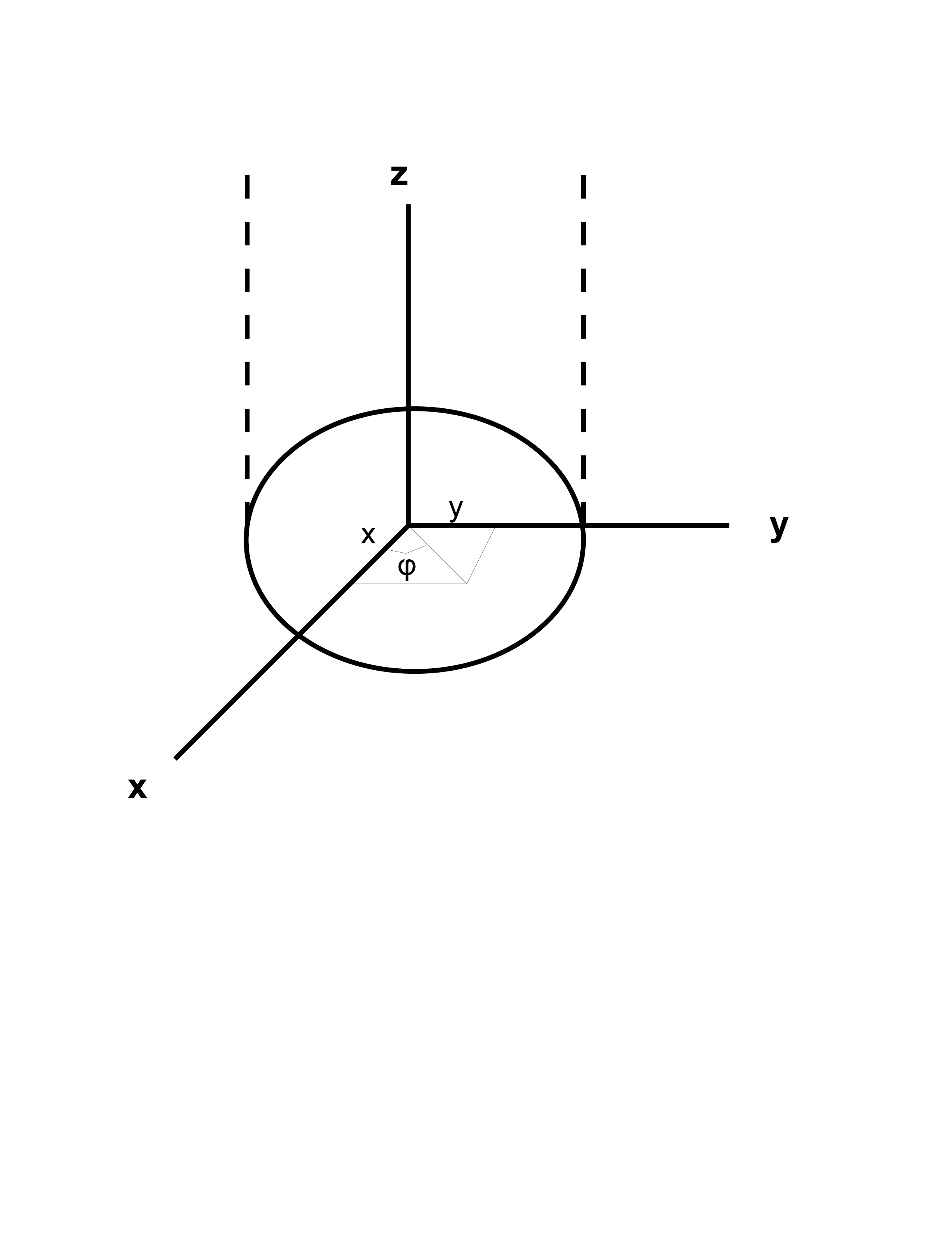
 the z coordinate is obvious, but to see the x and y coordinates see the below figure which shows a slice out of the cylinder
It might not be obvious now but the integrals for x and y will come out to the same answer and we shall show this shortly. So the switch to cylindrical coordinates is complete once we change dm to ρdV giving
Once again in cylindrical coordinates the infinitesmal volume dV is given by
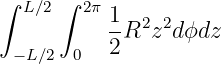
 so we must integrate

 Let us break up the integral and start with the rz2 term so first integrate dr to get
 the ϕ term leaves us with
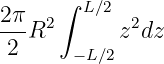 Finally, integrating the z term gives us
Next up is the r3 sin 2 term, so first integrate dr to get
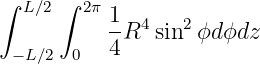 to integrate the ϕ term use the trigonometric identity that
 and then use another trigonometric identity
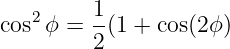 so the integration becomes
 Use u substitution to solve this so


 and we carry out the integration of
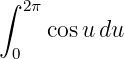 and this integrates to zero and we are left with
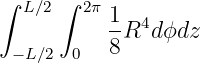 This integration is simple now and we get
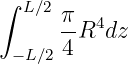 Finally, the z term gives us
Plugging equations (5) and (6) into (3) gives us
Using the volume of a cylinder
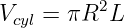 we get the expression for the density
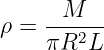 and plugging this into seven and simplifying gives us the moment of inertia about the x axis, which was stated in (1)
0.1 References[1] Halliday, D., Resnick, R., Walker, J.: ”Fundamentals of Physics”. 5th Edition, John Wiley & Sons, New York, 1997. "Rotational Inertia of a Solid Cylinder" is owned by bloftin.
This object's parent. Cross-references: identity, work, inertia tensor, volume, cylindrical coordinates, Rotational Inertia There is 1 reference to this object. This is version 8 of Rotational Inertia of a Solid Cylinder, born on 2006-03-28, modified 2006-07-10. Object id is 144, canonical name is RotationalInertiaOfASolidCylinder. Accessed 16672 times total. Classification:
|
|
|
|
Pending Errata and AddendaNone.
|
DiscussionNo messages.
|
Interact |
![[parent]](https://images.physicslibrary.org/images/uparrow.png)