1 Definition
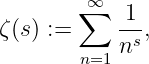
The Riemann zeta function is defined to be the complex valued function given by the
series
which is valid (in fact, absolutely convergent) for all complex numbers s with Re(s) > 1. We list
here some of the key properties [1] of the zeta function.
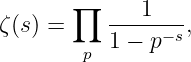
- For all s with Re(s) > 1, the zeta function satisfies the Euler product formula
where the product is taken over all positive integer primes p, and converges uniformly in a
neighborhood of s.
- The zeta function has a meromorphic continuation to the entire complex plane with a simple
pole at s = 1, of residue 1, and no other singularities.
- The zeta function satisfies the functional equation
for any s ∈ ℂ .
2 Distribution of primes
The Euler product formula (2) given above expresses the zeta function as a product over the
primes p ∈ ℤ, and consequently provides a link between the analytic properties of the zeta function
and the distribution of primes in the integers. As the simplest possible illustration of this link, we
show how the properties of the zeta function given above can be used to prove that there are
infinitely many primes.
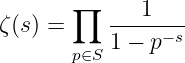
If the set S of primes in ℤ were finite, then the Euler product formula
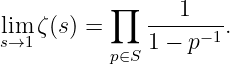
would be a finite product, and consequently lim s→1ζ(s) would exist and would equal
But the existence of this limit contradicts the fact that ζ(s) has a pole at s = 1, so the set S of
primes cannot be finite.
A more sophisticated analysis of the zeta function along these lines can be used to prove both the
analytic prime number theorem and Dirichlet’s theorem on primes in arithmetic progressions
.
Proofs of the prime number theorem can be found in [2] and [5], and for proofs of
Dirichlet’s theorem on primes in arithmetic progressions the reader may look in [3]
and [7].
3 Zeros of the zeta function
A nontrivial zero of the Riemann zeta function is defined to be a root ζ(s) = 0 of the zeta function
with the property that 0 ≤ Re(s) ≤ 1. Any other zero is called trivial zero of the zeta
function.
The reason behind the terminology is as follows. For complex numbers s with real part
greater than 1, the series definition (1) immediately shows that no zeros of the zeta
function exist in this region. It is then an easy matter to use the functional equation (3)
to find all zeros of the zeta function with real part less than 0 (it turns out they are
exactly the values −2n, for n a positive integer). However, for values of s with real
part between 0 and 1, the situation is quite different, since we have neither a series
definition nor a functional equation to fall back upon; and indeed to this day very little is
known about the behavior of the zeta function inside this critical strip of the complex
plane.
It is known that the prime number theorem is equivalent to the assertion that the zeta function
has no zeros s with Re(s) = 0 or Re(s) = 1. The celebrated Riemann hypothesis asserts that all
nontrivial zeros s of the zeta function satisfy the much more precise equation Re(s) = 1∕2. If true,
the hypothesis would have profound consequences on the distribution of primes in the
integers [5].
References
[1] Lars Ahlfors, Complex Analysis, Third Edition, McGraw–Hill, Inc., 1979.
[2] Joseph Bak & Donald Newman, Complex Analysis, Second Edition, Springer–Verlag,
1991.
[3] Gerald Janusz, Algebraic Number Fields, Second Edition, American Mathematical
Society, 1996.
[4] Serge Lang, Algebraic Number Theory, Second Edition, Springer–Verlag, 1994.
[5] Stephen Patterson, Introduction to the Theory of the Riemann Zeta Function,
Cambridge University Press, 1988.
[6] B. Riemann, Ueber die Anzahl der Primzahlen unter einer gegebenen Grösse,
http://www.maths.tcd.ie/pub/HistMath/People/Riemann/Zeta/
[7] Jean–Pierre Serre, A Course in Arithmetic, Springer–Verlag, 1973.
This entry is a derivative of the Riemann zeta function article from PlanetMath. Author of the
orginial article: djao. History page of the original is here