Physics Library
 An open source physics library
Encyclopedia | Forums | Docs | Random | Template Test |  
Login
create new user
Username:
Password:
forget your password?
Main Menu
Sections

Meta

Talkback

Downloads

Information
quaternion product (Definition)

Quaternion Product in Scalar Vector Form

The component formula for quaternion multiplication is correct but easy to misremember because of its pattern of signs. For physics and engineering, a more revealing form separates each quaternion into a real scalar and an ordinary three-dimensional vector. Hamilton multiplication then becomes a single formula involving only the familiar dot and cross products.

Let

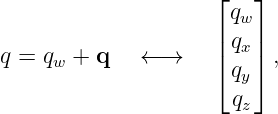
$\displaystyle p=p_w+\mathbf p, \qquad q=q_w+\mathbf q, $
where $p_w,q_w\in\mathbb{R}$ and $\mathbf p,\mathbf q\in\mathbb{R}^3$ are identified with pure quaternions. The Hamilton product is
$\displaystyle \boxed{ pq = \left(p_wq_w-\mathbf p\cdot\mathbf q\right) + \left(p_w\mathbf q+q_w\mathbf p+\mathbf p\times\mathbf q\right). }$ (1)
Equivalently, as an ordered scalar–vector pair,
$\displaystyle \boxed{ (p_w,\mathbf p)(q_w,\mathbf q) = \left( p_wq_w-\mathbf p\cdot\mathbf q, \;p_w\mathbf q+q_w\mathbf p+\mathbf p\times\mathbf q \right). }$ (2)

Equation (2) is one of the most useful forms of the Hamilton product for mechanics, attitude dynamics, navigation, robotics, and software. It shows immediately which part of multiplication is symmetric, which part changes sign when the order is reversed, and why quaternion multiplication is naturally tied to three-dimensional geometry.

Convention declaration

This entry uses the PhysicsLibrary convention established in the preceding quaternion entries:

$\displaystyle \mathbf i\mathbf j=\mathbf k, \qquad \mathbf j\mathbf k=\mathbf i, \qquad \mathbf k\mathbf i=\mathbf j,$ (3)
with reversed products changing sign. The three-dimensional cross product is the ordinary right-handed cross product,
$\displaystyle \hat{\mathbf x}\times\hat{\mathbf y}=\hat{\mathbf z}.$ (4)
Therefore the vector cross-product term in equation (1) appears with a plus sign.

Some aerospace and software literature uses the opposite, or flipped, quaternion multiplication. With the same right-handed vector cross product, that multiplication produces a minus sign in front of $\mathbf p\times\mathbf q$. This difference is sometimes described as right-handed versus left-handed quaternions. Those names are not reliable by themselves because authors have used “handedness” for the physical frame, screw sense, cross product, and quaternion algebra. The equation

$\displaystyle \mathbf i\mathbf j=+\mathbf k \quad\hbox{or}\quad \mathbf i\star\mathbf j=-\mathbf k$ (5)
is the safer diagnostic.

Pure-vector multiplication is the key

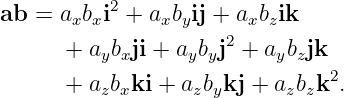
The entire scalar–vector formula follows from first understanding the product of two pure quaternions. Let

$\displaystyle \mathbf a=a_x\mathbf i+a_y\mathbf j+a_z\mathbf k, \qquad \mathbf b=b_x\mathbf i+b_y\mathbf j+b_z\mathbf k.$ (6)
Expanding their quaternion product gives
\begin{equation*}\begin{aligned} \mathbf a\mathbf b={}& a_xb_x\mathbf i^2+a_yb_y... ...+a_zb_x\mathbf k\mathbf i+a_zb_y\mathbf k\mathbf j. \end{aligned}\end{equation*}
Using
$\displaystyle \mathbf i^2=\mathbf j^2=\mathbf k^2=-1$ (8)
and the cyclic products in equation (3), the scalar terms are
$\displaystyle -(a_xb_x+a_yb_y+a_zb_z) =-\mathbf a\cdot\mathbf b,$ (9)
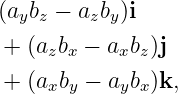
while the vector terms are
\begin{equation*}\begin{aligned} &(a_yb_z-a_zb_y)\mathbf i\ &\quad +(a_zb_x-a_... ...(a_xb_y-a_yb_x)\mathbf k =\mathbf a\times\mathbf b. \end{aligned}\end{equation*}
Hence
$\displaystyle \boxed{ \mathbf a\mathbf b =-\mathbf a\cdot\mathbf b+\mathbf a\times\mathbf b. }$ (11)

This compact identity is the bridge between Hamilton's nineteenth-century quaternion multiplication and modern vector analysis. The scalar part contains minus the dot product; the vector part contains the cross product.

Historical quaternion texts commonly denoted these two pieces by $S(\mathbf a\mathbf b)$ and $V(\mathbf a\mathbf b)$. In modern notation,

$\displaystyle \operatorname{Sc}(\mathbf a\mathbf b) =-\mathbf a\cdot\mathbf b, \qquad \operatorname{Vec}(\mathbf a\mathbf b) =\mathbf a\times\mathbf b.$ (12)

Deriving the general scalar–vector product

Write

$\displaystyle p=p_w+\mathbf p, \qquad q=q_w+\mathbf q.$ (13)
By distributivity,
\begin{equation*}\begin{aligned} pq &=(p_w+\mathbf p)(q_w+\mathbf q)\ &=p_wq_w+p_w\mathbf q+q_w\mathbf p+\mathbf p\mathbf q. \end{aligned}\end{equation*}
Real scalars commute with quaternions, so no ordering ambiguity occurs in the middle two terms. Apply equation (11) to the pure-vector product:
$\displaystyle \mathbf p\mathbf q =-\mathbf p\cdot\mathbf q+\mathbf p\times\mathbf q.$ (15)
Substitution gives
\begin{equation*}\begin{aligned} pq={}&p_wq_w-\mathbf p\cdot\mathbf q\ &+p_w\mathbf q+q_w\mathbf p+\mathbf p\times\mathbf q. \end{aligned}\end{equation*}
Separating scalar and vector parts yields
$\displaystyle \boxed{ \operatorname{Sc}(pq)=p_wq_w-\mathbf p\cdot\mathbf q, }$ (17)
and
$\displaystyle \boxed{ \operatorname{Vec}(pq) =p_w\mathbf q+q_w\mathbf p+\mathbf p\times\mathbf q. }$ (18)
Equations (17)–(18) are exactly equivalent to the four-component Hamilton product derived in the preceding PhysicsLibrary entry.

Recovering the component formula

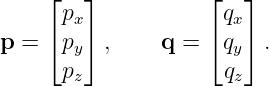
Let

$\displaystyle \mathbf p= \begin{bmatrix}p_x\\ p_y\\ p_z\end{bmatrix}, \qquad \mathbf q= \begin{bmatrix}q_x\\ q_y\\ q_z\end{bmatrix}.$ (19)
Then
$\displaystyle \mathbf p\cdot\mathbf q=p_xq_x+p_yq_y+p_zq_z,$ (20)
and
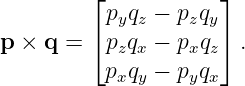
$\displaystyle \mathbf p\times\mathbf q= \begin{bmatrix} p_yq_z-p_zq_y\ p_zq_x-p_xq_z\ p_xq_y-p_yq_x \end{bmatrix}.$ (21)
Therefore equation (2) becomes
$\displaystyle \boxed{ [pq]_{\mathrm{PL}} = \begin{bmatrix} p_wq_w-p_xq_x-p_yq_y... ...\ p_wq_y-p_xq_z+p_yq_w+p_zq_x\ p_wq_z+p_xq_y-p_yq_x+p_zq_w \end{bmatrix}. }$ (22)
The apparently irregular signs in the component formula are therefore not arbitrary: the scalar signs come from the negative dot product and the antisymmetric signs come from the cross product.

Why reversing the product changes only the cross term

Reverse the factors in equation (2):

$\displaystyle qp = \left( q_wp_w-\mathbf q\cdot\mathbf p, \;q_w\mathbf p+p_w\mathbf q+\mathbf q\times\mathbf p \right).$ (23)
The dot product is symmetric,
$\displaystyle \mathbf q\cdot\mathbf p=\mathbf p\cdot\mathbf q,$ (24)
whereas the cross product is antisymmetric,
$\displaystyle \mathbf q\times\mathbf p=-\mathbf p\times\mathbf q.$ (25)
Thus
$\displaystyle \operatorname{Sc}(pq)=\operatorname{Sc}(qp),$ (26)
but generally
$\displaystyle \operatorname{Vec}(pq)\ne\operatorname{Vec}(qp).$ (27)
Subtracting the two products gives the quaternion commutator
$\displaystyle \boxed{ pq-qp=2\,\mathbf p\times\mathbf q, }$ (28)
where the right-hand side is interpreted as a pure quaternion.

An immediate consequence is that two quaternions commute precisely when their vector parts are parallel or one of the vector parts vanishes:

$\displaystyle pq=qp \quad\Longleftrightarrow\quad \mathbf p\times\mathbf q=\mathbf 0.$ (29)
This statement includes ordinary real numbers as the special case of zero vector part.

Dot and cross products can be recovered from quaternion products

For pure quaternions $\mathbf a$ and $\mathbf b$, equation (11) and the reversed product give

$\displaystyle \mathbf a\mathbf b =-\mathbf a\cdot\mathbf b+\mathbf a\times\mathbf b,$ (30)
$\displaystyle \mathbf b\mathbf a =-\mathbf a\cdot\mathbf b-\mathbf a\times\mathbf b.$ (31)
Adding them isolates the dot product:
$\displaystyle \boxed{ \mathbf a\cdot\mathbf b =-\frac12\left(\mathbf a\mathbf b+\mathbf b\mathbf a\right). }$ (32)
Subtracting them isolates the cross product:
$\displaystyle \boxed{ \mathbf a\times\mathbf b =\frac12\left(\mathbf a\mathbf b-\mathbf b\mathbf a\right). }$ (33)
Thus the familiar dot and cross products are respectively the symmetric-scalar and antisymmetric-vector pieces of the Hamilton product of pure quaternions.

Geometric special cases

Let $\theta$ be the angle from $\mathbf a$ to $\mathbf b$. Since

$\displaystyle \mathbf a\cdot\mathbf b =\lVert\mathbf a\rVert\lVert\mathbf b\rVert\cos\theta$ (34)
and
$\displaystyle \mathbf a\times\mathbf b =\lVert\mathbf a\rVert\lVert\mathbf b\rVert \sin\theta\,\hat{\mathbf n},$ (35)
where $\hat{\mathbf n}$ is the right-hand-rule unit normal, equation (11) gives
$\displaystyle \boxed{ \mathbf a\mathbf b =\lVert\mathbf a\rVert\lVert\mathbf b\rVert \left(-\cos\theta+\hat{\mathbf n}\sin\theta\right). }$ (36)
This formula already hints at the trigonometric structure that will later appear in unit-quaternion rotations.

Parallel vectors

If $\mathbf a\parallel\mathbf b$, then

$\displaystyle \mathbf a\times\mathbf b=\mathbf0, $
so the product is purely scalar:
$\displaystyle \mathbf a\mathbf b=-\mathbf a\cdot\mathbf b.$ (37)
For a pure quaternion multiplied by itself,
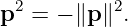
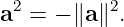
$\displaystyle \boxed{ \mathbf a^2=-\lVert\mathbf a\rVert^2. }$ (38)
In particular, every unit pure quaternion satisfies $\mathbf u^2=-1$.

Perpendicular vectors

If $\mathbf a\perp\mathbf b$, then

$\displaystyle \mathbf a\cdot\mathbf b=0, $
so
$\displaystyle \boxed{ \mathbf a\mathbf b=\mathbf a\times\mathbf b. }$ (39)
Reversing the factors gives
$\displaystyle \mathbf b\mathbf a=-\mathbf a\times\mathbf b=-\mathbf a\mathbf b.$ (40)
The basis relation $\mathbf i\mathbf j=\mathbf k$ is simply the special case of equation (39) for mutually perpendicular unit vectors in a right-handed basis.

Worked example 1: a general quaternion product

Let

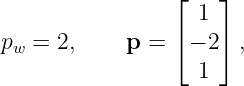
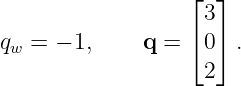
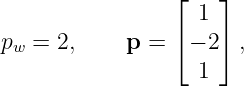
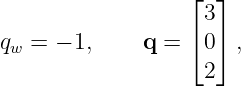
$\displaystyle p=(2,\,[1,-2,3]^T), \qquad q=(-1,\,[4,0,2]^T).$ (41)
First compute the dot product:
$\displaystyle \mathbf p\cdot\mathbf q =1(4)+(-2)(0)+3(2)=10.$ (42)
The scalar part is therefore
$\displaystyle p_wq_w-\mathbf p\cdot\mathbf q =2(-1)-10=-12.$ (43)
Next compute
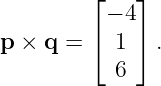
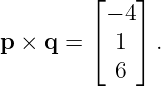
$\displaystyle \mathbf p\times\mathbf q = \begin{bmatrix}1\\ -2\\ 3\end{bmatrix}... ...\begin{bmatrix}4\\ 0\\ 2\end{bmatrix}= \begin{bmatrix}-4\\ 10\\ 8\end{bmatrix}.$ (44)
The vector part is
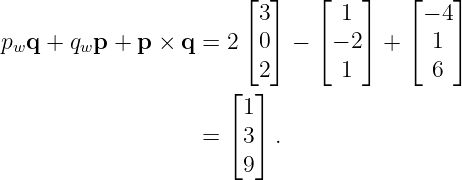
\begin{equation*}\begin{aligned} p_w\mathbf q+q_w\mathbf p+\mathbf p\times\mathb... ...atrix}\ &=\begin{bmatrix}3\\ 12\\ 9\end{bmatrix}. \end{aligned}\end{equation*}
Hence
$\displaystyle \boxed{ pq=(-12,\,[3,12,9]^T). }$ (46)

Reversing the order leaves the scalar part unchanged but changes the cross term:

$\displaystyle \boxed{ qp=(-12,\,[11,-8,-7]^T). }$ (47)
Indeed,
$\displaystyle pq-qp =(0,\,[-8,20,16]^T) =2(0,\,\mathbf p\times\mathbf q).$ (48)

Worked example 2: the basis rules from vector analysis

Take

$\displaystyle \mathbf a=\mathbf i, \qquad \mathbf b=\mathbf j. $
Because the vectors are perpendicular,

$\displaystyle \mathbf i\cdot\mathbf j=0. $
Because the basis is right handed,

$\displaystyle \mathbf i\times\mathbf j=\mathbf k. $
Therefore equation (11) gives
$\displaystyle \boxed{\mathbf i\mathbf j=\mathbf k.}$ (49)
Reversing the order,

$\displaystyle \mathbf j\times\mathbf i=-\mathbf k, $
so
$\displaystyle \boxed{\mathbf j\mathbf i=-\mathbf k.}$ (50)
The noncommutative multiplication table is therefore encoded directly in the orientation of the ordinary cross product.

Worked example 3: a mechanics interpretation

Let a position vector and force be

$\displaystyle \mathbf r= \begin{bmatrix}2\\ 0\\ 0\end{bmatrix}\ \mathrm m, \qquad \mathbf F= \begin{bmatrix}3\\ 4\\ 0\end{bmatrix}\ \mathrm N.$ (51)
Embed both as pure quaternions. Their Hamilton product is
$\displaystyle \mathbf r\mathbf F =-\mathbf r\cdot\mathbf F+\mathbf r\times\mathbf F.$ (52)
The dot product is
$\displaystyle \mathbf r\cdot\mathbf F=6\ \mathrm{N\,m},$ (53)
and the cross product is
$\displaystyle \mathbf r\times\mathbf F = \begin{bmatrix}0\\ 0\\ 8\end{bmatrix}\ \mathrm{N\,m}.$ (54)
Thus
$\displaystyle \boxed{ \mathbf r\mathbf F=-6+8\mathbf k \quad (\mathrm{N\,m}). }$ (55)
The vector part is exactly the torque about the origin,
$\displaystyle \boldsymbol\tau=\mathbf r\times\mathbf F=8\mathbf k\ \mathrm{N\,m}.$ (56)
The scalar part is minus the ordinary dot product. The quaternion product does not imply that these two pieces are the same physical observable; rather, it packages the longitudinal and rotational geometric products of the same pair of vectors into one algebraic object. This is one reason quaternion methods were historically attractive in mathematical physics.

Matrix form for implementation

For software it is often convenient to represent left multiplication by a fixed quaternion as a $4\times4$ real matrix. With scalar-first ordering,

$\displaystyle [pq]_{\mathrm{PL}}=L(p)[q]_{\mathrm{PL}},$ (57)
where
$\displaystyle \boxed{ L(p)= \begin{bmatrix} p_w&-p_x&-p_y&-p_z\ p_x&p_w&-p_z&p_y\ p_y&p_z&p_w&-p_x\ p_z&-p_y&p_x&p_w \end{bmatrix}. }$ (58)
Similarly,
$\displaystyle [pq]_{\mathrm{PL}}=R(q)[p]_{\mathrm{PL}},$ (59)
with
$\displaystyle \boxed{ R(q)= \begin{bmatrix} q_w&-q_x&-q_y&-q_z\ q_x&q_w&q_z&-q_y\ q_y&-q_z&q_w&q_x\ q_z&q_y&-q_x&q_w \end{bmatrix}. }$ (60)
The two matrices are generally different because left and right quaternion multiplication are different operations. Their distinction becomes important later in quaternion kinematics, where angular velocity may multiply the attitude quaternion on different sides depending on the frame and mapping convention.

Common pitfalls

  1. Using $+\mathbf p\cdot\mathbf q$ in the scalar part. Under Hamilton's convention, pure-vector squares are negative, so the scalar term is $-\mathbf p\cdot\mathbf q$.
  2. Changing the cross-product sign because the components are stored scalar last. Storage order does not alter the algebra. Scalar-first and scalar-last Hamilton quaternions both use the $+\mathbf p\times\mathbf q$ term when the same right-handed cross product is used.
  3. Calling $\mathbf i\mathbf j=-\mathbf k$ merely a different array convention. It is a different multiplication convention relative to Hamilton multiplication.
  4. Treating the vector part of a quaternion as though it commuted with another vector part. The noncommutativity is exactly the antisymmetry of the cross product.
  5. Confusing the quaternion product with a 4-D dot product. Quaternion multiplication is bilinear but returns another quaternion and includes the oriented three-dimensional cross product.
  6. Swapping $L(p)$ and $R(p)$ in software. Left multiplication and right multiplication have different sign patterns.
  7. Using “right-handed quaternion” as a sufficient specification. State an equation such as $\mathbf i\mathbf j=\mathbf k$ and identify the physical frame handedness separately.

Exercises

  1. Let

    $\displaystyle p=(1,[2,-1,3]^T), \qquad q=(2,[-1,4,0]^T). $
    Compute $pq$ using equation (2).
  2. For the same $p$ and $q$, compute $qp$ without repeating the entire component expansion. Verify equation (28).
  3. Embed

    $\displaystyle \mathbf a=2\mathbf i-\mathbf j+2\mathbf k, \qquad \mathbf b=\mathbf i+3\mathbf j-2\mathbf k $
    as pure quaternions. Compute $\mathbf a\mathbf b$ and identify its scalar and vector parts.
  4. Prove directly from equation (11) that

    $\displaystyle \mathbf a^2=-\lVert\mathbf a\rVert^2 $
    for every pure quaternion $\mathbf a$.
  5. Suppose $\mathbf a$ and $\mathbf b$ are nonzero pure quaternions. Show that they commute if and only if the corresponding three-dimensional vectors are parallel.
  6. Prove equations (32) and (33) by adding and subtracting $\mathbf a\mathbf b$ and $\mathbf b\mathbf a$.
  7. Let $\mathbf a$ and $\mathbf b$ be perpendicular unit vectors and define $\mathbf c=\mathbf a\mathbf b$. Show that $\mathbf c$ is a pure unit quaternion perpendicular to both $\mathbf a$ and $\mathbf b$, and show that $\mathbf b\mathbf a=-\mathbf c$.
  8. A source uses the same right-handed Cartesian cross product as PhysicsLibrary but defines a product $\star$ such that

    $\displaystyle (p_w,\mathbf p)\star(q_w,\mathbf q) = \left(p_wq_w-\mathbf p\cdot\mathbf q, p_w\mathbf q+q_w\mathbf p-\mathbf p\times\mathbf q\right). $
    Evaluate $\mathbf i\star\mathbf j$. Is this Hamilton multiplication?
  9. Verify equation (58) by multiplying $L(p)[q]_{\mathrm{PL}}$ and comparing all four components with equation (22).
  10. In a mechanics problem,

    $\displaystyle \mathbf r=(1,2,0)\ \mathrm m, \qquad \mathbf F=(4,-1,3)\ \mathrm N. $
    Compute the pure-quaternion product $\mathbf r\mathbf F$. Interpret its vector part physically.

Solutions

1. General product

The dot product is

$\displaystyle \mathbf p\cdot\mathbf q =2(-1)+(-1)(4)+3(0)=-6. $
Hence the scalar part is

$\displaystyle 1(2)-(-6)=8. $
The cross product is

$\displaystyle \begin{bmatrix}2\\ -1\\ 3\end{bmatrix}\times \begin{bmatrix}-1\\ 4\\ 0\end{bmatrix}= \begin{bmatrix}-12\\ -3\\ 7\end{bmatrix}. $
The vector part is

$\displaystyle 1\begin{bmatrix}-1\\ 4\\ 0\end{bmatrix}+2\begin{bmatrix}2\\ -1\\ ... ...n{bmatrix}-12\\ -3\\ 7\end{bmatrix}= \begin{bmatrix}-9\\ -1\\ 13\end{bmatrix}. $
Therefore

$\displaystyle \boxed{pq=(8,[-9,-1,13]^T).} $

2. Reverse order and commutator

The scalar part is again $8$. Reversing the order changes only the cross term, so

$\displaystyle \operatorname{Vec}(qp) = \begin{bmatrix}-1\\ 4\\ 0\end{bmatrix}+2... ...in{bmatrix}-12\\ -3\\ 7\end{bmatrix}= \begin{bmatrix}15\\ 5\\ -1\end{bmatrix}. $
Thus

$\displaystyle \boxed{qp=(8,[15,5,-1]^T).} $
Also

$\displaystyle pq-qp=(0,[-24,-6,14]^T), $
while

$\displaystyle 2\mathbf p\times\mathbf q =2[-12,-3,7]^T=[-24,-6,14]^T, $
which verifies equation (28).

3. Product of two pure quaternions

Compute

$\displaystyle \mathbf a\cdot\mathbf b =2(1)+(-1)(3)+2(-2)=-5, $
so the scalar part is $5$. The cross product is

$\displaystyle \begin{bmatrix}2\\ -1\\ 2\end{bmatrix}\times \begin{bmatrix}1\\ 3\\ -2\end{bmatrix}= \begin{bmatrix}-4\\ 6\\ 7\end{bmatrix}. $
Therefore

$\displaystyle \boxed{ \mathbf a\mathbf b =5-4\mathbf i+6\mathbf j+7\mathbf k. } $
The scalar part is $5=-\mathbf a\cdot\mathbf b$, and the vector part is $\mathbf a\times\mathbf b$.

4. Square of a pure quaternion

Set $\mathbf b=\mathbf a$ in equation (11):

$\displaystyle \mathbf a^2 =-\mathbf a\cdot\mathbf a+\mathbf a\times\mathbf a. $
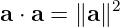
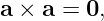
Since $\mathbf a\times\mathbf a=\mathbf0$ and $\mathbf a\cdot\mathbf a=\lVert\mathbf a\rVert^2$,

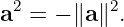
$\displaystyle \boxed{\mathbf a^2=-\lVert\mathbf a\rVert^2.} $

5. When pure quaternions commute

From equation (28), specialized to pure quaternions,

$\displaystyle \mathbf a\mathbf b-\mathbf b\mathbf a =2\mathbf a\times\mathbf b. $
Thus $\mathbf a\mathbf b=\mathbf b\mathbf a$ if and only if $\mathbf a\times\mathbf b=\mathbf0$. For nonzero three-dimensional vectors, this occurs if and only if the vectors are parallel.

6. Recovering the dot and cross products

Using

$\displaystyle \mathbf a\mathbf b=-\mathbf a\cdot\mathbf b+\mathbf a\times\mathbf b, $
and

$\displaystyle \mathbf b\mathbf a=-\mathbf a\cdot\mathbf b-\mathbf a\times\mathbf b, $
addition gives

$\displaystyle \mathbf a\mathbf b+\mathbf b\mathbf a=-2\mathbf a\cdot\mathbf b, $
so

$\displaystyle \boxed{ \mathbf a\cdot\mathbf b =-\frac12(\mathbf a\mathbf b+\mathbf b\mathbf a). } $
Subtraction gives

$\displaystyle \mathbf a\mathbf b-\mathbf b\mathbf a=2\mathbf a\times\mathbf b, $
so

$\displaystyle \boxed{ \mathbf a\times\mathbf b =\frac12(\mathbf a\mathbf b-\mathbf b\mathbf a). } $

7. Orthogonal unit pure quaternions

Because $\mathbf a\perp\mathbf b$,

$\displaystyle \mathbf a\cdot\mathbf b=0, $
and therefore

$\displaystyle \mathbf c=\mathbf a\mathbf b=\mathbf a\times\mathbf b. $
The cross product of perpendicular unit vectors is a unit vector perpendicular to both. Hence $\mathbf c$ is a pure unit quaternion perpendicular to $\mathbf a$ and $\mathbf b$. Reversing the order gives

$\displaystyle \mathbf b\mathbf a =\mathbf b\times\mathbf a =-\mathbf a\times\mathbf b =-\mathbf c. $

8. Identifying flipped multiplication

For pure basis vectors,

$\displaystyle \mathbf i\star\mathbf j =-(\mathbf i\times\mathbf j) =-\mathbf k. $
Thus

$\displaystyle \boxed{\mathbf i\star\mathbf j=-\mathbf k.} $
It is not Hamilton multiplication. It is the opposite/flipped product relative to the PhysicsLibrary convention.

9. Left-multiplication matrix

Multiplying equation (58) by

$\displaystyle [q]_{\mathrm{PL}}= \begin{bmatrix}q_w&q_x&q_y&q_z\end{bmatrix}^{T} $
gives

$\displaystyle \begin{bmatrix} p_wq_w-p_xq_x-p_yq_y-p_zq_z\ p_xq_w+p_wq_x-p_zq... ...z\ p_yq_w+p_zq_x+p_wq_y-p_xq_z\ p_zq_w-p_yq_x+p_xq_y+p_wq_z \end{bmatrix}, $
which is exactly equation (22), with terms merely reordered within ordinary real scalar sums.

10. Position–force product

The dot product is

$\displaystyle \mathbf r\cdot\mathbf F =1(4)+2(-1)+0(3)=2\ \mathrm{N\,m}. $
The cross product is

$\displaystyle \mathbf r\times\mathbf F = \begin{bmatrix}1\\ 2\\ 0\end{bmatrix}\... ...\ -1\\ 3\end{bmatrix}= \begin{bmatrix}6\\ -3\\ -9\end{bmatrix}\ \mathrm{N\,m}. $
Therefore

$\displaystyle \boxed{ \mathbf r\mathbf F =-2+6\mathbf i-3\mathbf j-9\mathbf k \quad (\mathrm{N\,m}). } $
Its vector part is the torque about the origin:

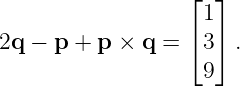
$\displaystyle \boxed{ \boldsymbol\tau =6\mathbf i-3\mathbf j-9\mathbf k\ \mathrm{N\,m}. } $

What comes next

The scalar–vector product makes the next algebraic operations nearly automatic. The following PhysicsLibrary entry develops quaternion conjugation, norm, and inverse. In particular, the conjugate reverses the vector part,

$\displaystyle q^*=q_w-\mathbf q, $
and equation (2) will show directly that

$\displaystyle qq^*=q^*q=q_w^2+\lVert\mathbf q\rVert^2. $
That result leads to the multiplicative inverse and then to unit quaternions, which are the objects used to represent three-dimensional rotations.

Sources and historical notes

Joly's A Manual of Quaternions develops a quaternion explicitly as the sum of a scalar and a vector and treats the product of two vectors through its scalar and vector parts. In Joly's historical notation, the vector part of the product corresponds to the oriented vector product while the scalar part carries the sign convention inherited from Hamilton multiplication.

Macfarlane's Vector Analysis and Quaternions is a useful historical bridge to modern engineering notation because it treats vector analysis and quaternions as complementary descriptions and organizes separate articles on products of vectors and composition of rotations. Hathaway's A Primer of Quaternions supplies elementary examples involving scalar and vector parts, conjugation, reversed products, and the fundamental Hamilton basis relations.

The derivations, worked examples, implementation matrices, exercises, and solutions in this PhysicsLibrary entry are newly written in modern notation.

Bibliography

1
C. J. Joly, A Manual of Quaternions, Macmillan and Co., London, 1905. Public-domain historical source. Internet Archive search
2
A. Macfarlane, Vector Analysis and Quaternions, John Wiley & Sons, New York, 1906. Public-domain historical source; Project Gutenberg TeX edition available. Project Gutenberg edition
3
A. S. Hathaway, A Primer of Quaternions, 1896. Public-domain text; Project Gutenberg edition and LATEX source available. Project Gutenberg edition
4
P. Kelland and P. G. Tait, Introduction to Quaternions, with Numerous Examples, 2nd ed., Macmillan and Co., London, 1882. Public-domain historical source. HathiTrust copy
5
Wikibooks contributors, “Abstract Algebra/Quaternions.” Openly licensed instructional source; consult the current page history and license notice for attribution requirements. Wikibooks quaternion article

License

Unless otherwise noted, this PhysicsLibrary entry is intended for release under the Creative Commons Attribution–ShareAlike 4.0 International license.



"quaternion product" is owned by bloftin.
(view preamble)
View style:
See Also: quaternion definition and basic algebra, Notation Quaternions for Physics and Engineering: Orientation, quaternion conjugate, quaternion norm, quaternion inverse

Other names:  quaternion multiplication
Keywords:  quaternion, Hamilton product, scalar vector form, dot product, cross product, pure quaternion, commutator, noncommutative algebra, quaternion multiplication, vector analysis

Cross-references: composition, vector product, norm, conjugation, 4-D, squares, velocity, kinematics, operations, matrix, mathematical physics, algebraic, observable, force, position vector, noncommutative, unit vectors, relation, commutator, commute, dot product, identity, mechanics, cross products, vector, scalar, quaternion, formula
There are 5 references to this object.

This is version 2 of quaternion product, born on 2026-08-23, modified 2026-08-23.
Object id is 1090, canonical name is QuaternionProduct.
Accessed 14 times total.

Classification:
Physics Classification02.10.Hh (Rings and algebras)
 02.10.Ud (Linear algebra)
 02.10.Xm (Multilinear algebra)
Pending Errata and Addenda
None.
Discussion
Style: Expand: Order:

No messages.

Interact
rate | post | correct | update request | add derivation | add example | add (any)