|
|
|
|||||||
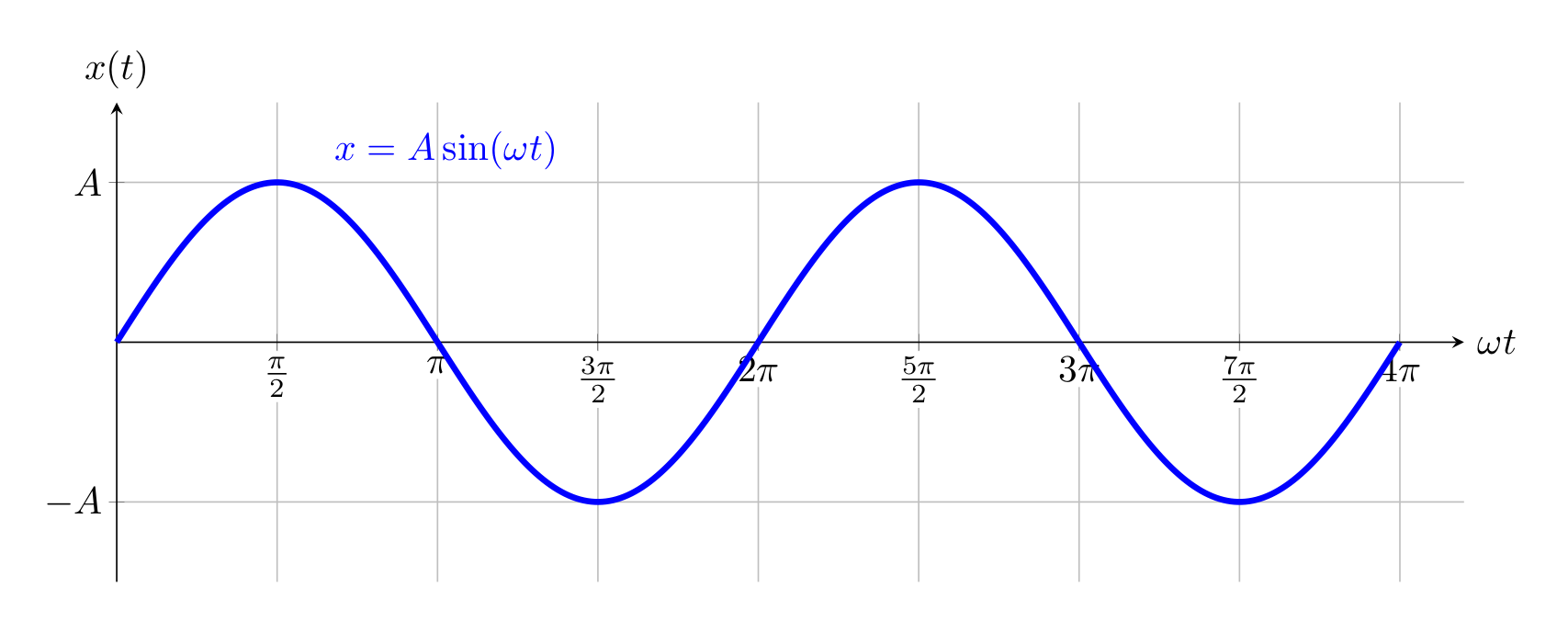
The sine function as a function of ωt is shown in figure 1.
Figure1. Sine function. One can see that the sine function repeats every 2π. Periodicicty was defined in oscillations as a function that is equal to itself at t + T,
Therefore, the arguments to the sine function must be equal to itself again at 2π (plug in t + T in for t).
expand paranthesis and subtract each side by ϕ
 ωt cancels to leave
 Finally, rearrange to get the eqaution for period
References
"Period Derivation for the Simple Harmonic Oscillator" is owned by bloftin.
This object's parent. Cross-references: period, oscillations, function, simple harmonic oscillator This is version 2 of Period Derivation for the Simple Harmonic Oscillator, born on 2026-10-10, modified 2026-10-10. Object id is 1466, canonical name is PeriodDerivationForTheSimpleHarmonicOscillator. Accessed 9 times total. Classification:
|
|
|
|
Pending Errata and AddendaNone.
|
DiscussionNo messages.
|
Interact |
![[parent]](https://images.physicslibrary.org/images/uparrow.png)