Suppose an object of mass m is free to move in some domain, D (it is assumed that D ⊆ ℝ3), and
let r1 and r2 denote the position vectors of points in D. The work required to move the object from
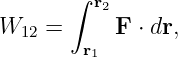
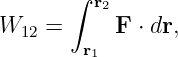
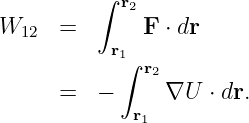
r1 to r2 is given by
where F is the total force acting on the object, as a function of position in D. If F is a conservative
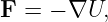
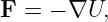
force, then it can be expressed in terms of a potential function; in particular, if U is taken to
denote the potential energy, then
where ∇ denotes the gradient operator. Under such conditions, the work required to move the
object of mass m from position r1 to r2 in D is path independent. This means that if the object
were to move along a straight line connecting r1 and r2, the amount of work done would be in
exact equality with any other path.
0.1 Proof of Path Independence
Given the expression for work,
and the relation between the conservative force, F and the potential energy, U,
it follows that, upon substitution of the later into the former,
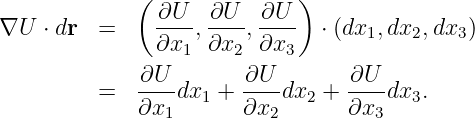
Focus on the integrand, ∇U ⋅ dr, and write it in terms of its components as,
Now, recall that for some arbitrary function, f = f(x,y,z), the differential of that function
is
Based on this, it immediately follows that
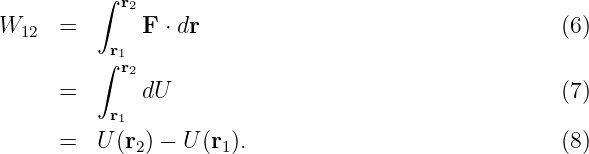
Substituting this result back into the work equation,
Therefore, from the final equation, it is clearly seen that the work to move the object from position
r1 to r2 is only dependent upon the potential energy at those positions, and not the path taken.
Note that in the above, the minus sign in front of the integral has been dropped; this was done to
show, in the final result, the amount of work done by the system. That is, if the potential energy at
the final position is greater than that at the initial, then W12 is positive, and has done
work.