The term differential equation was first used by Leibniz in 1676 to denote a relationship between
the differentials dx and dy of two variables x and y. Such a relationship, in general, explicitly
involves the variables x and y together with other symbols a,b,c,... which represent
constants.
This restricted use of the term was soon abandoned; differential equations are now understood to
include any algebraical or transcendental equalities which involve either differentials or differential
coefficients. It is to be under- stood, however, that the differential equation is not an
identity.
Differential equations are classified, in the first place, according to the number of variables which
they involve. An ordinary differential equation expresses a relation between an independent
variable, a dependent variable and one or more differential coefficients of the dependent with
respect to the independent variable. A partial differential equation involves one dependent and two
or more independent variables, together with partial differential coefficients of the dependent
with respect to the independent variables. A total differential equation contains two or
more dependent variables together with their differentials or differential coefficients with
respect to a single independent variable which may, or may not, enter explicitly into the
equation.
The order of a differential equation is the order of the highest differential coefficient which is
involved. When an equation is polynomial in all the differential coefficients involved, the Power to
which the highest differential coefficient is raised is known as the degree of the equation. When, in
an ordinary or partial differential equation, the dependent variable and its derivatives occur lo the
first degree only, and not as higher powers or products, the equation is said to be linear. The
coefficients of a linear equation are therefore either constants or functions of the independent
variable or variables.
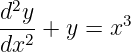
Thus, for example,
is an ordinary linear equation of the second order;
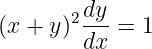
is an ordinary non-linear equation of the first order and the first degree;
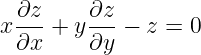
is a linear partial differential equation of the first order in two independent variables;
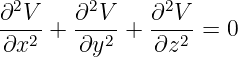
is a linear partial differential equation of the second order in three independent variables;
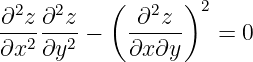
is a non-linear partial differential equation of the second order and the second degree in two
independent variables;
where u,v, and w are functions of x,y and z, is a total differential equation of the first order and
the first degree, and
is a total differential equation of the first order and the second degree.
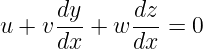
In the case of a total differential equation any one of the variables may be regarded as
independent and the remainder as dependent, thus, taking x as independent variable, the
equation
may be written
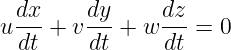
or an auxiliary variable t may be introduced and the original variables regarded as functions of t,
thus
0.1 References
[1] Ince, E.L. ”Ordinary Differential Equations.” London and New York, Longmans, Green,
1920.
This entry is a derivative of the Public domain work [1].