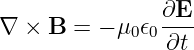
Maxwell’s Equations are a set of four partial differential equations first combined by James Clerk
Maxwell. Together, they completely describe classical electromagnetic phenomena, just as
Newton’s laws completely describe classical mechanical phenomena. All four are named after
persons other than Maxwell, but Maxwell was the first to add the displacement current term to
Ampère’s Law, which led to the association of electromagnetic waves with light and paved the
way for the discovery of special relativity. All four equations can be written in both integral and
differential forms, with both forms convenient for specific problems. Note that strictly
speaking these are Maxwell’s Equation in vacuo, with different forms for interaction with
matter.
0.1 Notation
Throughout this article SI units are adopted for clarity, but the interesting mathematical aspects
of the equations are independent of the constants μ0 and 𝜖0, and indeed of the physical meaning of
the equations.
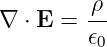
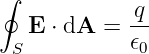
0.2 Gauss’ Law of Electrostatics
Differential form
Integral form
where q is the charge enclosed in the volume bounded by the surface S.
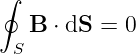
0.3 Gauss’ Law of Magnetostatics
This law can be interpreted as a statement of the non-existence of magnetic monopoles, a fact
confirmed by all experiments to date.
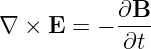
0.4 Faraday’s Law
Differential form
0.5 Ampère’s Law
Differential form
Integral form
0.6 Properties of Maxwell’s Equations
These four equations together have several interesting properties:
- Lorentz invariance
- Gauge invariance
- Invariance under the transformation B →
 , E → Bc