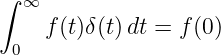
A Dirac δ symbol can be interpreted as a linear functional, that is, a linear mapping from a
suitable function space to ℝ (or ℂ), having the property
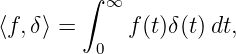
One may write this formally as the pairing
when the standard relation
is being used.
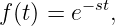
Applying this to
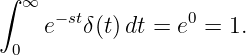
one obtains
Hence, in the convention used here, the Laplace transform is
By the delay theorem, this generalizes to
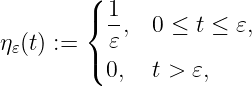
When introducing the approximation
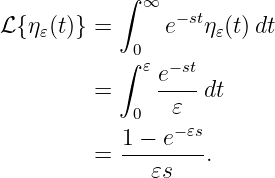
we obtain
Using the Taylor expansion of e−𝜀s,
we find
0.1 Laplace transform of Dirac delta
The Dirac delta, δ, is rigorously defined as a linear functional on a suitable space of test functions.
Its defining action is
Equivalently, one may write
using the half-line convention adopted in this article.
Therefore,
and, for a > 0,
References
[1] L. Schwartz, Théorie des distributions, vols. 1–2, Hermann, Paris, 1950–1951.
[2] W. Rudin, Functional Analysis, McGraw–Hill Book Company, 1973.
[3] L. Hörmander, The Analysis of Linear Partial Differential Operators I: Distribution
Theory and Fourier Analysis, 2nd ed., Springer–Verlag, 1990.

![δ[f] = f(0).](https://images.physicslibrary.org/cache/objects/846/make4ht/LaplaceTransformOfDiracsDelta0x.png)




![δ[f] = f(0).](https://images.physicslibrary.org/cache/objects/846/make4ht/LaplaceTransformOfDiracsDelta11x.png)


