Physics Library
 An open source physics library
Encyclopedia | Forums | Docs | Random |  
Login
create new user
Username:
Password:
forget your password?
Main Menu
Sections

Meta

Talkback

Downloads

Information
[parent] Hermite polynomials (Definition)

The polynomial solutions of the Hermite differential equation, with n a non-negative integer, are usually normed so that the highest degree term is (2z)n and called the Hermite polynomials H n(z). The Hermite polynomials may be defined explicitly by

Hn(z) := (1)nez2 -dn-
dznez2 , (1)

since this is a polynomial having the highest degree term (2z)n and satisfying the Hermite equation. The first six Hermite polynomials are

H0(z) 1,
H1(z) 2z,
H2(z) 4z2 2,
H3(z) 8z3 12z,
H4(z) 16z4 48z2 + 12,
H5(z) 32z5 160z3 + 120z,

and the general polynomial form is

Hn(z) (2z)n n(n−1)
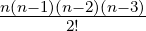
  1!(2z)n2 + n(n−1)(n−2)(n−-3)
      2!(2z)n4 +⋅⋅⋅.

Differentiating this termwise gives Hn(z) = 2n[    n− 1   (n−1)(n−2)   n− 3   (n−1)(n−2)(n−3)(n−4)-   n−5        ]
 (2z )   −     1!   (2z )   +          2!        (2z)    − + ⋅⋅⋅, i.e.

Hn(z) = 2nHn1(z). (2)

We shall now show that the Hermite polynomials form an orthogonal set on the interval (−∞, ) with the weight factor ex2. Let m < n; using (1) and integrating by parts we get

      ∫ ∞                        ∫ ∞         n −x2
    n                   −x2                 d-e----
(− 1)   −∞ Hm  (x)Hn (x)e   dx =   −∞ Hm  (x ) dxn   dx =

                         ∫
     ∞        dn−1e− x2     ∞   ′    dn−1e−x2
=   /  Hm  (x)----n−1--−      H m(x )----n−-1--dx.
   −∞          dx          −∞         dx

The substitution portion here equals to zero because ex2 and its derivatives vanish at ±∞. Using then (2) we obtain

∫ ∞                 2                 ∫ ∞          dn− 1e−x2
    Hm  (x)Hn (x)e−x dx =  2(− 1)1+nm       Hm −1(x)----n−1--dx.
 −∞                                    − ∞           dx

Repeating the integration by parts gives the result

∫ ∞                                      ∫ ∞        n− m −x2
    Hm  (x)Hn (x )e−x2 dx = 2m(− 1)m+nm!      H0 (x)d----e----dx =
 −∞                                       −∞         dxn−m

                               2
    m     m+n      ∞ dn−-m−1e−x--
= 2  (− 1)   m!  −/∞    dxn−m −1  = 0,

whereas in the case m = n the result

∫                                 ∫
  ∞         2 −x2       n    2n     ∞  −x2       n  √ --
    (Hn (x)) e   dx = 2  (− 1) n!     e    dx = 2 n!  π
 −∞                                −∞

(see the area under Gaussian curve). The results mean that the functions x↦→√-Hn(x)-
  2nn!√ πex22- form an orthonormal set on (−∞, ).

The Hermite polynomials are used in the quantum mechanical treatment of a harmonic oscillator, the wave functions of which have the form

                       − ξ2-
ξ ↦→  Ψn (ξ) = CnHn (ξ)e  2 .

"Hermite polynomials" is owned by pahio.
(view preamble)
View style:

This object's parent.

Cross-references: wave, functions, Hermite equation, differential equation
There are 3 references to this object.

This is version 1 of Hermite polynomials, born on 2009-04-19.
Object id is 684, canonical name is HermitePolynomials.
Accessed 1805 times total.

Classification:
Physics Classification02.30.Hq (Ordinary differential equations)
Pending Errata and Addenda
None.
Discussion
Style: Expand: Order:

No messages.

Interact
rate | post | correct | update request | add derivation | add example | add (any)