|
|
|
|||||||
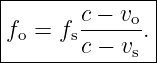
With this convention:
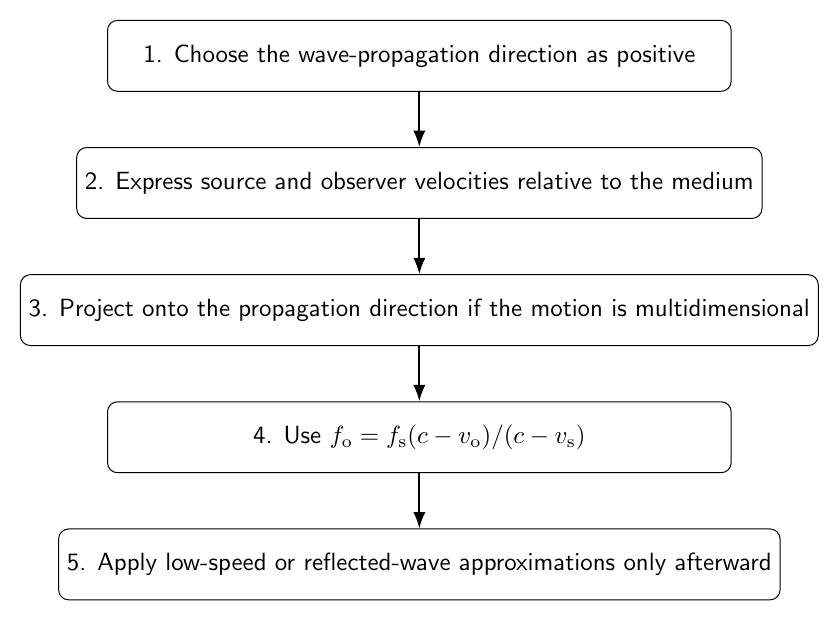
Figure 1. A compact Doppler strategy: fix the propagation direction and signs first, distinguish source motion from observer motion, project multidimensional velocities radially, and only then substitute into the Doppler relation.
1 High-value GRE facts
Part I: Original GRE-style problems
Problem 1: moving observerA stationary source emits
sound in air with
An observer moves toward the source at
The observed frequency is closest to
Problem 2: moving sourceA source emitting
moves toward a stationary observer at
Take
The observed frequency is closest to
Problem 3: source behindFor the source in Problem 2, a stationary observer behind the receding source hears a frequency closest to
Problem 4: both movingA
source moves toward an observer at
while the observer moves toward the source at
For
the observed frequency is closest to
Problem 5: low-speed shiftA source and observer approach one another with closing speed
For
the low-speed frequency shift is approximately
Problem 6: radial motionA source moves perpendicular to the line of sight at one instant. To first order in speed over
the instantaneous classical Doppler shift from that velocity component is
Problem 7: wave speedA sound source moves through still air. The speed of the emitted wavefronts relative to the air is
Problem 8: moving observer wavelengthA stationary source emits sound in still air. An observer begins moving toward the source. The wavelength in the air
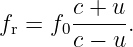
Problem 9: reflected DopplerFor a stationary transmitter and receiver with a target approaching at speed
the exact classical reflected frequency is
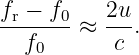
Problem 10: double-shift approximationFor
the fractional reflected Doppler shift for an approaching target is approximately
Problem 11: moving mediumFor acoustic Doppler calculations in moving air, source and observer velocities should be measured relative to
Problem 12: sonic limitAs a source moving toward a stationary observer approaches
from below, the simple subsonic forward-wave formula predicts an unbounded frequency. Physically this indicates
Part II: Complete worked solutions
Solution 1Moving toward the source means
Thus
Answer: (C).
Solution 2
Answer: (D).
Solution 3Behind the source,
Answer: (B).
Solution 4Use
Then
Answer: (D).
Solution 5At low speed,
Answer: (C).
Solution 6Only the radial component contributes to the first-order shift. A perpendicular instantaneous velocity has zero radial component. Answer: (C).
Solution 7In the ideal acoustic model, sound propagates through the air at speed
relative to the air. Answer: (B).
Solution 8Observer motion changes encounter rate but does not alter the wavefront spacing already established in the air. Answer: (C).
Solution 9The target experiences one Doppler shift while receiving and a second while returning the wave:
Answer: (B).
Solution 10For
Answer: (C).
Solution 11The medium defines the acoustic propagation frame. Velocities in the acoustic Doppler formula must therefore be relative to the air. Answer: (D).
Solution 12As
forward wavefront spacing collapses. The divergence marks failure of the separated subsonic-wavefront construction. Answer: (C).
2 GRE checklist
References
References
[1] PhysicsLibrary, M06-13, Beats, Interference, and Coherence. [2] PhysicsLibrary, M06-11, Acoustic Waves, Sound Intensity, and Acoustic Impedance. [3] A. P. French, Vibrations and Waves, W. W. Norton, 1971. [4] L. E. Kinsler, A. R. Frey, A. B. Coppens, and J. V. Sanders, Fundamentals of Acoustics, 4th ed., Wiley, 2000. "GRE Physics Companion: Doppler Effect and Moving Sources and Observers" is owned by bloftin.
This object's parent. Cross-references: dimension, divergence, mass, observed frequency, formula, double Doppler shift, radial velocity, frequency, wavefront, speed, relation, velocities This is version 1 of GRE Physics Companion: Doppler Effect and Moving Sources and Observers, born on 2026-10-24. Object id is 1530, canonical name is GREPhysicsCompanionDopplerEffectAndMovingSourcesAndObservers. Accessed 13 times total. Classification:
|
|
|
|
Pending Errata and AddendaNone.
|
DiscussionNo messages.
|
Interact |