The derivative of a real function, which has on a whole interval a constant value c, vanishes at
every point of this interval:
The converse theorem is also true. Ernst Lindelöf calls it the fundamental theorem
of integral calculus (in Finnish integraalilaskun peruslause). It can be formulated as
follows.
Theorem. If a real function is continuous and its derivative vanishes at all points of an interval,
the value of this function does not change on this interval.
Proof. Suppose, to the contrary, that there are two distinct points x1 and x2 in the interval such
that
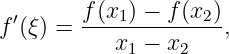
Then the mean-value theorem guarantees a point ξ between x1 and x2 such that
whose value is nonzero. This is impossible by the assumption of the theorem. Therefore the
supposition is false and the theorem is proved.
The theorem may also be expressed by saying that if two functions have the same derivative on a
whole interval, then their difference is constant on that interval. Accordingly, if F is an
antiderivative of a function f, then every other antiderivative of f has the form
where C is a constant.