1 Problem
Place  at
 and a second charge at
 , with
 . Find all
finite points where the field vanishes when the second charge is
 , then when it is
 .
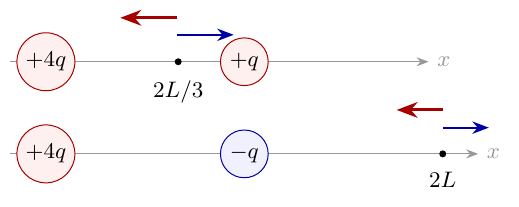
Figure 1. Field directions in the two intervals containing zeros. The filled dots mark the
cancellation points.
Try first.
Divide the line into three intervals and predict the sign of each contribution. Why must a zero of
these two source fields lie on the line through the charges?
2 Worked solution
A zero requires the two field vectors to be collinear and opposite. Away from the  axis the
vectors from the two distinct sources to the field point are not collinear, so examine the three
intervals on the axis.
For  at
 , both contributions point the same way outside the interval. Inside,
 points
right and
 points left. Equating their magnitudes gives
The positive square roots used here follow from  .
With  at
 , both fields point right between the sources. To the left,
 is both stronger
and closer, so its leftward field wins. To the right the fields oppose, and
Both source points are excluded from the field domain.
Check.
Substituting  gives
 and
 along
 . A field zero requires both
direction and magnitude to match the cancellation condition.
3 Practice variation
Replace  by
 in the like-sign case.
Solution.
The positive root gives  , so the zero moves to
 , closer to the weaker
source.
References
- P. Dourmashkin et al., Electricity and Magnetism, MIT TEAL, chapters 1–2.
- D. J. Griffiths, Introduction to Electrodynamics, 4th ed., chapter 2.



