|
|
|
|||||||
The matching quaternion is
where
1 Formula summaryDefine the half angle abbreviations


 Then
The passive 3-2-1 DCM is
On the principal nonsingular branch,
2 Exercises
3 Solutions
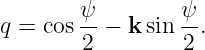
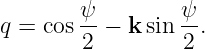
Solution 1: pure yawA positive frame yaw is a positive frame rotation about the 3 axis. Under the PhysicsLibrary passive axis rule,
 Set
 Therefore
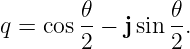
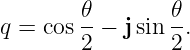
Solution 2: pure pitchPitch is the positive frame rotation about the 2 axis, so
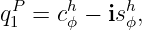
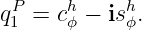
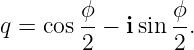
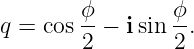
Solution 3: pure rollRoll is the positive frame rotation about the 1 axis, so
Solution 4: derive the passive
|
 | (17) |
 | (18) |
 | (19) |
 | (20) |
These are exactly the passive formulas summarized at the beginning of the article.
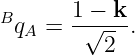
 yaw
yawWith

only the yaw quaternion remains:

Therefore
 | (21) |
 roll
rollOnly the roll quaternion remains:

Thus
 | (22) |
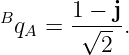
 pitch
pitchOnly the pitch quaternion remains:

Therefore
 | (23) |
 -
- -
- DCM
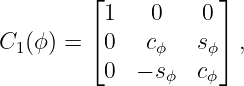
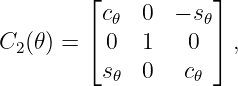
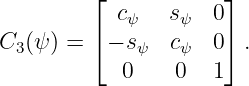
DCMThe elementary passive matrices are
and
Multiply

The result is
 | (24) |
From Exercise 5,
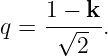
The quaternion to DCM relation from Q09 gives
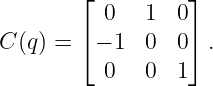 | (25) |
Now set

in the matrix from Exercise 8.
Then


This gives
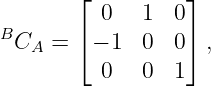 | (26) |
which agrees exactly with C(q).
 yaw
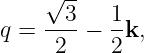
yawThe quaternion is
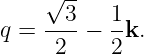
Thus

The roll formula gives

The pitch formula gives

For yaw,
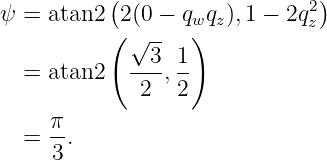
Therefore
 | (27) |
The orientation is a positive passive frame yaw of 60∘.
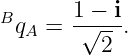
 roll
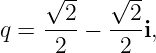
rollThe quaternion is
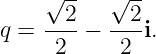
Thus

The roll angle is
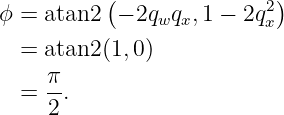
The pitch and yaw expressions both give zero:

Therefore
 | (28) |
For the passive 3-2-1 matrix,

At

we have

The matrix terms used to recover yaw and roll lose independent information. The first and third rotation axes become aligned in the Euler construction.
At

the orientation depends on the combination

At

it depends on

Thus yaw and roll cannot be recovered independently. The physical attitude remains valid; only the Euler coordinate description becomes singular.
The Euler extraction formulas assign specific meanings to

If software stores
![T
[qx,qy,qz,qw ]](https://images.physicslibrary.org/cache/objects/1104/make4ht/ExampleOfQuaternionsAndEulerAngles105x.png)
and those four numerical values are interpreted directly as
![T
[qw,qx,qy,qz] ,](https://images.physicslibrary.org/cache/objects/1104/make4ht/ExampleOfQuaternionsAndEulerAngles106x.png)
every semantic component is assigned to the wrong symbol.
The array must first be remapped:
![[qx,qy,qz,qw]T − → [qw, qx,qy,qz]T.](https://images.physicslibrary.org/cache/objects/1104/make4ht/ExampleOfQuaternionsAndEulerAngles107x.png)
Changing memory layout does not change Hamilton multiplication, frame direction, or active versus passive interpretation.
Euler Angles are not a globally unique orientation parameterization.
The simplest source of nonuniqueness is angular periodicity. For example,

and

represent the same orientation.
Inverse trigonometric branch choices also produce equivalent descriptions.
At the gimbal lock singularity, the nonuniqueness becomes stronger because yaw and roll cannot be determined independently.
Therefore equality of two orientations should not be tested merely by checking whether their Euler triples are numerically identical.
Quaternions are useful internal attitude states because they:
Euler angles remain useful because yaw, pitch, and roll are intuitive for operators, plots, displays, and many engineering requirements.
A common architecture is therefore

The internal state remains numerically robust while the external presentation remains physically intuitive.
 -
- -
- checks
| Case | PhysicsLibrary passive result |
Pure positive yaw  | q = cos(ψ∕2) − k sin(ψ∕2) |
Pure positive pitch  | q = cos(𝜃∕2) − j sin(𝜃∕2) |
Pure positive roll  | q = cos(ϕ∕2) − i sin(ϕ∕2) |
Intrinsic  - - - - | q = q1P (ϕ)q 2P (𝜃)q 3P (ψ) |
| Matching DCM | C = C1(ϕ)C2(𝜃)C3(ψ) |
Positive  yaw yaw | q = (1 − k)∕ |
| Gimbal lock | 𝜃 = ±π∕2 |
The exercises and solutions in this companion are rewritten for PhysicsLibrary under the passive intrinsic 3-2-1 convention.
Henderson provides an important aerospace reference for Euler angle, quaternion, and transformation matrix relationships. Moore provides an openly licensed modern treatment of reference frame orientation. Sommer and coauthors provide a modern analysis of quaternion convention choices.
[1] D. M. Henderson, Euler Angles, Quaternions, and Transformation Matrices: Working Relationships, JSC-12960, NASA Johnson Space Center, Mission Planning and Analysis Division, 1977. Engineering reference. NASA Technical Reports Server search
[2] J. K. Moore, Learn Multibody Dynamics, chapter “Orientation of Reference Frames.” Distributed under CC BY 4.0. Learn Multibody Dynamics
[3] H. Sommer, I. Gilitschenski, M. Bloesch, S. Weiss, R. Siegwart, and J. Nieto, “Why and How to Avoid the Flipped Quaternion Multiplication,” Aerospace, vol. 5, no. 3, article 72, 2018. Published under CC BY 4.0. Publisher article
[4] W. R. Hamilton, Elements of Quaternions, 2nd ed., edited by C. J. Joly, Longmans, Green, and Co., 1899. Public domain historical source. Internet Archive scan
Unless otherwise noted, this PhysicsLibrary entry is intended for release under the Creative Commons Attribution ShareAlike 4.0 International license.
| Keywords: | quaternion, Euler angles, yaw pitch roll, 321 sequence, gimbal lock, Tait-Bryan angles, exercises, worked solutions |
| Physics Classification: | 02.40.Yy (Geometric mechanics ) |
| 02.10.Hh (Rings and algebras) | |
| 45.40.-f (Dynamics and kinematics of rigid bodies) |
None.
No messages.
![[parent]](https://images.physicslibrary.org/images/uparrow.png)




























![T
[qx,qy,qz,qw ]](https://images.physicslibrary.org/cache/objects/1104/make4ht/ExampleOfQuaternionsAndEulerAngles38x.png)
![[qw,qx,qy,qz]T.](https://images.physicslibrary.org/cache/objects/1104/make4ht/ExampleOfQuaternionsAndEulerAngles39x.png)

 -
- -
- quaternion