Physics Library
 An open source physics library
Encyclopedia | Forums | Docs | Random |  
Login
create new user
Username:
Password:
forget your password?
Main Menu
Sections

Meta

Talkback

Downloads

Information
[parent] Electric Field of a Charged Disk (Example)

1 Electric Field of a Charged Disk

The Electric Field of a charged disk can teach us important concepts that you will see over and over in physics: superposition, cylindrical coordinates and non-constant basis vectors. To get a glimpse of the power of superposition, we will solve this problem the hard way first and then see how superposition can be a powerfull tool.

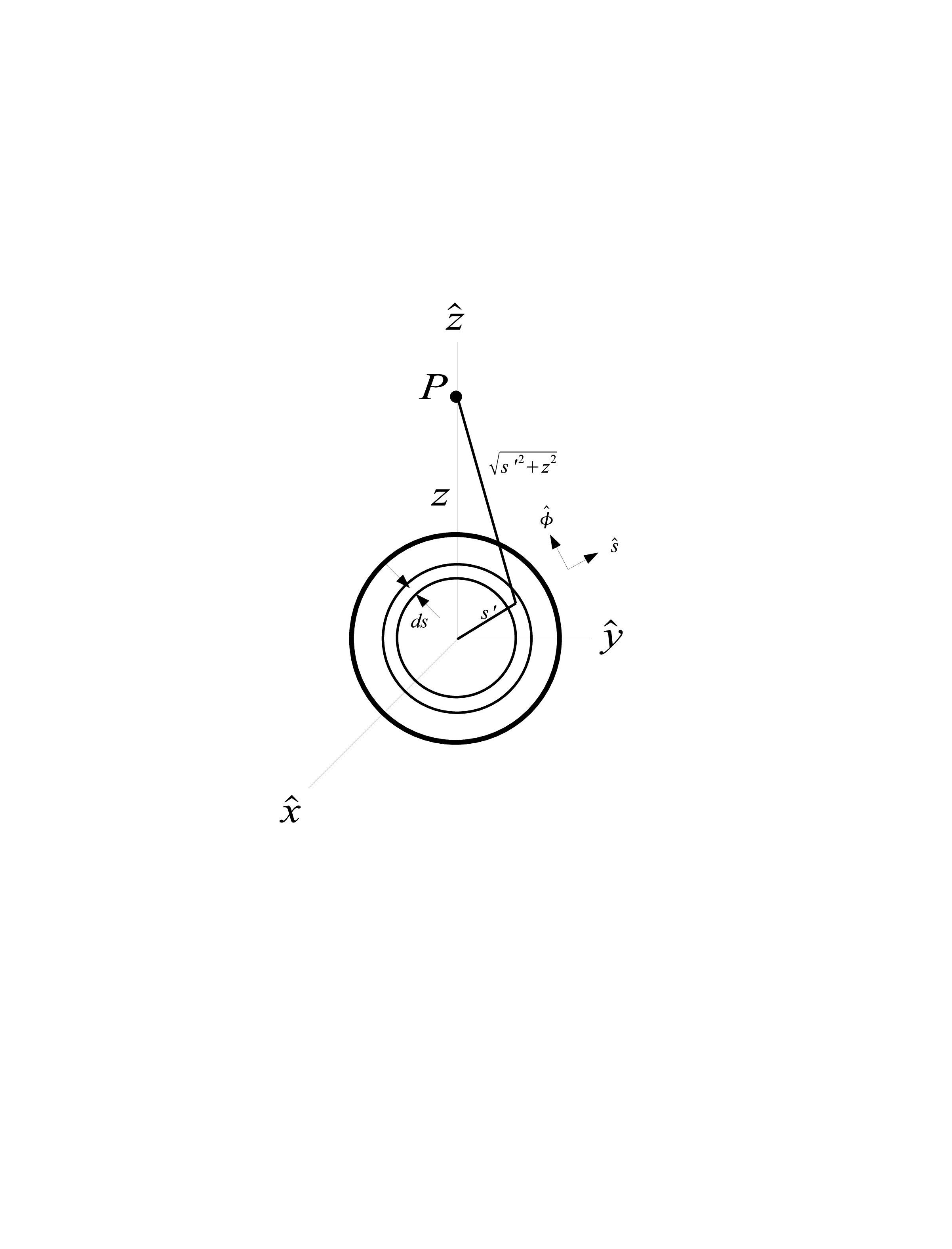
Let us calculate the Electric Field at a point P above the center of a charged disk with radius of R and a uniform surface charge density of σ as shown in below figure.

PIC

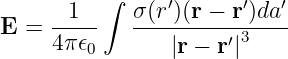
Starting with the general formula for a surface charge

          ∫
      1     σ (r′)(r − r′)da ′
E =  4π𝜖--  ----------′3---
        0       |r − r|
(1)

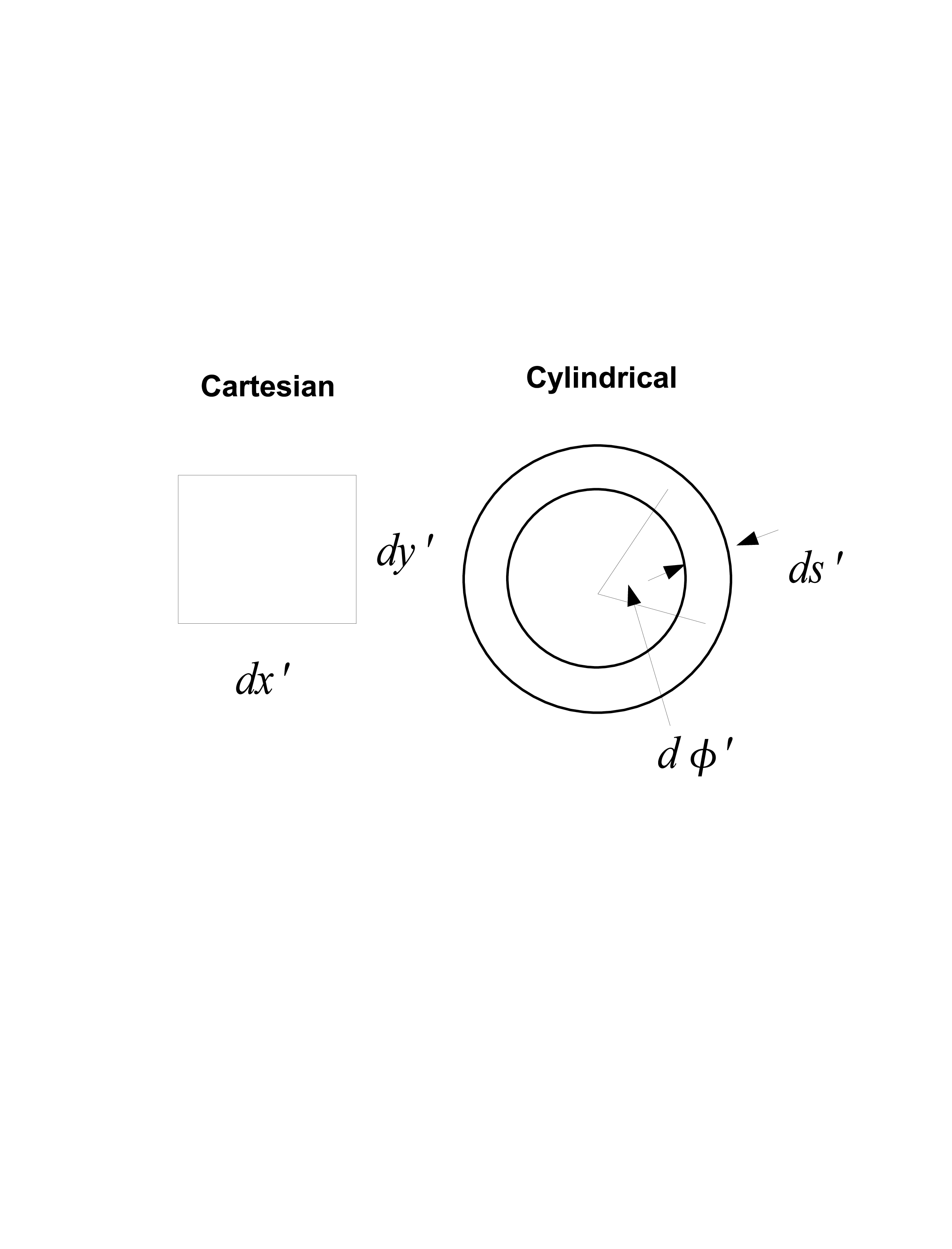
choose a coordinate system. A disk clearly lends itself to cylindrical coordinates. As a refresher, the next figure shows the infinitesimal displacement, where we have the infinitesmal area da

cartesian coordinates:

da′ = dx′dy′

cylindrical coordinates:

da′ = s′ds ′dϕ ′

PIC

The vectors to the source and field points that are needed for the integration in cylindrical coordinates

r = z ˆz

 ′   ′ˆ′
r = s ϕ

therefore

r − r′ = zˆz − s′ϕˆ′

          √ --------
|r − r′| =   s′2 + z2

substituting these relationships into (1) gives us

      σ  ∫  2π∫ R   s′ds′dϕ′  (         )
E =  -----        ---------3∕2  zˆz − s′ϕˆ′
     4π𝜖0  0   0  (s′2 + z2)
(2)

As usual break up the integration into the z and ϕ components

z component:

       σ   ∫ 2π∫  R z ˆzs′ds ′dϕ ′
Ez =  -----         -′2----23∕2-
      4π𝜖0  0    0  (s  +  z )

Since is always in the same direction and has the same magnitude (unit vector), it is constant and can be brought out of the integration. Integrating the ds them

           ∫       ∫
      σz-ˆz-  2π   ′  R ----s′ds-′---
Ez  = 4π 𝜖0     dϕ       ′2   2 3∕2
            0       0  (s  + z )

using u substitution

     ′2   2
u = s  + z

du =  2s′ds

     du-
ds = 2s

with the limits of integration becoming

u(s′ = 0 ) = z2

u(s′ = R ) = R2 + z2

trasnforming the integral to

           ∫ 2π    ∫ R2+z2  − 3∕2
Ez  = -σzˆz-     dϕ′        u----du-
      4π 𝜖0 0       z2        2

integrating

           ∫ 2π
      σz-ˆz-       ′ R2+z2    −1∕2
Ez =  4π 𝜖0  0  d ϕ |z2   −  u    du

evaluating the limits

           ∫  2π (               )
      -σzˆz-       1-  ----1-----    ′
Ez  = 4π 𝜖0 0     z − √ R2 + z2   dϕ

integrating again simply gives

          (               )
      σzˆz   1       1
Ez =  ----  --− √---2----2
      2𝜖0   z     R  + z

ϕ component:

           ∫   ∫
      -σ---  2π   R  -s′2ˆϕ′ds-′dϕ-′
E ϕ = 4π 𝜖         −   ′2    23∕2
         0  0    0   (s  +  z )

If you cannot simply see how the ϕ component is zero through symmetry, then carry out the integration. The key thing to learn here, and why it is not good to just skip over the ϕ component, is to realize that ϕ is not constant throughout the integration. Therefore, one cannot bring it out of the integration. What needs to be done is to substitute in for ϕ. An important result from cylindrical coordinates is the relation between its unit vectros and those of cartesian coordinates.


ˆs = cos ϕˆx + sinϕ ˆy

ˆϕ =  − sin ϕˆx + cos ϕˆy

ˆz = ˆz

Plugging in the ϕinto our integral

       σ   ∫ 2π∫ R   s′2(− sin ϕ′ˆx + cosϕ ′ˆy) ds′dϕ ′
Eϕ =  -----        − ----------′2----23∕2---------
      4π𝜖0  0   0            (s  +  z )

x component:

To make our job easier, let us first integrate

           ∫ R             ∫ 2π
 x    -σˆx--    ---s′2ds-′---         ′  ′
Eϕ =  4π𝜖0  0  (s′2 + z2)3∕2  0  sin ϕd ϕ

Note how x can be taken out of integral, so we get

           ∫
 x    σ-ˆx--  R ---s′2ds-′--- 2π        ′
Eϕ =  4π𝜖        ′2    2 3∕2 |0 − cos ϕ
         0  0  (s  + z )

Evaluating the limits, gives us the result we expected.

           ∫ R     ′2   ′
Exϕ = -σ---    ---s-ˆxds----(− 1 − (− 1)) = 0
      4π𝜖0  0  (s′2 + z2)3∕2

y component:

          ∫                ∫
 y    σ-ˆy--  R ---s′2ds′----  2π       ′  ′
Eϕ =  4π𝜖0       ′2    2 3∕2     − cos ϕ dϕ
            0  (s +  z )    0

integrating

           ∫ R     ′2  ′
Eyϕ =  -σˆy--    ---s-ds-----|20π− sin ϕ′
      4π𝜖0  0  (s′2 + z2)3∕2

which once again yeilds a zero.

          ∫
 y    σ-ˆy--  R ---s′2ds′----
Eϕ =  4π𝜖        ′2    2 3∕2 (0 − 0) = 0
         0  0  (s +  z )

Since the x and y components are zero

E   = 0
  ϕ

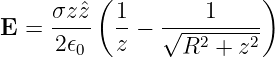
Therefore, for a charged disk at a point above the center, we have
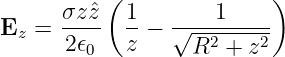
     σz ˆz( 1        1    )
E  = ----  --−  √---------
      2𝜖0  z      R2 + z2

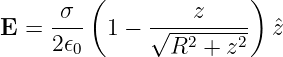
and rearranging

         (              )
E =  -σ-  1 − √---z-----  ˆz
     2𝜖0        R2 +  z2

1.1 Superposition

Before we can apply superposition to this problem, we need to calculate the electric field of a charged ring. This entry is coming soon.


"Electric Field of a Charged Disk" is owned by bloftin.
(view preamble)
View style:

This object's parent.

Cross-references: relation, unit vector, magnitude, field, system, formula, charge, Electric Field, power, vectors, concepts

This is version 8 of Electric Field of a Charged Disk, born on 2006-09-22, modified 2006-10-12.
Object id is 223, canonical name is ElectricFieldOfAChargedDisk.
Accessed 13950 times total.

Classification:
Physics Classification41.20.Cv (Electrostatics; Poisson and Laplace equations, boundary-value)
Pending Errata and Addenda
None.
Discussion
Style: Expand: Order:

No messages.

Interact
rate | post | correct | update request | add example | add (any)