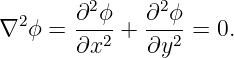
0.1 General Remarks.
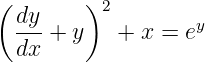
A differential equation is any equation involving derivatives of a dependent variable with respect to
one or more independent variables. Thus
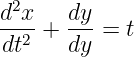
are classified as differential equations. Equation (3) is called a partial differential equation for
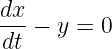
obvious reasons. The others are called ordinary differential equations. One may have a system of
differential equations involving more than one dependent variable,
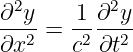
In addition to their own mathematical interest differential equations are particularly important
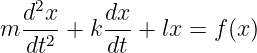
since the scientist attempts to describe the behavior of certain aspects of the universe in terms of
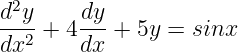
differential equations. We list a few of this type.
The order of the highest derivative occurring in a differential equation is called the order of the
differential equation.
0.2 Solution of a Differential Equation. Initial and Boundary Conditions
Let a differential equation be given involving the dependent variable ϕ and the independent
variables x and y. Any function ϕ(x,y) which satisfies the differential equation is called a
solution of the differential equation. For example, it is easy to prove that ϕ(x,y) = ex sin y
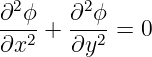
satisfies
We say that ex sin y is a solution of ∇2ϕ = 0. It is important to realize that a differential equation
has, in general, infinitely many solutions. For example, y′′ = 0 admits any function y = ax + b as a
solution, where a and b are constants which can be chosen arbitrarily. To specify a particular
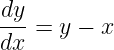
solution, either initial conditions like
or boundary conditions like
must be given in addition to the differential equation. In the first case y = x− 1is the solution, and
in the second case y = − x +
x +  is the solution. A full study of a differential equation implies the
determination of the most general solution of the equation (involving arbitrary elements which may
or may not be constants) and a discussion of how many additional conditions must be
imposed in order to fix uniquely the arbitrary elements entering in the general solution.
Without attempting an exact statement or proof, at the moment, we state the fact
that ”in general” the most general solution of an Ordinary Differential Equation of
order n contains exactly n arbitrary constants to be uniquely determined by n initial
conditions.
is the solution. A full study of a differential equation implies the
determination of the most general solution of the equation (involving arbitrary elements which may
or may not be constants) and a discussion of how many additional conditions must be
imposed in order to fix uniquely the arbitrary elements entering in the general solution.
Without attempting an exact statement or proof, at the moment, we state the fact
that ”in general” the most general solution of an Ordinary Differential Equation of
order n contains exactly n arbitrary constants to be uniquely determined by n initial
conditions.
0.3 References
[1] Lass, Harry. ”Elements of pure and applied mathematics” New York: McGraw-Hill Companies,
1957.
This entry is a derivative of the Public domain work [1].


![2 2
d-u-+ 8π--m-[E − V (x)]u = 0
dx2 h2](https://images.physicslibrary.org/cache/objects/839/make4ht/DifferentialEquations9x.png)