The backdrop for the motions of the ”wanderers” in the sky is the canopy of stars. If there were
no clouds in the sky and we were on a flat plain with nothing to obstruct our view,
we could see about 3000 stars with the unaided eye. To find their way around such a
multitude, the ancients found groupings of stars that made some familiar geometric
pattern or (more rarely) resembled something they knew. Each civilization found its own
patterns in the stars, much like a modern Rorschach test in which you are asked to
discern patterns or pictures in a set of inkblots. The ancient Chinese, Egyptians, and
Greeks, among others, found their own groupings or constellations of stars. These were
helpful in navigating among the stars and in passing their star lore on to their children.
You may be familiar with some of the old star patterns we still use today, such as the Big Dipper,
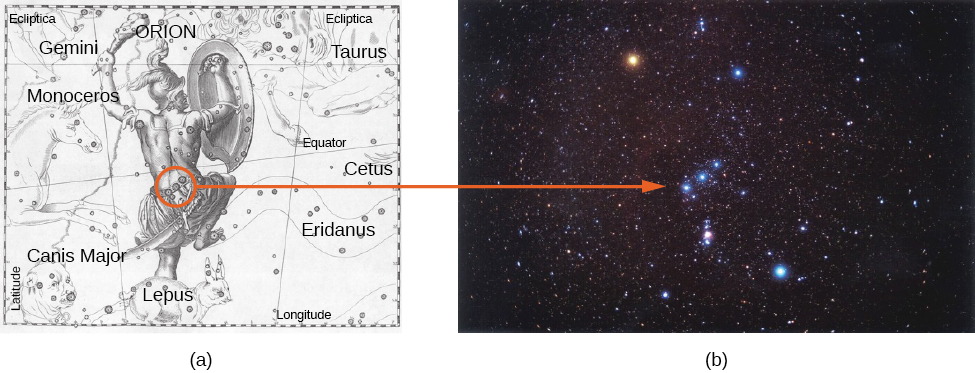
Little Dipper, and Orion the hunter, with his distinctive belt of three stars (Figure 1). However,
many of the stars we see are not part of a distinctive star pattern at all, and a telescope reveals
millions of stars too faint for the eye to see. Therefore, during the early decades of the 20th
century, astronomers from many countries decided to establish a more formal system for organizing
the sky.
Figure 1: Orion. (a) The winter constellation of Orion, the hunter, is
surrounded by neighboring constellations, as illustrated in the
seventeenth-century atlas by Hevelius. (b) A photograph shows the Orion
region in the sky. Note the three blue stars that make up the belt of the
hunter. The bright red star above the belt denotes his armpit and is called
Betelgeuse (pronounced ”Beetel-juice”). The bright blue star below the belt is
his foot and is called Rigel. (credit a: modification of workby Johannes
Hevelius; b: modification of work by Matthew Spinelli). Only the component of JNormal to the surface contributes to current through the surface. The angle is measured
between J and the area normal n.
Today, we use the term constellation to mean one of 88 sectors into which we divide the sky, much
as the United States is divided into 50 states. The modern boundaries between the constellations
are imaginary lines in the sky running north-south and east-west, so that each point in the
sky falls in a specific constellation, although, like the states, not all constellations are
the same size. Whenever possible, we have named each modern constellation after the
Latin translations of one of the ancient Greek star patterns that lies within it. Thus,
the modern constellation of Orion is a kind of box on the sky, which includes, among
many other objects, the stars that made up the ancient picture of the hunter. Some
people use the term asterism to denote an especially noticeable star pattern within
a constellation (or sometimes spanning parts of several constellations). For example,
the Big Dipper is an asterism within the constellation of Ursa Major, the Big Bear.
Students are sometimes puzzled because the constellations seldom resemble the people or animals
for which they were named. In all likelihood, the Greeks themselves did not name groupings of
stars because they looked like actual people or subjects (any more than the outline of Washington
state resembles George Washington). Rather, they named sections of the sky in honor of the
characters in their mythology and then fit the star configurations to the animals and people as best
they could.
This is version 2 of Constellations, born on 2025-02-24, modified 2026-09-17.
Object id is 946, canonical name is Constellations.
Accessed 1816 times total.