If a particle is subject to no torque then the angular momentum is conserved
The angular momentum, L of a particle with position vector, r, and total linear momentum, p is
given by L = r × p. If some force, F, acts on that particles, then the torque is defined similarily as
N = r × F = r × dp∕dt.
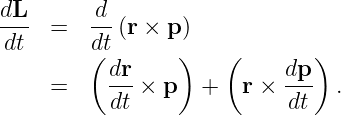
Taking the time derivative of the angular momentum equation,
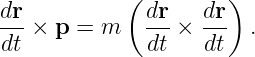
Consider the term, dr∕dt × p. Since p = mdr∕dt, it follows that
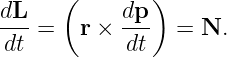
But, given an arbitrary vector, A, A × A = 0 (the zero vector), so the expression for the time
derivative of the angular momentum becomes,
Writing the above simplistically as dL∕dt = N is is clear that when the torque is zero, then the
angular momentum is constant in time; it is conserved.