Physics Library
 An open source physics library
Encyclopedia | Forums | Docs | Random  

[parent] an application of Gauss' law a cat's meow

(Example)

If you know the amount of charge contained within a Gaussian surface, then the total flux of the electric field generated by the enclosed charge is calculated from Gauss’ Law.

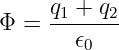
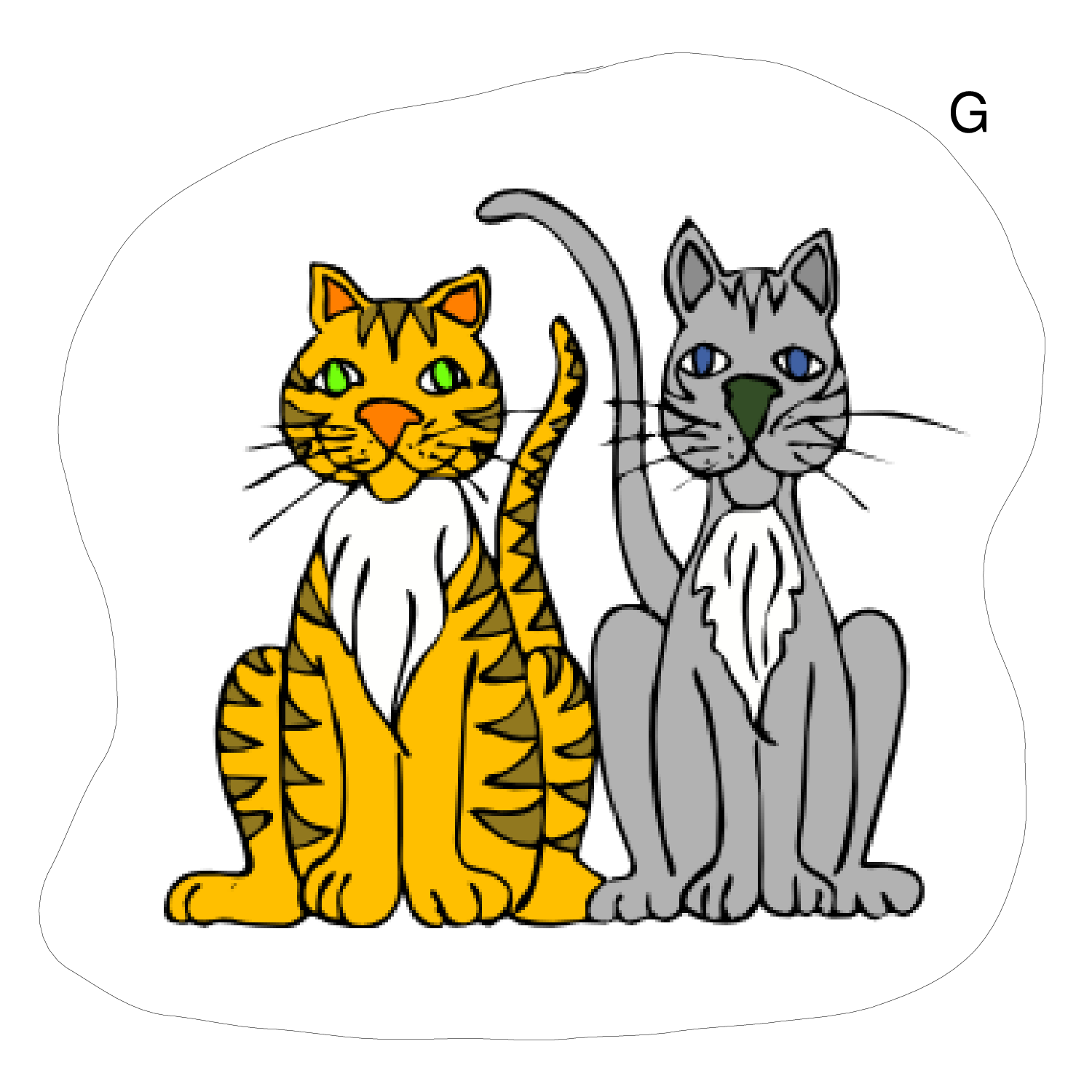
As a demonstration, imagine a pair of cats that have charges placed on them by their loyal masters. Although the contours of the cats’ elegant frames represent a complicated geometry, calculating the flux is a simple task if the charge on the cats is known. The flux through the Gaussian surface in Figure 1 is given by Gauss’ law

     q1 +-q2
Φ =    𝜖0
(1)

PIC

Figure 1: Gaussian Surface Encompassing Two Cats

Note that we add the charges in equation (1) because it is the net enclosed charge. For example if the charge on cat 1 is 10.5 [μC] and the charge on the cat 2 is 12.2[μC], then the total flux through G is


     10.5 × 10⁻⁸ [C ] + 12.2 × 10− 8[C ]
Φ =  -----8.85 ×-10−12[C2∕N--m2]-----

                 2
Φ  = 3073.4 [N m ∕C ]

The reverse of this problem is another important result. If we measure the flux through a given Gaussian surface, then we can calculate the amount of enclosed charge.

References

[1]   Figure 1, The Cat Clip art is public domain and was downloaded from WP Clipart


"an application of Gauss' law a cat's meow" is owned by bloftin.
(view preamble)
View style:
Keywords:  Gauss

This object's parent.

Cross-references: Gauss Law, electric field, flux, charge

This is version 4 of an application of Gauss' law a cat's meow, born on 2006-12-18, modified 2006-12-21.
Object id is 240, canonical name is ACatsMeowApplicationOfGaussLaw.
Accessed 3288 times total.

Classification:
Physics Classification: 40-XX (ELECTROMAGNETISM, OPTICS, ACOUSTICS, HEAT TRANSFER, CLASSICAL MECHANICS, AND FLUID MECHANICS)
 41.20.Cv (Electrostatics; Poisson and Laplace equations, boundary-value)

Pending Errata and Addenda

None.

Discussion

No messages.

Interact