The equatorial coordinate system is a celestial coordinate system widely used to specify the
positions of celestial objects. It may be implemented in spherical or rectangular coordinates,
both defined by an origin at the center of Earth, a fundamental plane consisting of the
projection of Earth’s equator onto the Celestial Sphere (forming the Celestial Equator),
a primary direction towards the March equinox, and a right-handed convention.[1][2]
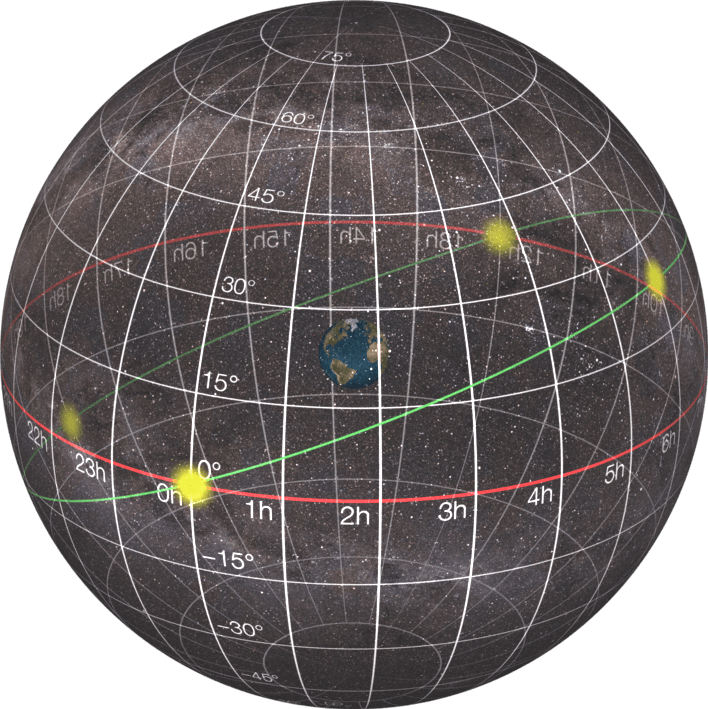
Figure 1:1. Model of the equatorial coordinate system. Declination (vertical arcs, degrees)
and hour angle (horizontal arcs, hours) is shown. For hour angle, right ascension (horizontal
arcs, degrees) can be used as an alternative.
The equatorial coordinate system is a celestial coordinate system widely used to specify the
positions of celestial objects. It may be implemented in spherical or rectangular coordinates,
both defined by an origin at the center of Earth, a fundamental plane consisting of the
projection of Earth’s equator onto the celestial sphere (forming the celestial equator),
a primary direction towards the March equinox, and a right-handed convention.[1][2]
The origin at the center of Earth means the coordinates are geocentric, that is, as seen from the
center of Earth as if it were transparent.[3] The fundamental plane and the primary direction mean
that the coordinate system, while aligned with Earth’s equator and pole, does not rotate with the
Earth, but remains relatively fixed against the background stars. A right-handed convention means
that coordinates increase northward from and eastward around the fundamental plane.
0.1 Primary direction
This description of the orientation of the reference frame is somewhat simplified; the orientation is
not quite fixed. A slow motion of Earth’s axis, precession, causes a slow, continuous turning of the
coordinate system westward about the poles of the ecliptic, completing one circuit in about 26,000
years. Superimposed on this is a smaller motion of the ecliptic, and a small oscillation of the
Earth’s axis, nutation.[4]
In order to fix the exact primary direction, these motions necessitate the specification of the
equinox of a particular date, known as an epoch, when giving a position. The three most
commonly used are:
Mean equinox of a standard epoch (usually J2000.0, but may include B1950.0,
B1900.0, etc.)
is a fixed standard direction, allowing positions established at various dates to be compared
directly.
Mean equinox of date
is the intersection of the ecliptic of ”date” (that is, the ecliptic in its position at ”date”) with the
mean equator (that is, the equator rotated by precession to its position at ”date”, but free
from the small periodic oscillations of nutation). Commonly used in planetary orbit
calculation.
True equinox of date
is the intersection of the ecliptic of ”date” with the true equator (that is, the mean equator plus
nutation). This is the actual intersection of the two planes at any particular moment, with all
motions accounted for.
A position in the equatorial coordinate system is thus typically specified true equinox and equator
of date, mean equinox and equator of J2000.0, or similar. Note that there is no ”mean ecliptic”, as
the ecliptic is not subject to small periodic oscillations.[5]
0.2 Spherical coordinates
0.2.1 Use in astronomy
A star’s spherical coordinates are often expressed as a pair, right ascension and declination,
without a distance coordinate. The direction of sufficiently distant objects is the same for all
observers, and it is convenient to specify this direction with the same coordinates for all. In
contrast, in the horizontal coordinate system, a star’s position differs from observer to observer
based on their positions on the Earth’s surface, and is continuously changing with the Earth’s
rotation.
Telescopes equipped with equatorial mounts and setting circles employ the equatorial
coordinate system to find objects. Setting circles in conjunction with a star chart or
ephemeris allow the telescope to be easily pointed at known objects on the celestial sphere.
0.2.2 Declination
The declination symbol δ, (lower case ”delta”, abbreviated DEC) measures the angular distance of
an object perpendicular to the celestial equator, positive to the north, negative to the south. For
example, the North Celestial Pole has a declination of +90∘. The origin for declination is the
celestial equator, which is the projection of the Earth’s equator onto the celestial sphere.
Declination is analogous to terrestrial latitude.[6][7][8]
0.2.3 Right ascension
The right ascension symbol α, (lower case ”alpha”, abbreviated RA) measures the angular distance
of an object eastward along the celestial equator from the March equinox to the hour circle passing
through the object. The March equinox point is one of the two points where the ecliptic intersects
the celestial equator. Right ascension is usually measured in sidereal hours, minutes and seconds
instead of degrees, a result of the method of measuring right ascensions by timing the passage of
objects across the meridian as the Earth rotates. There are 360∘∕24h = 15∘ in one hour of
right ascension, and 24h of right ascension around the entire celestial equator.[6][9][10]
When used together, right ascension and declination are usually abbreviated RA/Dec.
This article is a derivative work of the creative commons share alike with attribution in [14].
References
[1] Nautical Almanac Office, U.S. Naval Observatory; H.M. Nautical Almanac Office;
Royal Greenwich Observatory (1961). Explanatory Supplement to the Astronomical
Ephemeris and the American Ephemeris and Nautical Almanac. H.M. Stationery Office,
London (reprint 1974). pp. 24, 26. [2] Vallado, David A. (2001). Fundamentals of Astrodynamics and Applications.
Microcosm Press, El Segundo, CA. p. 157. [3] U.S. Naval Observatory Nautical Almanac Office; U.K. Hydrographic Office; H.M.
Nautical Almanac Office (2008). The Astronomical Almanac for the Year 2010. U.S.
Govt. Printing Office. p. M2, ”apparent place”. [4] Explanatory Supplement (1961), pp. 20, 28 [5] Meeus, Jean (1991). Astronomical Algorithms. Willmann-Bell, Inc., Richmond, VA.
p. 137. [6] Peter Duffett-Smith (1988). Practical Astronomy with Your Calculator, third edition.
Cambridge University Press. pp. 28-29 [7] Meir H. Degani (1976). Astronomy Made Simple. Doubleday and Company, Inc. p.
216. [8] Astronomical Almanac 2010, p. M4 [9] Moulton, Forest Ray (1918). An Introduction to Astronomy. p. 127. [10] Astronomical Almanac 2010, p. M14 [11] Peter Duffett-Smith (1988). Practical Astronomy with Your Calculator, third edition.
Cambridge University Press. pp. 34-36. [12] Astronomical Almanac 2010, p. M8 [13] Vallado (2001), p. 154 [14] Wikipedia contributors, ”Equatorial coordinate system,” Wikipedia, The Free
Encyclopedia
"equatorial coordinate system" is owned by bloftin.
This is version 17 of equatorial coordinate system, born on 2025-02-25, modified 2025-02-25.
Object id is 953, canonical name is EquatorialCoordinateSystem.
Accessed 2066 times total.