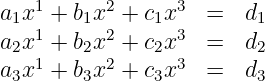
In attempting to solve a linear system of equations for x1, x2 and x3
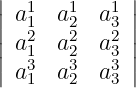
one is led in a very natural way to consider the square array
We have written aij = aji,i,j = 1, 2, 3. The solution of (1) requires that we attach a
numerical value to the matrix of elements (2). We do this in the following way: We
attach 33 = 27 numerical values to a set of 𝜖ijk,i,j,k = 1, 2, 3. If at least two of the
superscripts in 𝜖ijk are the same, the value of 𝜖ijk is zero. Thus 𝜖223 = 𝜖131 = 𝜖333 = 0, etc. If
the i, j, k are all different, the value of 𝜖ijk is to be +1 or −1 according to whether it
takes an even or odd number of permutations to rearrange the ijk into the natural
order 123. Let us lood at 𝜖321 and hence at the arrangement 321. Permuting the integers
2 and 3 permutes 321 into 231, then permuting 3 and 1 permutes 231 into 213, and
finally 213 permutes into 123 if we interchange the integers 2 and 1. Three (an odd
number) permutations were required to permute 321 into 123. Thus 𝜖123 = −1. We
have
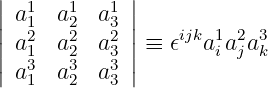
We now define
The letters i, j, k are indices of summation. Equation (3) defines the determinant of the square
matrix of elements (2) Its numerical value is given by the right-hand side of (3). It consists, in
general, of 3! = 3 ⋅ 2 ⋅ 1 = 6 terms, each term a product of three elements, one element from each
row and column of (3). Expand (3) to get
Only 3! = 6 terms occur in the exapansion of (3) since there are 3! permutations of 123. All other
values of 𝜖ijk are zero.
We can define 𝜖ijk in exactly the same manner in which the 𝜖ijk were defined. We leave it to the
reader to show that
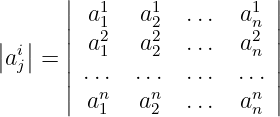
The generalization of second and third order determinants (the order of a determinant is the
number of rows or columns of the determinant) to the nth order determinants is simple. We define
the 𝜖i1i2 in to have the following numerical values: 𝜖i1i2
 in = 0 if at least two of the superscripts are
the same. The values of the superscripts range from 1 to n. If the i1,i2,…,in are distinct, the
value of 𝜖i1i2
in = 0 if at least two of the superscripts are
the same. The values of the superscripts range from 1 to n. If the i1,i2,…,in are distinct, the
value of 𝜖i1i2 in is to be +1 or −1 depending on whether an even or odd number of
permutations is required to rearrange i1,i2,…,in into the natural order 123
in is to be +1 or −1 depending on whether an even or odd number of
permutations is required to rearrange i1,i2,…,in into the natural order 123 n. The numerical
value (determinant) of the square array of elements
n. The numerical
value (determinant) of the square array of elements  , i,j = 1, 2,…,n, is defined
as
, i,j = 1, 2,…,n, is defined
as
where the 𝜖i1i2 in are defined in precisely the same manner in which the 𝜖i1i2
 in are defined. In
general, (4) consists of n! terms, each term a product of elements, one element fom each row and
column of
in are defined. In
general, (4) consists of n! terms, each term a product of elements, one element fom each row and
column of  .
.
To facilitate writing, we shall deal with third order determinants, but it will be obvious to the
reader that any theorem derived for third order determinants will apply to determinants of any
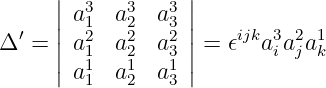
finite order. Le us consider
We can obtain a new third order determinant by interchanging the first and third row of Δ. This
yields
But 𝜖ijka
i3a
j2a
k1 = 𝜖ijka
k1a
j2a
i1 = 𝜖kjia
i1a
j2a
k3, since i amd k are dummy indices. We see that
every term of (6) is the same as every term in (5) with the exception that 𝜖ijk is replaced
by 𝜖kji. Since 𝜖ijk = −𝜖kji, we conclude that Δ = −Δ′. we thus obtain the following
theorems:
THEOREM 1.1. Interchanging two rows (or columns) of a determinant changes the sign of the
determinant.
THEOREM 1.1. If two rows (or columns) of a determinant are the same, the value of the
determinant is zero.
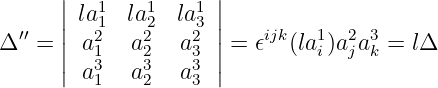
We note that
THEOREM 1.3. If a row (or column) of a determinant is multiplied by a factor l, the value of
the determinant is thereby multiplied by l.
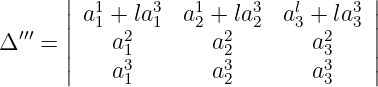
Let us now investigate the determinant
since 𝜖ijka
i3a
j2a
k3 = 0 from Theorem (1.2). Hence we obtain the following theorem:
THEOREM 1.4. The value of a determinant remains unchanged if to the elements of any row (or
column) is added a scalar multiple of the corresponding elements of another row (or
column).
The theorems derived above are very useful in evaluating a determinant.
1 References
[1] Lass, Harry. ”Elements of pure and applied mathematics” New York: McGraw-Hill Companies,
1957.
This entry is a derivative of the Public domain work [1].