minimal negation operator(Definition)
The minimal negation operator ν is a multigrade operator (νk)k∈ℕ where each νk is a k-ary
boolean function defined in such a way that νk(x1,…,xk) = 1 in just those cases where exactly one
of the arguments xj is 0.
In contexts where the initial letter ν is understood, the minimal negation operators can be
indicated by argument lists in parentheses. In the following text a distinctive typeface will be used
for logical expressions based on minimal negation operators, for example, (x, y, z) =
ν(x,y,z).
The first four members of this family of operators are shown below, with paraphrases
in a couple of other notations, where tildes and primes, respectively, indicate logical
negation.
() | = | ν0 | = | 0 | = | false |
| | | | | | | | | | | (x) | = | ν1(x) | = | x | = | x′ |
| | | | | | | | | | | (x, y) | = | ν2(x,y) | = | xy ∨ xỹ | = | x′y ∨ xy′ |
| | | | | | | | | | | (x, y, z) | = | ν3(x,y,z) | = | xyz ∨ xỹz ∨ xyz | = | x′yz ∨ xy′z ∨ xyz′ |
|
To express the general case of νk in terms of familiar operations, it helps to introduce an
intermediary concept:
Definition. Let the function ¬j : 𝔹k → 𝔹 be defined for each integer j in the interval [1,k] by the
following equation:
Then νk : 𝔹k → 𝔹 is defined by the following equation:
If we think of the point x = (x1,…,xk) ∈ 𝔹k as indicated by the boolean product x
1 ⋅… ⋅ xk or the
logical conjunction x1 ∧…∧xk, then the minimal negation (x1,…,xk) indicates the set of points in
𝔹k that differ from x in exactly one coordinate. This makes (x
1,…,xk) a discrete functional
analogue of a point omitted neighborhood in analysis, more exactly, a point omitted distance
one neighborhood. In this light, the minimal negation operator can be recognized as a
differential construction, an observation that opens a very wide field. It also serves to
explain a variety of other names for the same concept, for example, logical boundary
operator, limen operator, least action operator, or hedge operator, to name but a few. The
rationale for these names is visible in the venn diagrams of the corresponding operations on
sets.
The remainder of this discussion proceeds on the algebraic boolean convention that the plus sign
(+) and the summation symbol (∑
) both refer to addition modulo 2. Unless otherwise noted, the
boolean domain 𝔹 = {0, 1} is interpreted so that 0 = false and 1 = true . This has the following
consequences:
- The operation x + y is a function equivalent to the exclusive disjunction of x and y,
while its fiber of 1 is the relation of inequality between x and y.
- The operation ∑
j=1kx
j maps the bit sequence (x1,…,xk) to its parity.
The following properties of the minimal negation operators νk : 𝔹k → 𝔹 may be noted:
- The function (x, y) is the same as that associated with the operation x + y and the
relation x≠y.
- In contrast, (x, y, z) is not identical to x + y + z.
- More generally, the function νk(x1,…,xk) for k > 2 is not identical to the boolean sum
∑
j=1kx
j.
- The inclusive disjunctions indicated for the νk of more than one argument may be
replaced with exclusive disjunctions without affecting the meaning, since the terms
disjoined are already disjoint.
1 Truth tables
Table 1 is a truth table for the sixteen boolean functions of type f : 𝔹3 → 𝔹, each of which is either
a boundary of a point in 𝔹3 or the complement of such a boundary.
| Table 1. Logical Boundaries and Their Complements
|
|
|
|
| | | | | | | | L1 | L2 | | L3 | L4 |
| | | | | | | Decimal | Binary | | Sequential | Parenthetical |
|
|
|
|
| | | | | | | | | | p = | 1 1 1 1 0 0 0 0 | |
| | | | | | | | | q = | 1 1 0 0 1 1 0 0 | |
| | | | | | | | | r = | 1 0 1 0 1 0 1 0 | |
|
|
|
|
| | | | | | | | f
104 | f01101000 | | 0 1 1 0 1 0 0 0 | ( p , q , r ) |
| | | | | | | f148 | f10010100 | | 1 0 0 1 0 1 0 0 | ( p , q ,(r)) |
| | | | | | | f146 | f10010010 | | 1 0 0 1 0 0 1 0 | ( p ,(q), r ) |
| | | | | | | f97 | f01100001 | | 0 1 1 0 0 0 0 1 | ( p ,(q),(r)) |
| | | | | | | f134 | f10000110 | | 1 0 0 0 0 1 1 0 | ((p), q , r ) |
| | | | | | | f73 | f01001001 | | 0 1 0 0 1 0 0 1 | ((p), q ,(r)) |
| | | | | | | f41 | f00101001 | | 0 0 1 0 1 0 0 1 | ((p),(q), r ) |
| | | | | | | f22 | f00010110 | | 0 0 0 1 0 1 1 0 | ((p),(q),(r)) |
|
|
|
|
| | | | | | | | f233 | f11101001 | | 1 1 1 0 1 0 0 1 | (((p),(q),(r))) |
| | | | | | | f214 | f11010110 | | 1 1 0 1 0 1 1 0 | (((p),(q), r )) |
| | | | | | | f182 | f10110110 | | 1 0 1 1 0 1 1 0 | (((p), q ,(r))) |
| | | | | | | f121 | f01111001 | | 0 1 1 1 1 0 0 1 | (((p), q , r )) |
| | | | | | | f158 | f10011110 | | 1 0 0 1 1 1 1 0 | (( p ,(q),(r))) |
| | | | | | | f109 | f01101101 | | 0 1 1 0 1 1 0 1 | (( p ,(q), r )) |
| | | | | | | f107 | f01101011 | | 0 1 1 0 1 0 1 1 | (( p , q ,(r))) |
| | | | | | | f151 | f10010111 | | 1 0 0 1 0 1 1 1 | (( p , q , r )) |
|
|
|
|
| | | | | | | | |
2 Charts and graphs
This Section focuses on visual representations of minimal negation operators. A few bits of
terminology are useful in describing the pictures, but the formal details are tedious reading, and
may be familiar to many readers, so the full definitions of the terms marked in bold are relegated
to a Glossary at the end of the article.
Two ways of visualizing the space 𝔹k of 2k points are the hypercube picture and the venn diagram
picture. The hypercube picture associates each point of 𝔹k with a unique point of the
k-dimensional hypercube. The venn diagram picture associates each point of 𝔹k with a unique
”cell” of the venn diagram on k ”circles”.
In addition, each point of 𝔹k is the unique point in the fiber of truth [|s|] of a singular
proposition s : 𝔹k → 𝔹, and thus it is the unique point where a singular conjunction of k
literals is equal to 1.
For example, consider two cases at opposite vertices of the k-cube:
- The point (1, 1,…, 1, 1) with all 1’s as coordinates is the point where the conjunction
of all posited variables evaluates to 1, namely, the point where:
- The point (0, 0,…, 0, 0) with all 0’s as coordinates is the point where the conjunction
of all negated variables evaluates to 1, namely, the point where:
To pass from these limiting examples to the general case, observe that a singular proposition
s : 𝔹k → 𝔹 can be given canonical expression as a conjunction of literals, s = e
1 e2 … ek−1 ek.
Then the proposition ν(e1,e2,…,ek−1,ek) is 1 on the points adjacent to the point where s is 1, and
0 everywhere else on the cube.
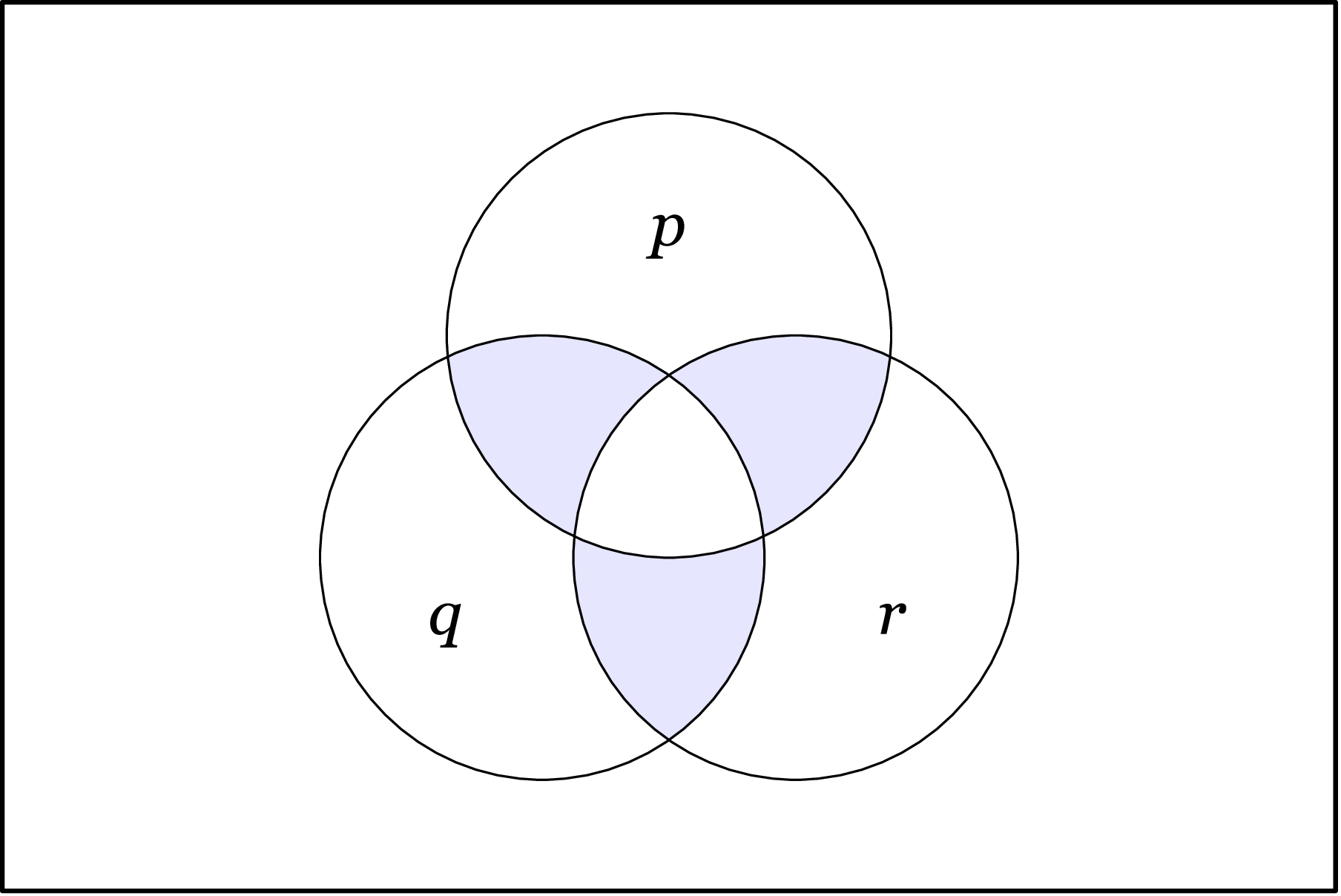
For example, consider the case where k = 3. Then the minimal negation operation ν(p,q,r) —
written more simply as (p, q, r) — has the following venn diagram:
 | | Figure 2. (p, q, r) |
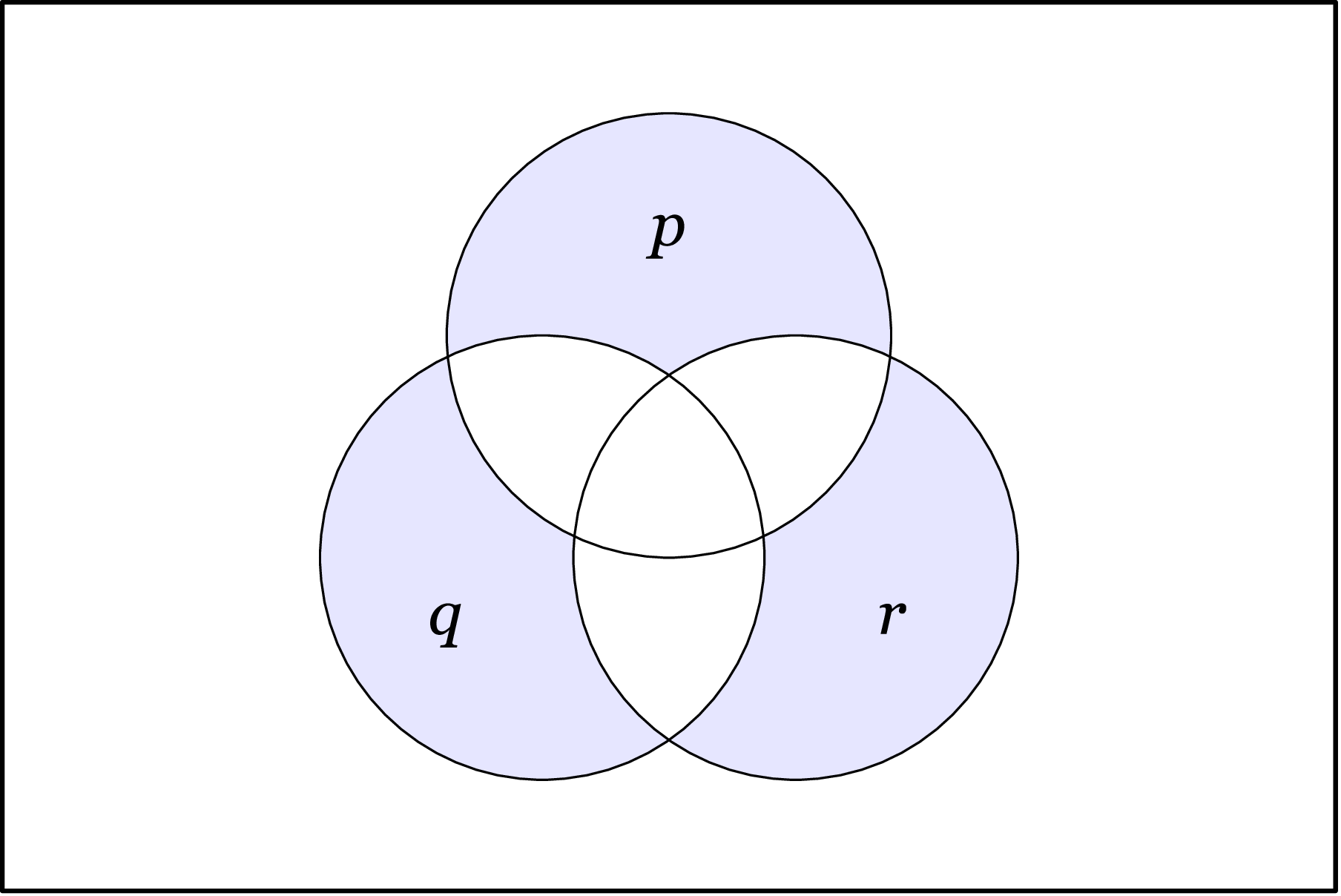
For a contrasting example, the boolean function expressed by the form ((p),(q),(r)) has the
following venn diagram:
 | | Figure 3. ((p),(q),(r)) |
3 Glossary of basic terms
- A boolean domain 𝔹 is a generic 2-element set, say, 𝔹 = {0, 1}, whose elements are
interpreted as logical values, usually but not invariably with 0 = false and 1 = true.
- A boolean variable x is a variable that takes its value from a boolean domain, as
x ∈ 𝔹.
- In situations where boolean values are interpreted as logical values, a boolean-valued
function f : X → 𝔹 or a boolean function g : 𝔹k → 𝔹 is frequently called a
proposition.
- Given a sequence of k boolean variables, x1,…,xk, each variable xj may be treated
either as a basis element of the space 𝔹k or as a coordinate projection x
j : 𝔹k → 𝔹.
- This means that the k objects xj for j = 1 to k are just so many boolean functions
xj : 𝔹k → 𝔹, subject to logical interpretation as a set of basic propositions that generate
the complete set of 22k propositions over 𝔹k.
- A literal is one of the 2k propositions x1,…,xk,(x1),…,(xk), in other words, either a
posited basic proposition xj or a negated basic proposition (xj), for some j = 1 to k.
- In mathematics generally, the fiber of a point y under a function f : X → Y is defined
as the inverse image f−1(y).
- In the case of a boolean-valued function f : X → 𝔹, there are just two fibers:
The fiber of 0 under f, defined as f−1(0), is the set of points where f is 0.
The fiber of 1 under f, defined as f−1(1), is the set of points where f is 1.
- When 1 is interpreted as the logical value true, then f−1(1) is called the fiber of truth in
the proposition f. Frequent mention of this fiber makes it useful to have a shorter way of
referring to it. This leads to the definition of the notation [|f|] = f−1(1) for the fiber of truth
in the proposition f.
- A singular boolean function s : 𝔹k → 𝔹 is a boolean function whose fiber of 1 is a single
point of 𝔹k.
- In the interpretation where 1 equals true, a singular boolean function is called a singular
proposition.
- Singular boolean functions and singular propositions serve as functional or logical
representatives of the points in 𝔹k.
- A singular conjunction in (𝔹k → 𝔹) is a conjunction of k literals that includes just one
conjunct of the pair {xj, ν(xj)} for each j = 1 to k.
- A singular proposition s : 𝔹k → 𝔹 can be expressed as a singular conjunction:
s | = | e1 e2 … ek−1 ek |
where | ej | = xj |
or | ej | = ν(xj) |
for | j | = 1 to k |
"minimal negation operator" is owned by Jon Awbrey.(view preamble)
See Also: differential logic, differential propositional calculus, differential propositional calculus : appendix 1, differential propositional calculus : appendix 2, differential propositional calculus : appendix 3, differential propositional calculus : appendix 4
Cross-references: negation, operators, boolean function, multigrade operator
There is 1 reference to this object.
This is version 15 of minimal negation operator, born on 2009-05-16, modified 2009-08-30.
Object id is 760, canonical name is MinimalNegationOperator.
Accessed 2774 times total.
Classification:
|




