Physics Library
 An open source physics library
Encyclopedia | Forums | Docs | Random |  
Login
create new user
Username:
Password:
forget your password?
Main Menu
Sections

Meta

Talkback

Downloads

Information
using convolution to find Laplace transforms (Definition)

We start from the relations (see the table of Laplace transforms)

eαt --1--
s− α, √1-
  t ∘ --
  π-
   s (s > α) (1)

where the curved arrows point from the Laplace-transformed functions to the original functions. Setting α = a2 and dividing by √ --
  π in (1), the convolution property of Laplace transform yields

                               ∫
-----1----        a2t  --1--      t a2(t−u)--1--
(s− a2)√s-- ↷    e  ∗ √ πt- =     e      √ πu-du.
                                0

The substitution a2u = x2 then gives

                a2t ∫ a√t                   a2t     ∫ a√t-            a2t     √ -
----1--√---↷   e√---      e−x2⋅a-⋅2x-dx =   e--⋅√2--     e− x2 dx =  e---erf a t.
(s− a2)  s       pi  0        x  a2         a    π  0                a

Thus we may write the formula

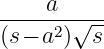
ℒ{ea2t erf a√ -
  t} = ----a-----
(s− a2)√s-- (s > a2). (2)

Moreover, we obtain

                  √--
-----1-----     ---s-−-a--    --1---  -----a-----      a2t  a2t    √ -     a2t       √ -
(√s+a  )√s--=   (s− a2)√s- =  s − a2− (s − a2)√s--↷   e  − e   erf a t =  e  (1− erf a t),

whence we have the other formula

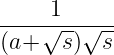
ℒ{ea2t erfca  -
√ t} = ----√1--√---
(a+   s)  s. (3)

0.1 An improper integral

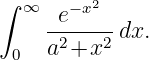
One can utilise the formula (3) for evaluating the improper integral

∫  ∞   −x2
     -e-----dx.
  0  a2+x2

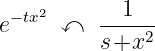
We have

 −tx2       1
e     ↶   ----2-
          s+x

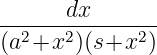
(see the table of Laplace transforms). Dividing this by a2+x2 and integrating from 0 to , we can continue as follows:

0e− tx2
-2---2-
a +x dx 0      dx
--2---2------2-
(a +x  )(s+x  ) =   1
-----2
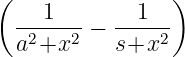
s − a 0(                )
    1        1
  -2---2-− -----2
  a +x     s+xdx
=   1
----2-
s− a ∕ x=0 (                           )
 1        x    1          x
 --arctan --−  √--arctan √---
 a        a     s          s
=   1
----2-
s− aπ
--
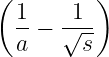
2( 1     1 )
  --−  √---
  a      s =  π
---
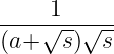
2a     1
----√---√--
(a+   s) s
-π-
2aea2t erfca√t-

Consequently,

∫        2
  ∞  e−-tx---      -π- a2t     √ -
     a2+x2  dx =  2a e   erfc a  t,
 0

and especially

∫ ∞  e− x2         π   2
    -2----2 dx =  ---ea erfc a.
 0  a  +x         2a

Anyone with an account can edit this entry. Please help improve it!

"using convolution to find Laplace transforms" is owned by pahio.
(view preamble)
View style:
See Also: table of Laplace transforms


Cross-references: formula, Laplace transform, functions, table of Laplace transforms

This is version 3 of using convolution to find Laplace transforms, born on 2009-05-04, modified 2009-05-05.
Object id is 733, canonical name is UsingConvolutionToFindLaplaceTransforms.
Accessed 1608 times total.

Classification:
Physics Classification02.30.Uu (Integral transforms)
Pending Errata and Addenda
None.
Discussion
Style: Expand: Order:

No messages.

Interact
rate | post | correct | update request | add derivation | add example | add (any)