A geodesic is generally described as the shortest possible, or topologically allowed, path between
two points in a curved space.
Remark 0.1. Given a curved space §C one can find the geodesic by writing the equation for
the length lv of a curve– which is defined as a function f : (R) →§C from an open interval
(R) of ℛ to the manifold §C– and then by using the calculus of variations minimizing this
length. In physical applications, however, to simplify the calculation one may also require
the minimization of energy as well as the length of the curve.
However, in Riemannian geometry geodesics are not coinciding with the “shortest length
curves” joining two points, even though a close connection may exist between geodesics and
the shortest paths; thus, moving around a great circle on a Riemann sphere the ‘long way
round’ between two arbitrary, fixed points on a sphere is a geodesic but it is not obviously
the shortest length curve between the points (which would be a straight line that is not
permitted by the topology of the surface of the Riemann sphere).
Example 0.1. The orbits of satellites and planets are all geodesics in curved spacetime. As
a more general physical example in general relativity theory, relativistic geodesics describe
the motion of point particles in a spacetime with a curvature determined only by gravity.
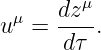
Consider such a point particle zμ that moves along a trajectory or “track” in physical
spacetime; also assume that the track is parameterized with the values of τ. Then, the
velocity vector pointing in the direction of motion of the point particle in spacetime can be
written as:
If there are no forces acting on a point particle, then its velocity is unchanged along the
trajectory or ‘track’ and one has the following geodesic equation:
Definition 0.1. More generally, a geodesic in metric geometry is defined as a a curve
Γ : I → M from an interval I ⊂ℛ to the metric space M for which there exists a constant
v ≤ 0 such that for any t ∈ I there is a neighborhood J of t ∈ I such that for any t1,t2 ∈ J
one has that
When the equality
is satisfied for all t1,t2 ∈ I, the geodesic is called the shortest path or a minimizing
geodesic.