Euler 213 Sequence
The Euler 213 sequence is an intrinsic three rotation description of frame orientation.
This entry uses the PhysicsLibrary passive intrinsic convention and replaces the older generic
ϕ,𝜃,ψ sequence notation with
where α is the first rotation, β the second, and γ the third.
For this sequence, the chronological intrinsic axis order is
This is a Tait Bryan sequence.
1 Convention and frame chain
Let
The intrinsic frame construction is:
- rotate frame A0 through α about axis 2 of A0 to form A1;
- rotate frame A1 through β about axis 1 of A1 to form A2;
- rotate frame A2 through γ about axis 3 of A2 to form A3 = B.
For any fixed physical vector,
The intermediate passive coordinate maps are
and
Therefore
The rightmost factor acts first on a coordinate column.
2 Elementary passive matrices
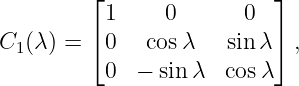
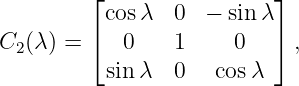
The elementary matrices used in this article are
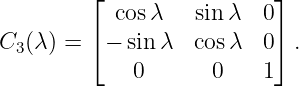
and
3 Expanded Euler 213 direction cosine matrix
Define
and
Carrying out the matrix multiplication gives
This is the canonical PhysicsLibrary passive intrinsic Euler 213 matrix.
4 Single angle checks
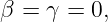
The matrix must reduce to the correct elementary transformation when two sequence angles are
zero.
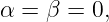
If
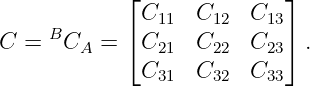
then
If
then
If
then
These reductions are useful sign and order checks.
5 Inverse extraction
Let
Away from the singularity, the principal angles may be extracted as
and
The two-argument function atan2(y,x) is required so that the correct quadrant is retained.
6 Principal ranges
A standard principal branch is
On this branch, cos β ≥ 0.
7 Coordinate singularity
The sequence becomes singular when
that is,
At this configuration the first and third physical rotation axes become aligned or anti-aligned. The
orientation remains valid, but α and γ are no longer independently recoverable. Only one
combination of the two outer angles remains observable.
Near this singularity, the nonsingular inverse formulas below should not be used without a
numerical threshold and an explicitly chosen singularity policy.
8 Alternate Euler branch
Away from the singularity, one equivalent nonprincipal triple is
with the outer angles wrapped by integer multiples of 2π as needed.
This identity explains why inverse Euler extraction requires a declared principal branch.
9 Equivalent extrinsic description
The intrinsic Euler 213 sequence with angle list (α,β,γ) is equivalent to the extrinsic
sequence
with chronological angle list
Thus
This equivalence changes the verbal axis construction, not the final orientation.
10 Passive quaternion equivalent
The migrated PhysicsLibrary quaternion series uses the same frame map direction.
For a positive frame rotation about axis n,
The Euler 213 sequence therefore has quaternion product
The quaternion and DCM represent the same passive map:
11 Numerical example
Take
Substitution into the Euler 213 product gives approximately
This matrix is orthogonal to numerical precision and has determinant +1.
Applying the nonsingular extraction formulas to this matrix recovers the principal triple
12 Verification properties
A correct implementation should satisfy
and
It should also agree with the corresponding passive quaternion:
13 Common mistakes
- Using the legacy ϕ,𝜃,ψ symbols as generic first, second, and third angles while also
interpreting them as roll, pitch, and yaw.
- Treating the sequence digits as written matrix order rather than chronological intrinsic
axis order.
- Mixing the active elementary matrices with the passive PhysicsLibrary coordinate map.
- Applying inverse formulas from another Euler sequence.
- Ignoring the sequence singularity when extracting angles.
- Comparing Euler triples directly rather than comparing their DCMs when alternate
branches may be present.
- Forgetting to reverse both axis order and angle association when translating to an
extrinsic description.
14 Summary
For the intrinsic Euler 213 sequence,
The sequence belongs to the Tait Bryan family.
Its passive DCM, inverse extraction formulas, singularity, alternate branch, and passive quaternion
product are all determined by that one declared sequence and convention.
15 References and further reading
Henderson provides a classic engineering tabulation of all twelve Euler sequences and
transformation matrix relationships.
Diebel gives a compact unified treatment of Euler angles, DCMs, quaternions, and rotation
vectors.
Moore develops orientation through reference frame basis relationships and is useful for
interpreting the passive coordinate map.
References
[1] D. M. Henderson, Euler Angles, Quaternions, and Transformation Matrices: Working
Relationships, JSC-12960, NASA Johnson Space Center, 1977. NASA Technical Reports
Server
[2] J. Diebel, “Representing Attitude: Euler Angles, Unit Quaternions, and Rotation
Vectors,” Stanford University, 2006. Online PDF
[3] J. K. Moore, Learn Multibody Dynamics, chapter “Orientation of Reference Frames,”
2026 edition. Licensed CC BY 4.0. Orientation of Reference Frames
License
Unless otherwise noted, this PhysicsLibrary entry is intended for release under the Creative
Commons Attribution ShareAlike 4.0 International license.