
|
|
|
|||||||
satisfied by the ordinates u(x, t) of the points of the string with the abscissa x on the time moment t (≧ 0). The boundary conditions are thus  We suppose also the initial conditions  which give the initial position of the string and the initial velocity of the points of the string. For trying to separate the variables, set  The boundary conditions are then X(0) = X(p) = 0, and the partial differential equation (1) may be written
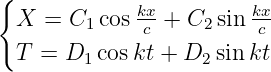
This is not possible unless both sides are equal to a same constant −k2 where k is positive; we soon justify why the constant must be negative. Thus (2) splits into two ordinary linear differential equations of second order:
The solutions of these are, as is well known,
with integration constants Ci and Di. But if we had set both sides of (2) equal to +k2, we had got the solution T = D 1ekt + D 2e−kt which can not present a vibration. Equally impossible would be that k = 0. Now the boundary condition for X(0) shows in (4) that C1 = 0, and the one for X(p) that 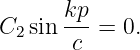 If one had C2 = 0, then X(x) were identically 0 which is naturally impossible. So we must have 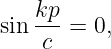 which implies 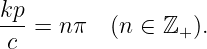 This means that the only suitable values of k satisfying the equations (3), the so-called eigenvalues, are  So we have infinitely many solutions of (1), the eigenfunctions ![[ ]
nπ- nπc- n-πc
u = XT = C2 sin p x D1 cos p t + D2 sin p t](https://images.physicslibrary.org/cache/objects/259/make4ht/SolvingTheWaveEquationDueToDBernoulli13x.png) or ![[ ]
nπc- nπc- n-π
u = An cos p t + Bn sin p t sin p x](https://images.physicslibrary.org/cache/objects/259/make4ht/SolvingTheWaveEquationDueToDBernoulli14x.png) (n = 1, 2, 3, …) where An’s and Bn’s are for the time being arbitrary constants. Each of these functions satisfy the boundary conditions. Because of the linearity of (1), also their sum series
is a solution of (1), provided it converges. It fulfils the boundary conditions, too. In order to also the initial conditions would be fulfilled, one must have 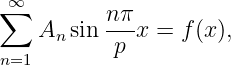
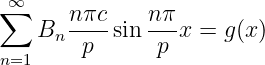 on the interval [0, p]. But the left sides of these equations are the Fourier sine series of the functions f and g, and therefore we obtain the expressions for the coefficients: 
 References
"solving the wave equation due to D. Bernoulli" is owned by bloftin. This object's parent. Cross-references: functions, differential equations, partial differential equation, velocity, position, boundary, wave equation, vibration This is version 1 of solving the wave equation due to D. Bernoulli, born on 2007-08-10. Object id is 259, canonical name is SolvingTheWaveEquationDueToDBernoulli. Accessed 2345 times total. Classification:
|
|
|
|
Pending Errata and AddendaNone.
|
DiscussionNo messages.
|
Interact |
![[parent]](https://images.physicslibrary.org/images/uparrow.png)
 =
= 
 =
= 

 sin
sin 