Here we will investigate time independent Schrödinger equation with a ramp potential.
Starting with the S.E
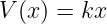
substitute the potential in to get
Not sure off hand how to solve this differential equation analytically, so it may be useful to write it
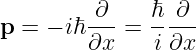
in operator form, using the momentum operator
we get
Before we choose a method of attack, let us get a feel for the problem at hand. In Figure 1, we plot
a potential function that goes from ±∞. In this example we see the classical turning point at
E = V , and we should remember that there will be tunneling.
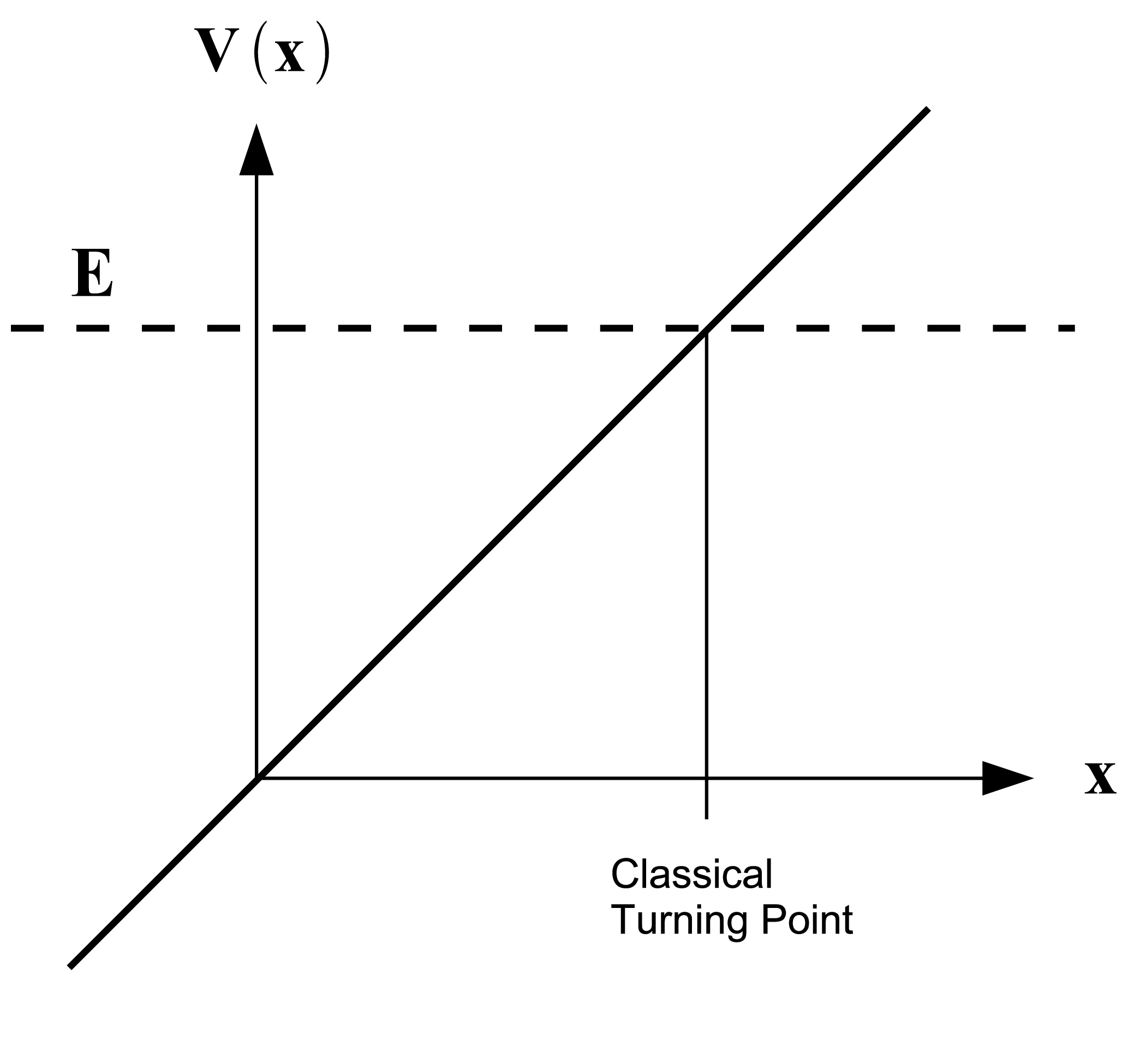
Figure 1: Open Ramp Potential
This representation where E exceeds V on the left side, demonstrates that the particle would come
in from infinity, slow down because of the increase in potential energy and then reflect back going
off into infinity. This results in the so called scattering State.
However, if in a similar way to the infinite square well, we say that V (0) = ∞, then we get the
potential depicted in Figure 2.
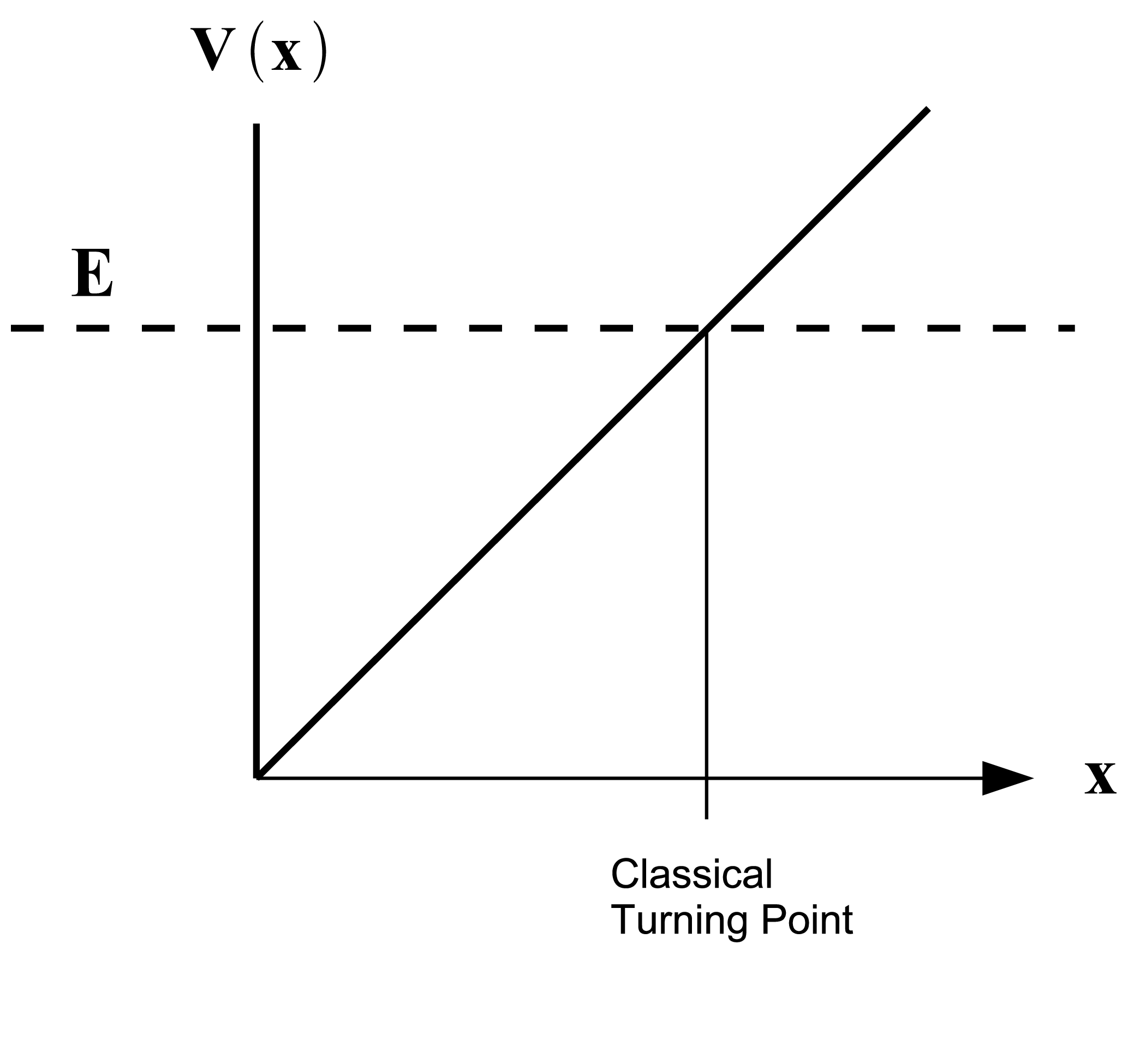
Figure 2: Open Ramp Potential
For this example, we see that at V (−∞) and at V (+∞), E is less than V . Therefore, we would get
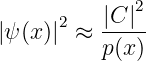
bound states. One more thing to keep in mind is that the square of the wave function for these 1D
potentials, leads to the relation
This tells us that the probability of finding the particle is higher where the potential energy is
higher, i.e. higher up the ramp, because here the kinetic energy which is related to momentum is
low. This makes sense because if the particle is moving fast on the left side of Figure 2 near the
infinite potential, you will be less likely to find it here and more likely to find the particle when it
is slowed down up the ramp. Next, we should attempt to solve for ψ. The three most
common ways to attack this type of problem are: to solve the differential equation using a
power series, use some algebraic trick similar to the harmonic oscillator or use the WKB
method.
All of these techniques would be excellent exercises for students to solve and make good
PlanetPhysics entries. Here we will explore the WKB (Wentzel, Kramers, Brillouin) method, which
is used to find approximate solutions to the time-independent Schorödinger equation for 1D
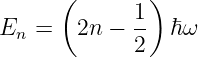
problems. Before we go on, we can look at solutions to a similar problem to guide us. If
we have the exact same setup, except that instead of the ramp in Figure 2, we have a
harmonic oscillator ramp, where V (x) =  mω2x2 for positive x, the WKB approximation
yields
mω2x2 for positive x, the WKB approximation
yields
Finally, from [Griffiths] the allowed energies for a general power-law potential
is
References
[1] Griffiths, D. ”Introduction to Quantum Mechanics” Prentice Hall, New Jersey, 1995.

![[parent]](https://images.physicslibrary.org/images/uparrow.png)


![[ ]
1 ( ℏ ∂ )2
---- ----- + kx ψ (x) = E ψ(x)
2m i ∂x](https://images.physicslibrary.org/cache/objects/247/make4ht/SchrodingerEquationWtihRampPotential4x.png)

![[ ( ) ∘ ----- (1-- 3) ]m2m+2-
E = k n − 1- ℏ -π--Γ-(-m-+-2)
n 2 2mk Γ 1m-+ 1](https://images.physicslibrary.org/cache/objects/247/make4ht/SchrodingerEquationWtihRampPotential9x.png)