|
|
|
|||||||
For an intrinsic i-j-k sequence,
For an extrinsic i-j-k sequence,
Therefore
Intrinsic means that later rotations use axes of the current intermediate frame. Extrinsic means that every rotation axis remains attached to the original reference frame.
2 Visual reference
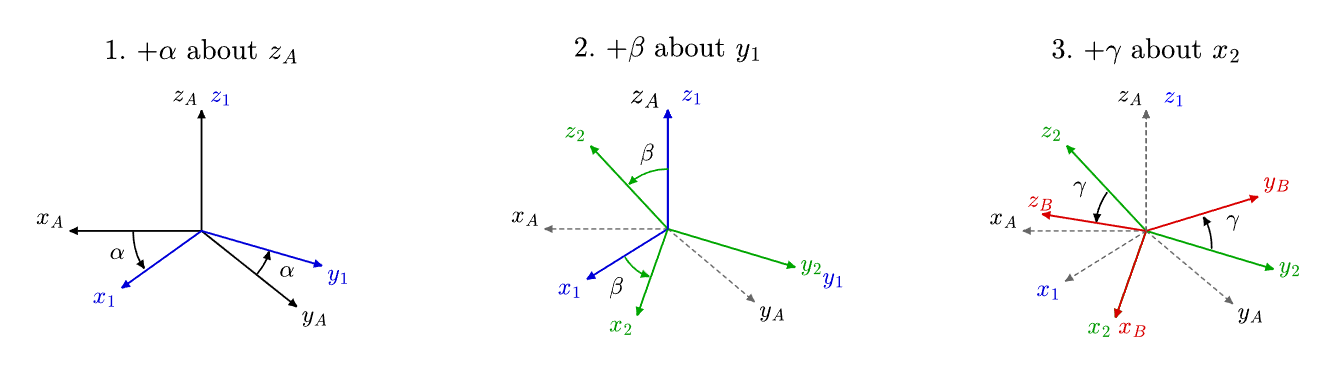
Figure. Intrinsic construction: the second rotation uses the moved axis of the intermediate frame.
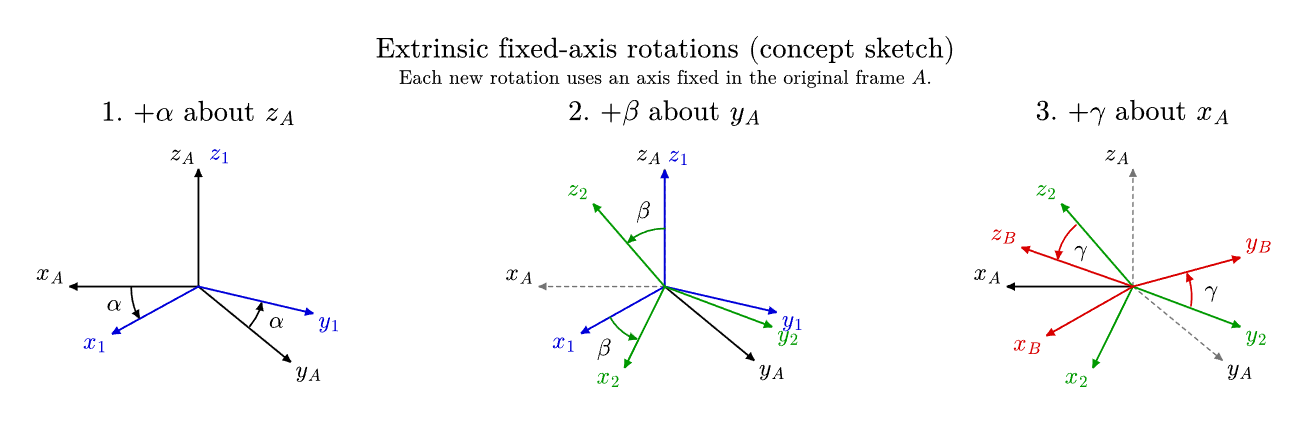
Figure. Extrinsic construction: the second rotation uses an axis fixed in the original reference frame.
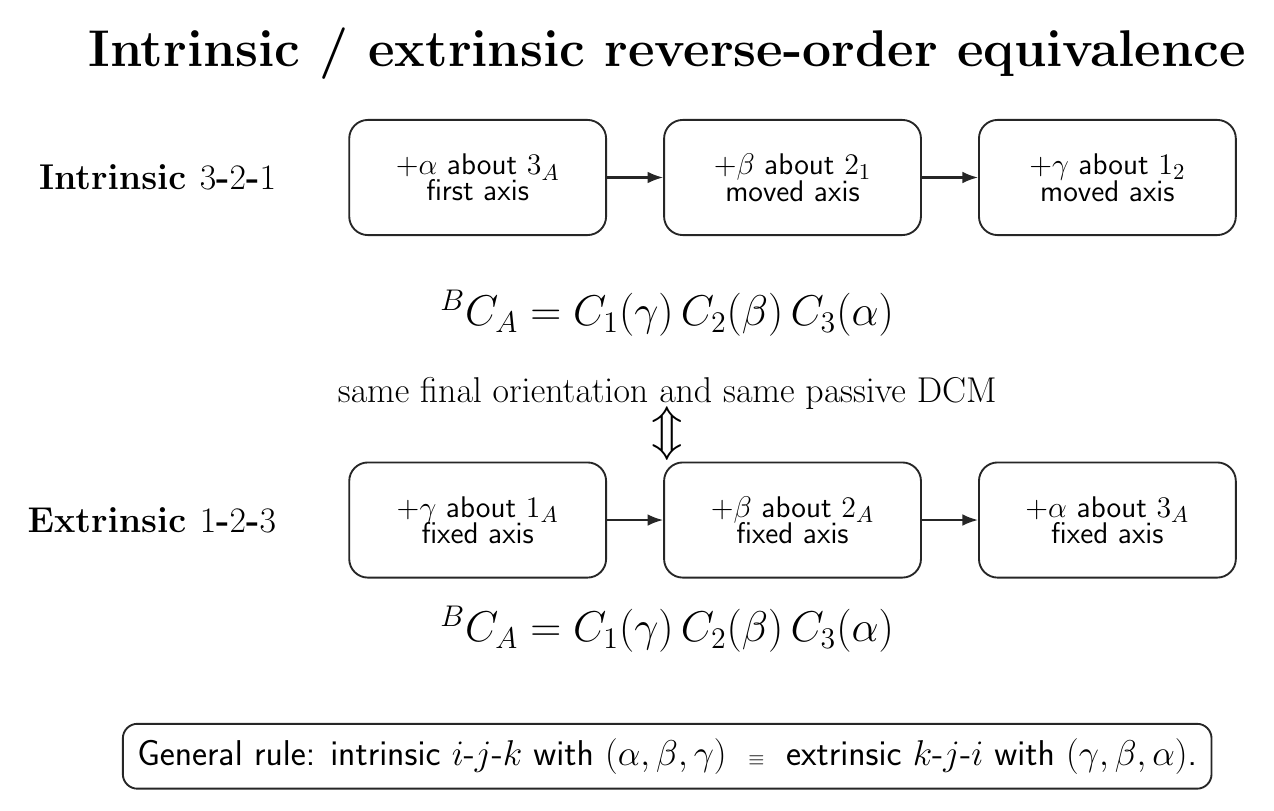
Figure. Reverse-order equivalence between intrinsic and extrinsic sequence descriptions.
3 Exercises
4 Solutions
Solution 1: intrinsic or extrinsic?The second rotation is about the new y axis, and the third is about the newest x axis. Therefore the axes move with the intermediate frame. The sequence is intrinsic

Solution 2: fixed axis interpretationEvery rotation is explicitly about an axis of the original frame A:
 Therefore the construction is extrinsic

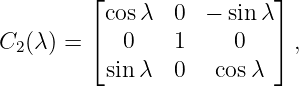
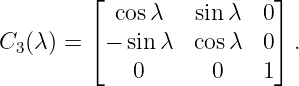
Solution 3: intrinsic matrix productFor intrinsic 2-3-1,
 Hence
Solution 4: extrinsic matrix productFor extrinsic 2-3-1, the generic passive rule is
 Therefore
Solution 5: same labels, different interpretationIntrinsic 2-3-1 gives
Extrinsic 2-3-1 gives
The products have different factor order. Since finite rotations about different axes generally do not commute,
 in general.
Solution 6: reverse-order equivalent sequenceThe general equivalence is
 Thus
Solution 7: reverse the other directionThe extrinsic sequence is
 with chronological angles
 Reverse the axis order and reverse the associated angle order. Therefore
Solution 8: aerospace yaw pitch rollFor PhysicsLibrary intrinsic 3-2-1,
 Hence
The equivalent extrinsic sequence is
 with chronological angle list
Thus the equivalent fixed axis description is roll about 1A, then pitch about 2A, then yaw about 3A.
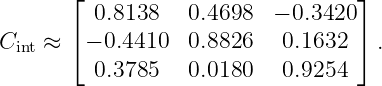
Solution 9: numerical difference for the same sequence labelsFor intrinsic 3-2-1,
 Numerically,
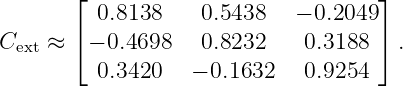
For extrinsic 3-2-1,
 Numerically,
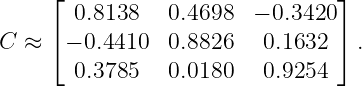
The matrices are not equal. Thus identical sequence labels do not imply identical orientation when one description is intrinsic and the other extrinsic.
Solution 10: numerical reverse-order equivalenceIntrinsic 3-2-1 with (α,β,γ) gives
 Extrinsic 1-2-3 with (γ,β,α) gives
 The products are symbolically identical. For the numerical angles of Exercise 9, both give
Solution 11: frame-label derivationThe three intrinsic coordinate maps are
and
Compose the maps by matching adjacent frame labels:
 Therefore
Solution 12: single-angle diagnosticFor intrinsic 3-2-1,
 Set
 Then
The equivalent extrinsic representation is 1-2-3 with angle list (γ,β,α). Setting γ = β = 0 leaves the final chronological extrinsic rotation about fixed axis 3A through α, whose passive product is also
Thus the single-angle reduction agrees.
Solution 13: proper Euler subtletyIntrinsic 3-1-3 with angles (α,β,γ) is equivalent to extrinsic
 with chronological angles
 So
The sequence label is a palindrome, so reversing the axis order does not visibly change the digits. The angle association still reverses. That is why proper Euler sequences such as 3-1-3 can be especially easy to misinterpret.
Solution 14: body fixed and space fixed terminologyBody fixed corresponds to intrinsic. Each new rotation axis belongs to the current intermediate frame and therefore moves with the body or moving frame. Space fixed corresponds to extrinsic. Each rotation axis remains attached to the original reference frame. The word “fixed” therefore refers to which frame owns the successive rotation axes, not to whether the mathematical transformation is active or passive.
Solution 15: active/passive independenceThe statement is incorrect because two independent choices are being mixed. Intrinsic versus extrinsic specifies the axis behavior. Active versus passive specifies whether the physical vector or coordinate frame is being transformed. The four logical combinations are:
PhysicsLibrary uses intrinsic passive as its default Euler convention, but the other three combinations are mathematically valid.
Solution 16: convention auditBefore comparing
 with PhysicsLibrary, one should ask at least:
Without these answers, matrix order alone is not enough to compare conventions.
Solution 17: software interface auditUnder the stated software convention:
One must still verify whether the software rotation object represents an active vector rotation or a passive coordinate transformation, and which frame-map direction its matrix represents. Intrinsic/extrinsic notation alone does not determine those choices.
Solution 18: correct an incorrect equivalence statementThe student’s axis reversal is correct, but the angle order was not reversed. The correct statement is
The axes and their associated angles must be reversed together.
5 Compact reviewThe two passive sequence rules are
and
The reverse-order equivalence is
The words intrinsic and extrinsic describe the axes used for successive rotations. They do not, by themselves, specify active versus passive transformation.
6 Sources and exercise provenanceThe exercises and worked solutions in this companion are newly written for PhysicsLibrary to reinforce the convention and frame geometry developed in Euler angles: intrinsic and extrinsic rotations. Henderson provides the classic NASA engineering background for Euler sequence relationships. Moore develops successive reference-frame orientation with explicit intermediate frames. SymPy distinguishes body fixed and space fixed reference-frame sequences in its mechanics API. SciPy explicitly distinguishes intrinsic and extrinsic Euler sequence strings.
References
[1] D. M. Henderson, Euler Angles, Quaternions, and Transformation Matrices: Working Relationships, JSC-12960, NASA Johnson Space Center, 1977. NASA Technical Reports Server [2] J. K. Moore, Learn Multibody Dynamics, chapter “Orientation of Reference Frames,” 2026 edition. Licensed CC BY 4.0. Orientation of Reference Frames [3] SymPy Development Team, “ReferenceFrame orientation methods,” SymPy documentation. SymPy ReferenceFrame documentation [4] SciPy Developers, “Rotation.from_euler,” SciPy documentation. SciPy Euler rotation documentation
LicenseUnless otherwise noted, this PhysicsLibrary entry is intended for release under the Creative Commons Attribution ShareAlike 4.0 International license. "example of Euler angles: intrinsic and extrinsic rotations" is owned by bloftin.
This object's parent. Cross-references: mechanics, vector, commute, formula, type, representation, matrix product, matrix, Euler Angles This is version 3 of example of Euler angles: intrinsic and extrinsic rotations, born on 2026-08-28, modified 2026-08-29. Object id is 1124, canonical name is ExampleOfEulerAnglesIntrinsicAndExtrinsicRotations. Accessed 256 times total. Classification:
|
|
|
|
Pending Errata and AddendaNone.
|
DiscussionNo messages.
|
Interact |
![[parent]](https://images.physicslibrary.org/images/uparrow.png)