|
|
|
|||||||
Generic Euler sequences are intrinsic moving axis sequences. For intrinsic i-j-k with first, second, and third angles α,β,γ,
The chronological sequence is
 while the rightmost matrix acts first on a coordinate column. The six Tait Bryan sequences are
The six proper Euler sequences are
2 Exercises
3 Solutions
Solution 1: frame-map interpretationThe notation
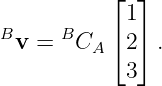
 means that the matrix maps coordinate columns from frame A into frame B. Thus
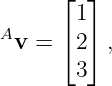
For the supplied vector,
The physical vector itself is unchanged. Only its coordinate representation changes.
Solution 2: reverse mapA valid DCM is orthogonal, so
 The reverse map is therefore
This works because an orthonormal change of basis has inverse equal to transpose.
Solution 3: interpret an intrinsic sequenceIntrinsic 3-2-1 means:
The second and third axes are moving axes because they belong to frames created by earlier rotations.
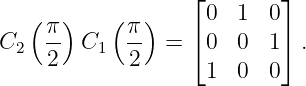
Solution 4: write the passive matrix productFor intrinsic 2-3-1,
 Therefore
Solution 5: rightmost matrix acts firstA coordinate column is multiplied as
 The first multiplication applied to Av is therefore
 The result is then multiplied by
 and finally by
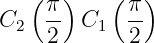
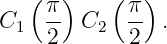
 Thus the chronological intrinsic order is
 The written matrix order is ordinary composition of linear maps.
Solution 6: classify the sequence familyA Tait Bryan sequence uses three distinct axes. A proper Euler sequence repeats the first axis as the third axis. Therefore:




 and

Solution 7: why adjacent axes cannot repeatElementary rotations about the same axis form an ordinary one-parameter rotation group. For axis 1,
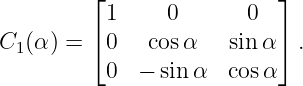 Direct multiplication gives
 Hence
Two consecutive rotations about the same current axis collapse into one rotation. Thus a nominal sequence such as 1-1-3 does not supply three independent orientation coordinates.
Solution 8: why there are twelve standard sequencesThere are three choices for the first axis. Once the first axis is selected, the second axis must differ from the first, leaving two choices. For the third axis there are two standard admissible possibilities:
Therefore
Solution 9: noncommutativityThe passive elementary matrices are
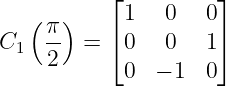 and
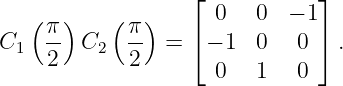
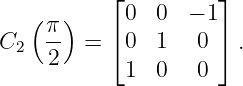 First,
Reversing the order gives
The matrices are different, so the final orientations are different. Finite rotations in three dimensions do not generally commute.
Solution 10: single-axis reductionStarting from
 set
 Since
 we obtain
Thus only the first intrinsic frame rotation remains: a rotation through α about axis 3.
Solution 11: aerospace notation specializationFor intrinsic 3-2-1,

 and
 Therefore
Solution 12: Euler triples are not vectorsEuler angles are nonlinear sequence coordinates. The second and third angles are defined about intermediate moving axes, so their geometric meaning depends on earlier rotations. Therefore coordinate subtraction,
 does not generally reproduce the finite relative orientation. The correct relative orientation must be obtained by composing or inverting the corresponding rotation maps.
Solution 13: intrinsic versus extrinsicAn intrinsic sequence
 can be represented by a corresponding extrinsic sequence using the reverse fixed axis order
 with the corresponding angle association handled consistently. This equivalence does not eliminate the need to specify intrinsic versus extrinsic. The two descriptions use different geometric constructions even though they can produce the same final orientation.
Solution 14: proper Euler first and third axesIn intrinsic 3-1-3, the first rotation is about axis 3 of the initial frame. The second rotation changes the orientation of the frame. The third rotation is about axis 3 of the newest intermediate frame. That third axis is generally not aligned with the original axis 3. Therefore the first and third rotations are not generally rotations about the same physical direction and cannot be combined.
Solution 15: nonuniqueness from periodicityElementary rotation matrices depend on sine and cosine. Because
 and
 we have
Thus adding integer multiples of 2π to an Euler coordinate may leave the orientation unchanged. Euler coordinates are therefore not globally unique. Additional nonuniqueness arises from alternate branches and singular configurations.
Solution 16: coordinate singularity conceptFor a Tait Bryan sequence,
 when
on the usual principal interval. For a proper Euler sequence,
 when
on the usual principal interval. The physical orientation remains completely well defined. Only the chosen Euler coordinate chart loses rank.
4 Compact reviewThe principal geometric facts reinforced by this companion are:
and
standard sequence choices. The six Tait Bryan sequences use three distinct axes. The six proper Euler sequences repeat the first axis as the third axis. Euler triples are local orientation coordinates, not ordinary three component vectors.
5 Sources and exercise provenanceThe exercises and solutions in this companion are newly written for PhysicsLibrary to reinforce the geometric definitions developed in Euler angles: definition and basic geometry. Henderson provides a classic engineering treatment of Euler sequences and transformation matrices. Diebel presents a modern comparison of Euler angles, matrices, quaternions, and rotation vectors. Moore develops orientation from reference-frame basis vectors and passive direction cosine matrices. Goldstein, Poole, and Safko provide the classical rigid-body mechanics context for proper Euler angles.
References
[1] D. M. Henderson, Euler Angles, Quaternions, and Transformation Matrices: Working Relationships, JSC-12960, NASA Johnson Space Center, 1977. NASA Technical Reports Server [2] J. Diebel, “Representing Attitude: Euler Angles, Unit Quaternions, and Rotation Vectors,” Stanford University, 2006. Online PDF [3] J. K. Moore, Learn Multibody Dynamics, chapter “Orientation of Reference Frames,” 2026 edition. Licensed CC BY 4.0. Orientation of Reference Frames [4] H. Goldstein, C. Poole, and J. Safko, Classical Mechanics, 3rd ed., Addison Wesley, 2002. Publisher search
LicenseUnless otherwise noted, this PhysicsLibrary entry is intended for release under the Creative Commons Attribution ShareAlike 4.0 International license. "example of Euler angles: definition and basic geometry" is owned by bloftin.
This object's parent. Cross-references: mechanics, quaternions, commute, dimensions, Tait Bryan sequence, composition, works, representation, concept, Euler Angle, periodicity, vectors, matrix product, direction cosine matrix, Tait Bryan sequences, matrix, vector, formula, Euler Angles This is version 1 of example of Euler angles: definition and basic geometry, born on 2026-08-28. Object id is 1121, canonical name is ExampleOfEulerAnglesDefinitionAndBasicGeometry. Accessed 208 times total. Classification:
|
|
|
|
Pending Errata and AddendaNone.
|
DiscussionNo messages.
|
Interact |
![[parent]](https://images.physicslibrary.org/images/uparrow.png)