Physics Library
 An open source physics library
Encyclopedia | Forums | Docs | Random | Template Test |  
Login
create new user
Username:
Password:
forget your password?
Main Menu
Sections

Meta

Talkback

Downloads

Information
[parent] example of dynamics of a particle: free_motion (Example)

Examples for Free Motion

(a) Polar Coordinates in a Plane

Let us get the equations in polar coordinates for motion in a plane. Here

$\displaystyle x=r\cos\phi,\qquad y=r\sin\phi, $

$\displaystyle \dot{x}^{2}+\dot{y}^{2} = \dot r^{\,2}+r^{2}\dot\phi^{\,2}, $
and

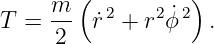
$\displaystyle T=\frac{m}{2}\left(\dot r^{\,2}+r^{2}\dot\phi^{\,2}\right). $

Then

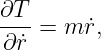
$\displaystyle \frac{\partial T}{\partial\dot r}=m\dot r, \qquad \frac{\partial T}{\partial r}=mr\dot\phi^{\,2}. $

If $R$ is the impressed force resolved along the radius vector,

$\displaystyle \delta_r W = m\left(\ddot r-r\dot\phi^{\,2}\right)\delta r = R\delta r. $

Also

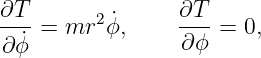
$\displaystyle \frac{\partial T}{\partial\dot\phi}=mr^{2}\dot\phi, \qquad \frac{\partial T}{\partial\phi}=0, $
and, if $\Phi$ is the impressed force resolved perpendicular to the radius vector,

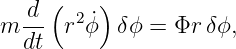
$\displaystyle \delta_\phi W = m\frac{d}{dt}\left(r^2\dot\phi\right)\delta\phi = \Phi r\,\delta\phi. $

In more familiar form,

$\displaystyle m\left[ \frac{d^2r}{dt^2} -r\left(\frac{d\phi}{dt}\right)^2 \right] = R, $

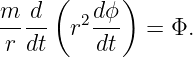
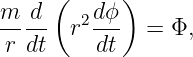
$\displaystyle \frac{m}{r}\frac{d}{dt} \left( r^2\frac{d\phi}{dt} \right) = \Phi. $

(b) Cylindrical Coordinates

In cylindrical coordinates, where

$\displaystyle x=r\cos\phi,\qquad y=r\sin\phi,\qquad z=z, $

$\displaystyle T=\frac{m}{2} \left( \dot r^{\,2}+r^{2}\dot\phi^{\,2}+\dot z^{\,2} \right). $

We have

$\displaystyle \frac{\partial T}{\partial\dot r}=m\dot r,\qquad \frac{\partial T}{\partial r}=mr\dot\phi^{\,2}, $

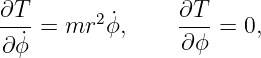
$\displaystyle \frac{\partial T}{\partial\dot\phi}=mr^2\dot\phi,\qquad \frac{\partial T}{\partial\phi}=0, $

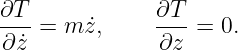
$\displaystyle \frac{\partial T}{\partial\dot z}=m\dot z,\qquad \frac{\partial T}{\partial z}=0. $

Hence

$\displaystyle m\left(\ddot r-r\dot\phi^{\,2}\right)\delta r=R\delta r, $

$\displaystyle m\frac{d}{dt}\left(r^2\dot\phi\right)\delta\phi = \Phi r\,\delta\phi, $

$\displaystyle m\ddot z\,\delta z=Z\delta z, $
or

$\displaystyle m\left[ \frac{d^2r}{dt^2} -r\left(\frac{d\phi}{dt}\right)^2 \right]=R, $

$\displaystyle \frac{m}{r}\frac{d}{dt} \left(r^2\frac{d\phi}{dt}\right)=\Phi, $

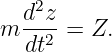
$\displaystyle m\frac{d^2z}{dt^2}=Z. $

(c) Spherical Coordinates

In spherical coordinates where

$\displaystyle x=r\cos\theta,\qquad y=r\sin\theta\cos\phi,\qquad z=r\sin\theta\sin\phi, $

$\displaystyle T=\frac{m}{2} \left[ \dot r^{\,2} +r^2\dot\theta^{\,2} +r^2\sin^2\theta\,\dot\phi^{\,2} \right]. $

Then

$\displaystyle \frac{\partial T}{\partial\dot r}=m\dot r, $

$\displaystyle \frac{\partial T}{\partial r} = mr\left(\dot\theta^{\,2}+\sin^2\theta\,\dot\phi^{\,2}\right), $

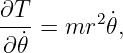
$\displaystyle \frac{\partial T}{\partial\dot\theta}=mr^2\dot\theta, $

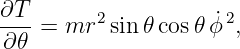
$\displaystyle \frac{\partial T}{\partial\theta} = mr^2\sin\theta\cos\theta\,\dot\phi^{\,2}, $

$\displaystyle \frac{\partial T}{\partial\dot\phi} = mr^2\sin^2\theta\,\dot\phi, \qquad \frac{\partial T}{\partial\phi}=0. $

Thus

$\displaystyle \delta_r W = m\left[ \ddot r -r\left(\dot\theta^2+\sin^2\theta\,\dot\phi^2\right) \right]\delta r = R\delta r, $

$\displaystyle \delta_\theta W = m\left[ \frac{d}{dt}(r^2\dot\theta) -r^2\sin\theta\cos\theta\,\dot\phi^2 \right]\delta\theta = \Theta r\,\delta\theta, $
and

$\displaystyle \delta_\phi W = m\frac{d}{dt} \left(r^2\sin^2\theta\,\dot\phi\right)\delta\phi = \Phi r\sin\theta\,\delta\phi. $

Or

$\displaystyle m\left[ \frac{d^2r}{dt^2} -r\left\{ \left(\frac{d\theta}{dt}\right)^2 +\sin^2\theta \left(\frac{d\phi}{dt}\right)^2 \right\} \right]=R, $

$\displaystyle \frac{m}{r} \left[ \frac{d}{dt}\left(r^2\frac{d\theta}{dt}\right) -r^2\sin\theta\cos\theta \left(\frac{d\phi}{dt}\right)^2 \right]=\Theta, $

$\displaystyle \frac{m}{r\sin\theta} \frac{d}{dt} \left( r^2\sin^2\theta\frac{d\phi}{dt} \right)=\Phi. $

Source

William Elwood Byerly, An Introduction to the Use of Generalized Coördinates in mechanics and Physics, Ginn and Company, 1916. Chapter I, “Introduction.”

The 1916 source work is in the public domain in the United States.


"example of dynamics of a particle: free_motion" is owned by bloftin.
(view preamble)
View style:
See Also: coordinates of a point


This object's parent.

Cross-references: domain, work, mechanics, radius vector, motion

This is version 1 of example of dynamics of a particle: free_motion, born on 2026-08-19.
Object id is 1062, canonical name is ExampleOfDynamicsOfAParticleFree_motion.
Accessed 22 times total.

Classification:
Physics Classification45. (Classical mechanics of discrete systems)
Pending Errata and Addenda
None.
Discussion
Style: Expand: Order:

No messages.

Interact
rate | post | correct | update request | add example | add (any)