The equation for the relationship between the speed and other characteristics of a wave can be
derived from our basic understanding of motion. The average speed of anything that is moving
is:
(So, for example, a CAR on the highway traveling at a speed of 100 km/h covers 100 km
during the time of 1 h.) For an electromagnetic wave to travel the distance of one of
its wavelengths, λ, at the speed of light, c, we have c =  . The frequency of a wave
is the number of cycles per second. If a wave has a frequency of a million cycles per
second, then the time for each cycle to go by is a millionth of a second. So, in general,
t =
. The frequency of a wave
is the number of cycles per second. If a wave has a frequency of a million cycles per
second, then the time for each cycle to go by is a millionth of a second. So, in general,
t =  .
.
Substituting into our wave equation, we get c = λ×f. Now let’s use this to calculate an example.
What is the wavelength of visible Light that has a frequency of 5.66 × 10¹⁴ Hz?
Solution
Solving the wave equation for wavelength, we find:
Substituting our values gives:
This answer can also be written as 530 nm, which is in the yellow-green part of the visible
spectrum (nm stands for nanometers, where the term “nano” means “billionths”).
Check Your Learning
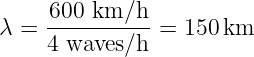
“Tidal waves,” or tsunamis, are waves caused by earthquakes that travel rapidly through the
ocean. If a tsunami travels at the speed of 600 km/h and approaches a shore at a rate of one wave
crest every 15 min (4 waves/h), what would be the distance between those wave crests at
sea?
Answer:
Bibliography
This example is a derivative work of the Creative Commons source in [1].
[1] Andrew Fraknoi, David Morrison, and Sidney Wolff, “Example 5.1: Deriving and Using the
Wave Equation,” in “5.1 The Behavior of Light,” Astronomy 2e. Houston, Texas: OpenStax, 2022.
Licensed CC BY 4.0 in the original 2022 release (https://creativecommons.org/licenses/by/4.0/).
Changes: converted to LaTeX for PhysicsLibrary and separated from section 5.1 as a standalone
example. Access for free at https://openstax.org/books/astronomy-2e/pages/1-introduction.
Section source: https://openstax.org/books/astronomy-2e/pages/5-1-the-behavior-of-light.

![[parent]](https://images.physicslibrary.org/images/uparrow.png)