0.1 Introduction
Mathematics relies on precise symbolic language to express relationships between
statements. Central to this language are connective symbols, also called logical
connectives. These symbols combine simpler statements into more complex ones whose
truth values depend in a well-defined way on their components.
Logical connectives form the foundation of mathematical reasoning, formal proof, set
theory, computer science, and many areas of physics and engineering. Every theorem,
definition, and proof ultimately rests on combinations of these connectives.
A statement that is either true or false is called a proposition. We typically denote
propositions by lowercase letters such as p, q, and r.
0.2 Basic Logical Connectives
There are five primary logical connectives used throughout mathematics.
0.2.1 Negation
The negation of a proposition reverses its truth value.
This is read as
“not p”
Example:
If
then
0.2.2 Conjunction
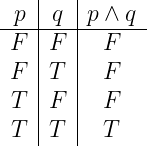
The conjunction of two propositions is true only if both are true.
This is read as
“p and q”
Example:
0.2.3 Disjunction
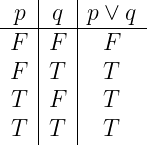
The disjunction represents logical “or.”
This is the inclusive or, meaning one or both may be true.
Example:
0.2.4 Implication
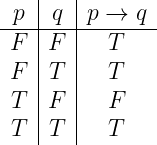
The implication represents logical consequence.
This is read as
“if p, then q”
Here:
- p is called the antecedent
- q is called the consequent
Example:
0.2.5 Biconditional
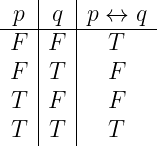
The biconditional expresses logical equivalence.
This is read as
“p if and only if q”
This means both statements have the same truth value.
Example:
0.3 Truth Tables
The meaning of connectives is formally defined using truth tables.
0.3.1 Negation
0.3.2 Conjunction
0.3.3 Disjunction
0.3.4 Implication
Note the important fact:
An implication is false only when the antecedent is true and the
consequent is false.
0.3.5 Biconditional
0.4 Compound Statements
Logical connectives allow the construction of complex propositions.
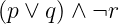
Example:
This represents
“(p or q) and not r”
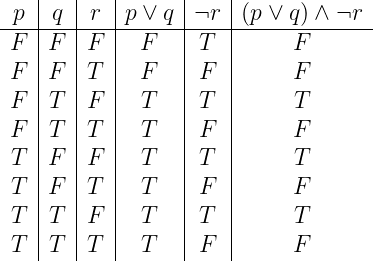
To evaluate the compound proposition, we construct intermediate columns for each logical
operation.
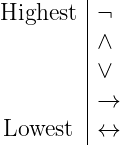
0.5 Operator Precedence
Logical connectives follow a precedence order similar to arithmetic operations.
Parentheses should always be used when ambiguity is possible.
0.6 Logical Equivalence
Two propositions are logically equivalent if they always have the same truth
value.
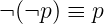
We write:
Example: Double Negation
0.7 Important Logical Laws
These laws are fundamental to mathematical reasoning.
0.7.1 Commutative Laws
0.7.2 Associative Laws
0.7.3 Distributive Laws
0.7.4 De Morgan’s Laws
These laws are essential for simplifying logical expressions.
0.8 Logical Connectives in Mathematics
Logical connectives appear in nearly every mathematical definition.
Example: Definition of Continuity
A function f is continuous at x0 if
such that
This definition uses implication as its central logical structure.
0.9 Applications
Logical connectives are fundamental in:
- Mathematical proof
- Computer programming
- Digital circuit design
- Set theory
- Artificial intelligence
Every computer processor physically implements logical connectives using electronic logic
gates.
0.10 Summary
Logical connectives provide the symbolic framework for mathematical reasoning.
The primary connectives are:
They allow simple statements to be combined into complex logical structures and form the
foundation of formal mathematics.
In more advanced mathematics these connectives will be extended through quantifiers,
predicate logic, and formal proof systems.
References
[1] Kenneth H. Rosen, Discrete Mathematics and Its Applications, 7th edition,
McGraw Hill, 2012.
[2] Susanna S. Epp, Discrete Mathematics with Applications, 4th Edition,
Cengage Learning, 2011.
[3] Patrick Suppes, Introduction to Logic, Dover Publications, 1999.
[4] Elliott Mendelson, Introduction to Mathematical Logic, 5th Edition, Chapman
and Hall/CRC, 2009.
[5] Herbert B. Enderton, A Mathematical Introduction to Logic, 2nd Edition,
Academic Press, 2001.
[6] Paul R. Halmos, Naive Set Theory, Springer, 1974.
[7] George Boolos, John Burgess, Richard Jeffrey, Computability and Logic, 5th
Edition, Cambridge University Press, 2007.
[8] Claude E. Shannon, “A Symbolic Analysis of Relay and Switching Circuits,”
Transactions of the American Institute of Electrical Engineers, Vol. 57, 1938.