In examining the graphs of differentiable real functions, it may be useful to state the intervals
where the function is convex and those where it is concave.
- A function f is said to be convex on an interval if the restriction of f to that interval
is convex. Geometrically, the graph is often described as concave upward. If f is twice
differentiable, f′′(x) ≥ 0 throughout the interval is sufficient for convexity. For the sine
curve, f′′(x) = − sin x > 0 on (−π, 0).
- Correspondingly, f is concave downward on an interval when its graph bends
downward. For a twice differentiable function, f′′(x) ≤ 0 throughout the interval is
sufficient for concavity. For the sine curve, f′′(x) = − sin x < 0 on (0,π).
- A point at which the graph changes from concave upward to concave downward, or
vice versa, is called an inflection point (or inflexion point). For a twice differentiable
function, an inflection point often satisfies f′′(x) = 0, but the essential condition is
that the concavity changes sign across the point.
The origin is an inflection point of the sinusoid y = sin x.
Since the sine function is 2π-periodic, the sinusoid possesses infinitely many inflection points.
Indeed,
Thus
for
Moreover,
so
Hence f′′ changes sign at every x = nπ, confirming that these points are inflection
points.
Remarks
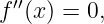
1. For finding the inflection points of the graph of f, it does not suffice merely to find the roots
of
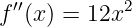
because the sign of f′′ need not change as such a root is crossed. For example, x = 0 is not an
inflection point of f(x) = x4, since
does not change sign at the origin.
2. Recalling that the signed curvature of a plane curve y = f(x) may be written
an inflection point is associated with a change in the sign of the signed curvature.
3. If an inflection point x = ξ also satisfies
it is called a stationary inflection point. If
it is a non-stationary inflection point.






![′′
κ(x) = ----f--(x-)----,
[1 + f′(x )2]3∕2](https://images.physicslibrary.org/cache/objects/643/make4ht/InflexionPoint7x.png)

