The cross product (or vector product) of A = (Ax,Ay,Az) and B = (Bx,By,Bz) is
Geometrically, its magnitude is
where 𝜃 is the smaller angle between A and B. Its direction is perpendicular to the plane
determined by the two vectors and is selected by the right-hand rule:
It is often convenient to remember the cross product through the determinant mnemonic
Vector Product (Cross Product)
For vectors A,B ∈ ℝ3 separated by the angle 𝜃, one may summarize the geometric definition
as
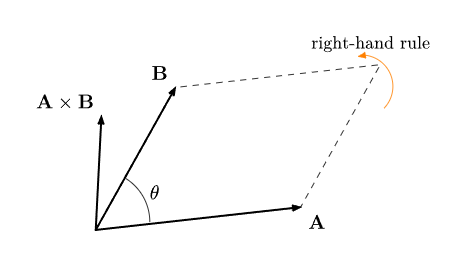
Figure: right-hand-rule orientation of the cross product.
Its magnitude equals the area of the parallelogram spanned by A and B:
For nonzero vectors,
The cross product is anti-commutative:
It is a specifically three-dimensional Euclidean operation in this form.
Modern notation references
The notation and terminology in this modernized article follow standard present-day mechanics
and vector-analysis usage, particularly:
- J. R. Taylor, Classical Mechanics, University Science Books, 2005.
- D. Kleppner and R. Kolenkow, An Introduction to Mechanics, 2nd ed., Cambridge
University Press, 2014.
- H. Goldstein, C. Poole, and J. Safko, Classical Mechanics, 3rd ed., Addison–Wesley,
2002.
Source
This article is a modernized restatement of the corresponding public-domain article in Louis
Brand, Vectorial Mechanics, John Wiley & Sons, New York, 1930, Chapter I, “Vector Algebra.”
The original 1930 edition is the source basis.








