Consider the Schrödinger equation and the complex conjugate equation:
If Ψ is normalized to unity at the initial instant, it remains normalized at any later
time. The mean value of a given observable A is equal at every instant to the scalar
product
and one has
The last term of the right-hand side, < ∂A∕∂t >, is zero if A does not depend upon the time
explicitly.
Taking into account the Schrödinger equation and the hermiticity of the hamiltonian, one
has
Hence we obtain the general equation giving the time-dependence of the mean value of
A:
When we replace Aby the operator eiξA, we obtain an analogous equation for the time-dependence
of the characterisic function of the statistical distribution of A.
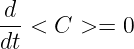
In particular, for any variable C which commutes with the Hamiltonian
and which does not depend explicitly upon the time, one has the result
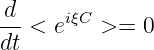
The mean value of C remains constant in time. More generally, if C commutes with H, the
function eiξC also commues with H, and, consequently
The characteristic function, and hence the statistical distribution of the observable C, remain
constant in time.
By analogy with Classical Analytical mechanics, C is called a constant of the motion. In particular,
if at the initial instant the wave function is an eigenfunction of C corresponding to a give
eigenvalue c, this property continues to hold in the course of time. One says that c is a ”good
quantum number”. If, in particular, H does not explicitly depend upon the time, and if the
dynamical state of the system is represented at time t0 by an eigenfunction common
to H and C, the wave function remains unchanged in the course of time, to within
a phase factor. The energy and the variable C remain well defined and constant in
time.
1.1 References
[1] Messiah, Albert. ”Quantum mechanics: volume I.” Amsterdam, North-Holland Pub. Co.; New
York, Interscience Publishers, 1961-62.
This entry is a derivative of the Public domain work [1].

![[parent]](https://images.physicslibrary.org/images/uparrow.png)




![d 1 ⟨ ∂A ⟩
-- < A >= -- < Ψ, [A, H ]Ψ > + ---
dt iℏ ∂t](https://images.physicslibrary.org/cache/objects/819/make4ht/ConstantsOfTheMotionTimeDependenceOfTheStatisticalDistribution4x.png)
![⟨ ⟩
d- ∂A-
iℏdt < A >= < [A, H ] > +i ℏ ∂t](https://images.physicslibrary.org/cache/objects/819/make4ht/ConstantsOfTheMotionTimeDependenceOfTheStatisticalDistribution5x.png)
![[C, H ] = 0](https://images.physicslibrary.org/cache/objects/819/make4ht/ConstantsOfTheMotionTimeDependenceOfTheStatisticalDistribution6x.png)