An equation
| xn + a
1xn−1 + … + a
n = 0, | | (1) |
with coefficients aj in a field K, is algebraically solvable, if some of its roots may be expressed with
the elements of K by using rational operations (addition, subtraction, multiplication, division) and
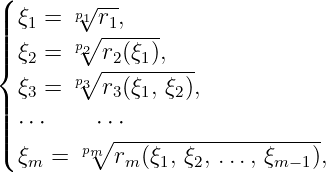
root extractions. I.e., a root of (1) is in a field K(ξ1, ξ2, …, ξm) which is obtained of K by
adjoining to it in succession certain suitable radicals ξ1, ξ2, …, ξm. Each radical may be contain
under the root sign one or more of the previous radicals,
where generally rk(ξ1, ξ2, …, ξk−1) is an element of the field K(ξ1, ξ2, …, ξk−1) but no pk’th power
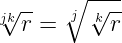
of an element of this field. Because of the formula
one can, without hurting the generality, suppose that the indices p1, p2, …, pm are prime
numbers.
Example. Cardano’s formulae show that all roots of the cubic equation y3 + py + q = 0 are in
the algebraic number field which is obtained by adjoining to the field ℚ(p, q) successively the
radicals
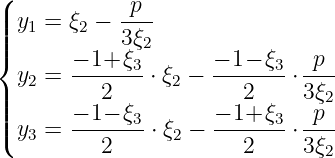
In fact, as we consider also the equation (4), the roots may be expressed as