1 Highly-complex systems
1.1 Introduction
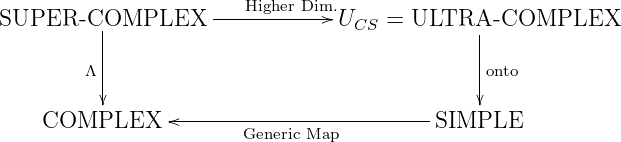
Modeling the emergence of the ultra-complex system of the human mind, based on the
super-complex human organism, one needs to consider an associated progression towards
higher-dimensional algebras from the lower dimensions of human neural-network dynamics and the
simple algebra of physical dynamics, as shown in the following essentially non-commutative
categorical diagram.
One can represent by square categorical diagrams the emergence of ultra-complex dynamics from
the super-complex dynamics of human organisms coupled via social interactions in characteristic
patterns represented by Rosetta biogroupoids, together with complex, albeit inanimate, systems
with “chaos,” as discussed next.
1.2 Diagrams of simple and highly-complex systems
Definition 1.1. An ultra-complex system, UCS, is defined as an object representation in the
following non-commutative diagram of systems and dynamic-system morphisms, or “dynamic
transformations”:
1.3 Remarks
Note that the above diagram is indeed not “natural” (that is, it is not commutative) for reasons
related to the emergence of the higher dimensions of the super-complex biological or organismic
level and the ultra-complex psychological or neural-network-dynamic level, in comparison with the
low dimensions of either simple physical or classical systems or complex chaotic dynamic
systems.
An ultra-complex system represents the human mind and consciousness from the standpoint of a
categorical ontology theory of levels as the highest level of complexity that emerged through
biological and social coevolution over the last 2.2 million years on Earth.