Physics Library
 An open source physics library
Encyclopedia | Forums | Docs | Random |  
Login
create new user
Username:
Password:
forget your password?
Main Menu
Sections

Meta

Talkback

Downloads

Information
[parent] Fresnel formulae result (Result)

The Fresnel formulae presented in the parent entry are

∫                ∫                √ ---
  ∞      2         ∞      2       --2π-
    cos(x ) dx =     sin(x )dx  =   4  .
 0                0

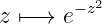
The proof in the parent entry Fresnel formulae uses the entire function

       −z2
z ↦− → e

and integrates it around a circular sector of angle π∕4.

Let

     ∫ R    2             ∫     2             ∫    2
I1 =     e−x dx,     I2 =   e −z dz,     I3 =   e−z dz,
      0                    b                   s

where b is the circular arc and s is the radial segment from Reiπ∕4 back to the origin. By Cauchy’s integral theorem,

I + I  + I =  0.
 1   2    3

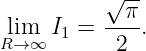
From the Gaussian integral,

          √--
          -π--
lRim→∞ I1 =   2 .

For the circular arc, write

z =  Reiφ,     dz = iReiφ dφ,     0 ≤ φ ≤  π.
                                           4

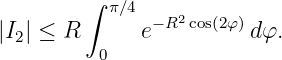
Then

        ∫  π∕4    2
|I2| ≤ R       e−R cos(2φ)dφ.
          0

Since

               4φ      (         π)
cos(2φ ) ≥ 1 − ---      0 ≤ φ ≤  -- ,
                π                4

we obtain

        ∫ π∕4    2   4φ        π (        2)     π
|I2| ≤ R      e− R (1− π )dφ =  ---  1 − e−R   <  ---.
         0                    4R                4R

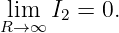
Therefore

 lim  I =  0.
R→ ∞  2

For the radial segment, use

z =  1 +√-it,    dz =  1 +√-idt,     R ≥ t ≥ 0.
       2                 2

Because z2 = it2,

   2      2
e−z =  e−it = cos(t2) − i sin(t2).

Thus

I3 = 1 + i
-√---
   2 R0eit2 dt
= -1--
√--
 2( ∫              ∫            )
    R      2        R     2
      cos(t) dt +    sin(t )dt
   0               0
+ -i--
√2--( ∫ R            ∫  R         )
           2              2
   0  sin(t) dt −  0 cos(t )dt.

Letting R →∞ in

I1 + I2 + I3 = 0

gives

√ --      ( ∫ ∞            ∫  ∞         )        (∫  ∞            ∫ ∞          )
--π-− √1--      cos(t2) dt +     sin (t2)dt   + √i--      sin (t2)dt −      cos(t2)dt   = 0.
 2      2    0               0                 2    0              0

The imaginary part yields

∫ ∞             ∫ ∞
    cos(t2)dt =     sin(t2)dt.
 0               0

The real part then gives

√ --      ∫ ∞
--π-  √ --         2
 2  −   2  0  sin(t) dt = 0,

and hence

∫                ∫                 √ --   √ ---
  ∞      2         ∞      2          π      2π
    sin(x ) dx =     cos(x ) dx = -√---=  --4--.
 0                0               2  2

"Fresnel formulae result" is owned by bci1.
(view preamble)
View style:

This object's parent.

Cross-references: theorem, function, Fresnel formulae

This is version 10 of Fresnel formulae result, born on 2009-04-29, modified 2026-09-09.
Object id is 694, canonical name is FresnelFormulaeResult.
Accessed 1711 times total.

Classification:
Physics Classification02.30.-f (Function theory, analysis)
Pending Errata and Addenda
None.
Discussion
Style: Expand: Order:

No messages.

Interact
rate | post | correct | update request | add example | add (any)