Proof.
Quarter-sector contour used in the proof.
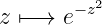
The function
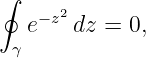
is entire. Hence, by Cauchy’s integral theorem,
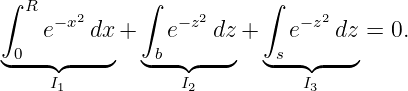
where γ is the positively oriented boundary of the circular sector shown above. Split the contour
integral into three parts:
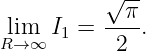
From the Gaussian integral,
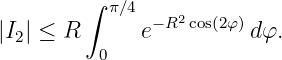
For I2, parameterize the circular arc by
Then
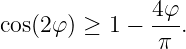
On the interval 0 ≤ φ ≤ π∕4, the function cos(2φ) lies above the chord joining (0, 1) and (π∕4, 0),
so
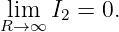
Therefore
Hence
For I3, parameterize the diagonal segment by
Since z2 = it2,
Thus
| I3 | =  ∫
R0e−it2
dt ∫
R0e−it2
dt | |
|
| = −  | |
|
| +   . . | | |
Letting R →∞ in
gives
The imaginary part must vanish, so
Using the real part then gives
Therefore

![[parent]](https://images.physicslibrary.org/images/uparrow.png)